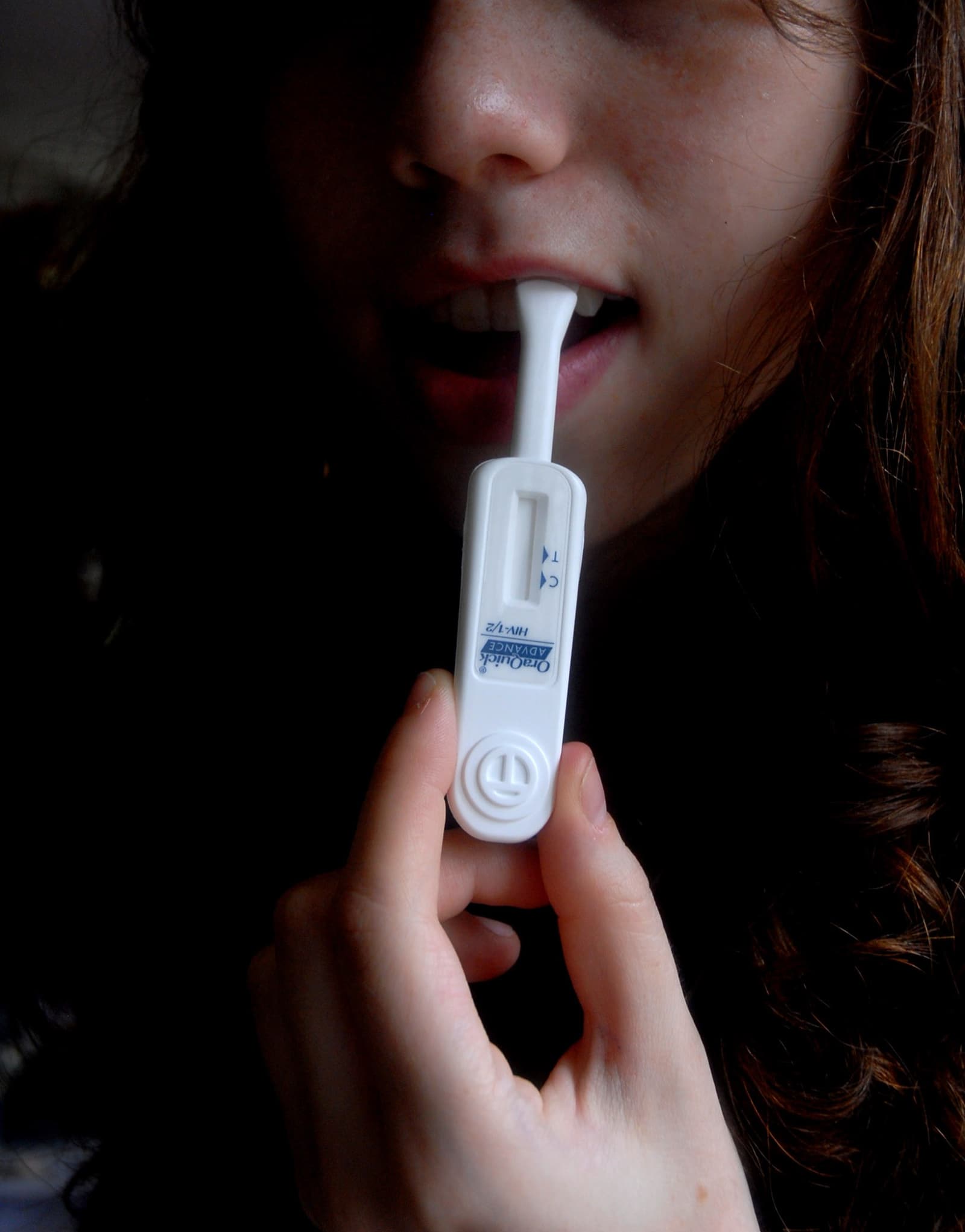
The home HIV test is easy to misremember as a simple privacy breakthrough. In that compressed story, public health finally let a worried person stay out of the clinic, swab once, and get an answer alone. The chronology is more revealing. HIV home testing reached privacy in stages, and each stage solved one problem by accepting another. The first U.S. over-the-counter model in 1996 let the user collect blood at home, but the result still belonged to a laboratory and a telephone counselor.[1][2] The later oral-fluid rapid test made the answer immediate and solitary, but it also made the boundary around recent infection much more visible.[5][6][7]
That is why this subject fits a narrative chronicle rather than a device profile. What changed over time was not just packaging. The whole diagnostic sequence kept being rearranged: who touches the specimen, who interprets the signal, how long the user waits, how counseling enters the process, and how much diagnostic uncertainty the user must personally manage.[1][2][5][6] HIV home testing did not move in one jump from clinic control to domestic certainty. It moved from home collection with laboratory confirmation, to rapid oral-fluid screening in professional hands, and only then to the self-test that most people now picture.[1][2][3][4][5]
The current CDC language makes the long arc legible. HIV self-tests are still antibody tests, still limited by a window period, and still require follow-up if the result is positive or if recent exposure remains a concern.[6][7] In other words, the home test changed the first threshold of diagnosis, not the whole diagnostic chain.
Image context: the cover uses a real photograph of an OraQuick oral-fluid HIV test device rather than a symbolic red ribbon or abstract clinic scene.[8] That matters because the article is about a medical sequence becoming a consumer object. The test's social force came from being small enough, legible enough, and private enough to sit in one person's hand.
Timeline anchors
- July 22, 1996: FDA approved the Home Access HIV-1 Test System for self-use by people seeking anonymous HIV testing.[1]
- 1996: the Home Access system used fingerstick blood spots mailed to a laboratory, with results released later by telephone along with counseling.[2]
- June 22, 2004: FDA approved OraQuick ADVANCE Rapid HIV-1/2 Antibody Test labeling for oral fluid detection, helping move HIV rapid testing into a swab-based format outside venous laboratory workflows.[3]
- July 20, 2012: FDA's OTC IVD listing gave the effective date for the OraQuick In-Home HIV Test, the first rapid over-the-counter HIV self-test in the United States.[4]
- 2024: CDC still described the HIV self-test as an oral-fluid antibody test, with results in about 20 minutes and a window period for antibody tests of 23 to 90 days after exposure.[6]
- December 16, 2024: FDA updated the product page under the name OraQuick HIV Self-Test, preserving the same oral-fluid home-use lane in current approval records.[5]
1. In 1996, "home testing" still meant home collection rather than home interpretation
The Home Access HIV-1 Test System is the best place to start because it shows what regulators and manufacturers thought "safe privacy" looked like in the mid-1990s.[1][2] FDA's product page states the approval date plainly: July 22, 1996.[1] But the more important detail is structural. The system was sold over the counter, yet it did not try to turn the user into a full test operator. FDA's explanatory page says the kit used a finger prick to create dried blood spots on special paper, then mailed those spots to a laboratory for analysis.[2]
That workflow matters because the result still belonged to the laboratory until the very end. The user collected the sample privately and anonymously, but trained clinicians performed the actual testing, and the result came back later through a call center using a unique PIN.[2] FDA says users could call for results in about 7 business days, or 3 business days for the express system.[2] Counseling was not an optional add-on. It was built into the model itself, with pre-test and post-test counseling delivered through printed materials and telephone interaction.[2]
This older architecture tells you what had not yet been transferred into the home. Privacy had moved. Interpretation had not. The test system was trying to solve stigma and access without fully giving up laboratory control or the public-health belief that HIV results should arrive with counseling attached. That is why the performance figures on the Home Access page are so striking. FDA reported estimated sensitivity and specificity both above 99.9%, with positive results undergoing screening and confirmatory testing before release.[2] In other words, the first OTC home-use lane did not trade away much analytic confidence. It preserved confidence by keeping the lab in the middle.
That is a very different kind of home test from the one most people now imagine. The user controlled place and anonymity. The system still controlled the answer.
2. Oral-fluid rapid testing changed the physical grammar of HIV screening
The next important step was not yet a solo home test. It was a change in what kind of specimen and what kind of pace rapid HIV testing could use. FDA's page for the OraQuick ADVANCE Rapid HIV-1/2 Antibody Test records an approval date of June 22, 2004 and notes a labeling claim for detecting HIV-1 and HIV-2 antibodies in oral fluid.[3] That sounds like a technical update, but it changed the whole physical grammar of the encounter.
Fingerstick blood and mailed dried spots belong to one public-health world. An oral swab belongs to another. The oral-fluid route made HIV screening quicker, cleaner, and easier to stage in non-laboratory settings, because the specimen no longer required a lancet, a blood spot card, or return shipping.[2][3] The rapid test had not yet become an over-the-counter self-test, but the format that would later make that possible was now in place.
This middle step matters because it separates two achievements that are often collapsed into one. A rapid oral-fluid test is not the same thing as a self-test. The former changes specimen collection and turnaround time. The latter also changes who performs the steps, who reads the result, and who bears the immediate emotional and practical burden of acting on it. By 2004, HIV rapid testing had become physically more portable. It had not yet fully become privately self-interpreted in the retail sense.[3]
That distinction keeps the later 2012 transition from looking inevitable. The oral-fluid format made self-testing plausible, but it did not settle whether the public-health system was ready to let the user stand alone with the first answer.
3. In 2012, the answer moved fully into the user's own time
FDA's OTC test database gives the effective date for the OraQuick In-Home HIV Test as July 20, 2012.[4] That is the real threshold in the modern story because the user no longer had to wait for a laboratory or a telephone result line. FDA's information page says the kit uses oral fluid collected by swabbing the upper and lower gums, then placing the device into a vial of developer solution and waiting 20 to 40 minutes for the result.[5]
This was the moment when home HIV testing stopped being mainly a privacy-of-sample story and became a privacy-of-answer story. FDA described the kit as designed to let a person test "anonymously and in private."[5] CDC's current self-testing page preserves the same structure in simpler language: an HIV self-test is an antibody test that can be used at home or in a private location, using an oral-fluid sample and producing results within about 20 minutes.[6]
But the new speed came with a different kind of boundary. FDA's page says the OraQuick home test has expected sensitivity of about 92% and specificity of 99.98%.[5] It explains the implication directly: roughly one false negative out of every 12 results among infected individuals, and about one false positive out of every 5,000 results among uninfected individuals.[5] A positive result does not confirm infection by itself and must be followed by additional testing in a medical setting.[5][6] A negative result does not rule out infection if exposure was recent, because the window period for this test is about three months.[5]
That is the central tradeoff the article wants to keep visible. The old Home Access system delayed the answer but returned it only after laboratory testing and embedded counseling.[2] The 2012 OraQuick self-test gave the user privacy and speed, but it also made the user live much more directly with screening uncertainty. The answer came sooner, yet the need for interpretation became more personal and more immediate.
4. Current CDC guidance shows what the self-test can and cannot do
CDC's current pages are useful because they strip away the launch drama and show what remains true after the novelty fades. The self-test page says HIV self-tests are antibody tests and notes that a negative result does not necessarily mean a person does not have HIV because of the window period.[6] CDC gives a broader antibody-test detection interval of 23 to 90 days after exposure and says that if a person tests after a possible exposure and gets a negative result, they should test again after the relevant window period for the test they used.[6]
The HIV Nexus clinical guidance page makes the diagnostic hierarchy even clearer. It says three kinds of HIV tests are available, each with its own window, and that the only rapid self-test currently available in the United States is an oral fluid test.[7] It also explains why newer laboratory tests reduce time to diagnosis: nucleic acid tests detect earliest, then antigen/antibody tests, and antibody-only tests later.[7] Put plainly, the home self-test is valuable because it lowers access and privacy barriers. It is not the earliest or strongest tool for detecting the newest infections.
That is why the home HIV test should be read as a threshold device rather than as a full diagnostic endpoint. It changes who gets to start the process and under what emotional conditions. It does not abolish follow-up testing, window-period caution, or the need for linkage to prevention or treatment after the first result.[5][6][7]
5. Why the chronology still matters in 2026
The deepest historical point is that HIV home testing did not move in a straight line toward pure convenience. It moved through a series of negotiated compromises. In 1996, privacy was granted, but the laboratory still held the final interpretation and the counseling frame.[1][2] In 2004, oral-fluid rapid testing made the test physically more portable and easier to stage outside classic lab workflows.[3] In 2012, the result finally shifted into the user's own private time, but the price of that immediacy was a more exposed relationship to the antibody window and to the difference between screening and confirmation.[4][5][6]
That sequence changes how the device should be remembered. The home HIV test did not simply miniaturize a clinic. It redistributed responsibility. The user gained autonomy over place, timing, and disclosure. At the same time, the user inherited more of the interpretive burden that earlier systems had kept inside the laboratory and the counseling line.[2][5][6]
In 2026, that remains the right way to read the home HIV test. It is a serious access tool because it lets people cross the first threshold privately and quickly. It is also a bounded tool because the fastest private answer is still not the same thing as the earliest or most definitive diagnosis. The history makes the tradeoff visible: HIV home testing reached privacy in stages, and every stage rearranged certainty, speed, and support rather than maximizing all three at once.[1][2][3][5][6][7]
Sources
- U.S. Food and Drug Administration, "Home Access HIV-1 Test System" - product page giving PMA number BP950002, indication for self-use, and approval date of July 22, 1996.
- U.S. Food and Drug Administration, "Information regarding the Home Access HIV-1 Test System" - explanation of fingerstick blood spots mailed to a laboratory, 7-business-day result timing, built-in counseling, and reported greater-than-99.9% sensitivity and specificity.
- U.S. Food and Drug Administration, "OraQuick ADVANCE Rapid HIV-1/2 Antibody Test" - product page noting June 22, 2004 approval and oral-fluid detection claims for the rapid test used outside standard venous-laboratory workflows.
- U.S. Food and Drug Administration, "OTC - Over The Counter" IVD listing - FDA OTC database entry showing the effective date of July 20, 2012 for the OraQuick In-Home HIV Test.
- U.S. Food and Drug Administration, "Information regarding the OraQuick In-Home HIV Test" - oral-fluid self-test description, 20-40 minute result window, 92% sensitivity, 99.98% specificity, confirmatory-testing requirement, and approximately three-month window period.
- Centers for Disease Control and Prevention, "Self Testing" - current consumer guidance on oral-fluid HIV self-tests, 20-minute results, follow-up after positive tests, and antibody-test window periods of 23 to 90 days after exposure.
- Centers for Disease Control and Prevention, "Clinical Testing Guidance for HIV" - current testing hierarchy, window-period discussion, and note that the only rapid self-test currently available in the United States is an oral-fluid test.
- Wikimedia Commons, "File:Oraquick.jpg" - documentary photograph source page for the OraQuick oral-fluid HIV test image used in this article.