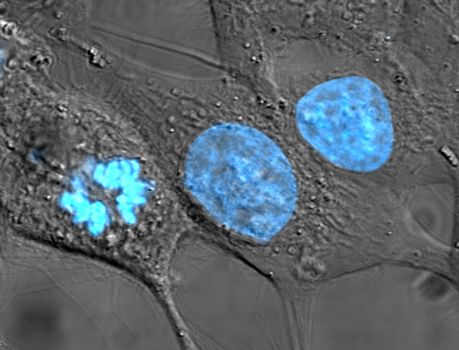
The medical breakthrough story of HeLa is famous. The harder policy story is slower: how one person’s tissue became global infrastructure, then forced institutions to redesign rules for consent and genomic privacy decades after the original extraction. If we frame this as a health-systems question, the core issue is not whether HeLa accelerated discovery (it did), but whether governance caught up to scale in time.
Image note: the cover image is a fluorescence micrograph of HeLa cells stained with Hoechst dye, included to ground the article in the laboratory reality that made HeLa scalable while also making downstream governance stakes concrete.
Timeline anchors: from one patient to a permanent policy stress test
- 1951: Henrietta Lacks, age 31, is treated for cervical cancer at Johns Hopkins; tumor cells taken during care eventually become the HeLa line.[1][2]
- 1952: HeLa becomes the first human cell line reported as continuously growing in laboratory culture, enabling repeatable large-scale experiments.[2]
- 2013-03: Public posting of HeLa genome data triggers controversy over family privacy and the boundary between open science and identifiable lineage risk.[3]
- 2013-08-07: NIH and members of the Lacks family announce the NIH-Lacks Family Agreement, moving HeLa whole-genome access into controlled channels.[1][3]
- 2017-01-19: Final Rule revisions to the U.S. Common Rule are published (the “2018 Requirements”), reflecting broader pressure to modernize human-subject protections in biospecimen-era research.[4][5]
- 2023-2024: NIH reaffirms the agreement’s privacy commitments and issues updated expectations (NOT-OD-24-098) for HeLa whole-genome data submission/access workflows.[1]
The timeline matters because the scientific curve and governance curve did not move together. Scientific diffusion was fast; consent architecture was delayed and then retrofitted.
Why this biography still changes present-day health policy
A biography/microhistory lens is useful here because institutional behavior becomes visible only when we follow one case across decades.
- HeLa turned cell culture from fragile craft into an industrial research substrate; NIH’s timeline notes 110,000+ publications involving HeLa-linked work.[2]
- That scale multiplied public-health upside (infectious disease, cancer, cell biology), but it also multiplied exposure of unresolved ethical assumptions from the pre-consent era.[2][5]
- When genomic sequencing made lineage inference practically meaningful, the old “de-identified enough” intuition became less stable.[1][3]
In other words, HeLa did not merely produce biomedical knowledge; it exposed a governance lag that precision medicine could no longer ignore.
Mechanism: how the 2013 agreement changed the operating model
The 2013 NIH-Lacks arrangement did three operational things that still matter:
- Moved access from open dump to controlled review for HeLa whole-genome sequence data in NIH repositories.[1]
- Added accountability conditions (health/biomedical purpose boundaries and acknowledgment expectations) around downstream use.[1][3]
- Made family preference part of governance design, not only historical narrative.[1][3]
This did not reverse the original non-consensual extraction in 1951. It did establish a practical template: when legacy biospecimens collide with modern genomic identifiability, access governance must become explicit, reviewable, and socially legible.
Two competing interpretations
Interpretation A: HeLa is mainly a triumph story with governance added later
Under this interpretation, the dominant fact is extraordinary health benefit at global scale; governance updates are important but secondary adjustments to a fundamentally successful scientific system.
Interpretation B: HeLa is mainly a governance-failure story with scientific benefit riding on top
Here, the dominant fact is institutional extraction without permission, followed by delayed accountability; scientific success is real, but does not neutralize the legitimacy deficit.
The strongest current reading is a mixed model: scientific benefit and governance failure are both first-order facts. Health systems that deny either side usually make poor policy—either by romanticizing extraction or by flattening real biomedical gains into a single moral verdict.
What changed after 2013 in day-to-day operating practice
The 2013 agreement is often discussed as symbolic reconciliation, but its practical value is procedural. The shift to controlled data access changed who could retrieve HeLa whole-genome files, under what stated purpose, and with what review trace.[1][3] That is boring compared with headline controversy, yet this “boring layer” is what determines whether privacy commitments survive staff turnover, new tooling, and policy churn.
Three operational effects are especially important for health-policy readers:
- Review friction moved upfront. Researchers had to define use intent and align requests with repository governance before downstream analysis, instead of treating data retrieval as trivial first step.[1]
- Family acknowledgement became routinized. Formal recognition requirements did not undo past harm, but they changed institutional memory from optional ethics language to repeatable workflow.[1][3]
- Governance became auditable. Controlled-access structures produce logs, committee decisions, and policy updates that can be externally assessed over time, unlike ad hoc “trust us” arrangements.[1][6]
This matters because the health-system objective is not moral perfection in one decision memo; it is reducing recurrence of avoidable legitimacy failure as technology changes.
Why HeLa still sits inside 2026 genomic governance debates
HeLa keeps reappearing in current policy conversations for a simple reason: modern genomics increases re-identification pressure faster than institutions update consent-era assumptions. Cloud-scale storage, cross-dataset linkage, and machine-learning inference can extract family-relevant signals from material once treated as practically anonymous.[1][6]
That trend creates a recurring governance question beyond the original case: when historical biospecimens gain new inferential power, what threshold should trigger new consent dialogue, stronger access controls, or community-facing oversight? Existing frameworks do not answer this uniformly across institutions.[4][5][6]
So HeLa remains less a closed historical episode than a live stress test. It is where health policy can observe, in one long-running file, how scientific utility, privacy risk, and institutional legitimacy collide under evolving technical conditions.
What would materially change this assessment
Two kinds of evidence would shift the balance:
- Comparative governance outcomes: whether controlled-access frameworks like the NIH-Lacks model measurably improve trust and participation without degrading research throughput.
- Policy portability tests: whether similar governance can be applied to other legacy biospecimen contexts with different communities, risk profiles, and institutional histories.
If controlled models preserve discovery speed while improving legitimacy, HeLa’s afterlife will look less like a one-off compromise and more like a durable governance prototype.
Why this remains high-value for health readers now
Modern health research runs on scale, data linkage, and cross-border reuse. That means old samples can create new privacy surfaces long after collection. The practical lesson from the Lacks case is straightforward: scientific infrastructure without governance redesign eventually creates political and ethical bottlenecks that slow the same research it once accelerated.
Sources
- NIH Grants & Funding — The NIH-Lacks Family Agreement (2013 agreement; 2023 reaffirmation; NOT-OD-24-098 expectations)
- NIH Office of Science Policy — Significant Research Advances Enabled by HeLa Cells (timeline; publication scale)
- Hudson KL, Collins FS. Family matters. Nature 500, 141–142 (2013)
- Federal Register — Federal Policy for the Protection of Human Subjects (2017 Final Rule / 2018 requirements baseline)
- NCI DCTD — Federal Regulations and the Ethical Collection of Specimens and Data (Common Rule final rule date and biospecimen governance context)
- Clayton EW, et al. Lessons from HeLa Cells: The Ethics and Policy of Biospecimens. Annu Rev Genomics Hum Genet. 2016;17:395–417