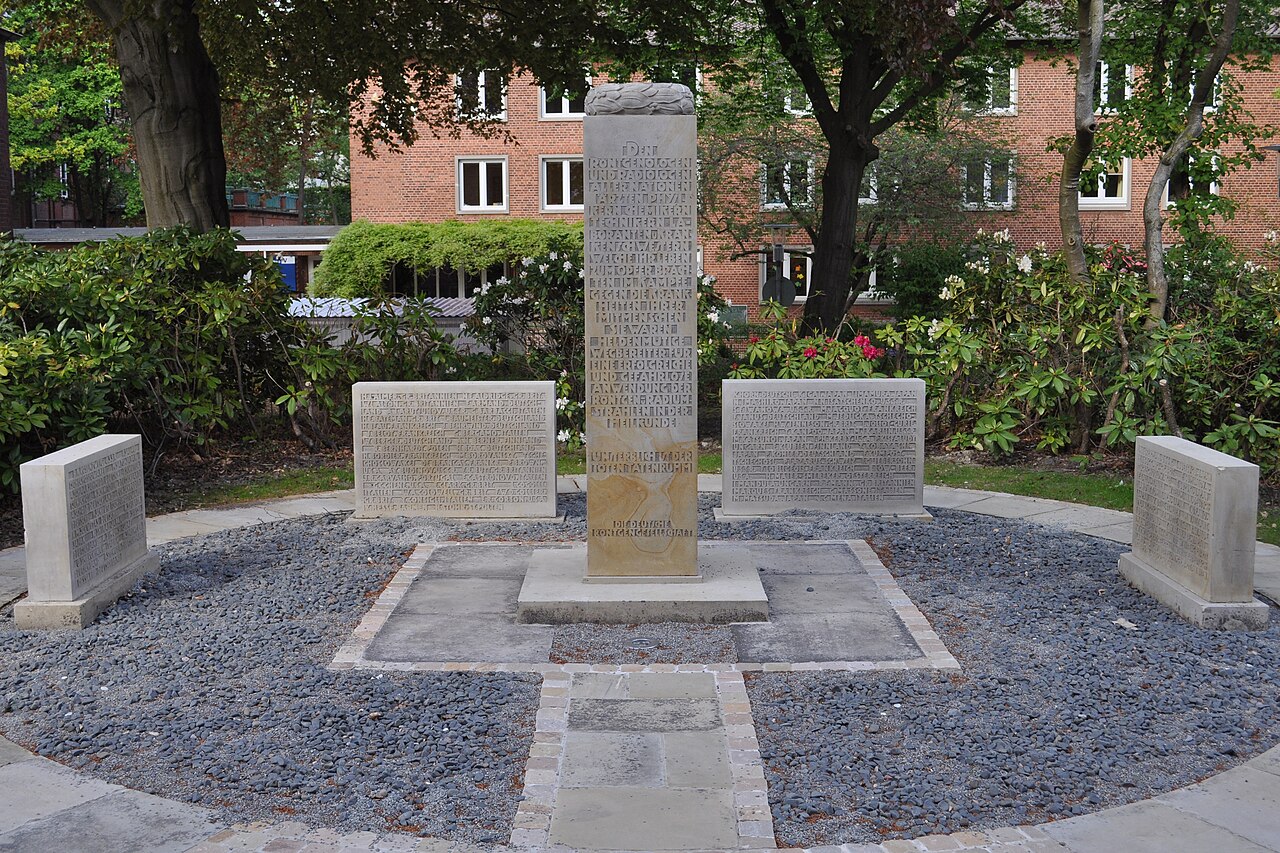
In the garden of St. Georg Hospital in Hamburg, a stone memorial addresses the dead as people who gave their lives in the fight against disease. Its dedication gathers doctors, physicists, chemists, technicians, laboratory workers, and nurses under one title: X-ray and radium martyrs of all nations. It calls them “heroic pioneers” and declares their achievement immortal. The Deutsche Röntgengesellschaft unveiled the memorial on April 4, 1936, near the clinic associated with Heinrich Albers-Schönberg, an early specialist who had himself died after years of radiation injury.[1][2]
The honor is deserved. Early radiology workers sustained burns that would not heal, cancers of the hands and face, blood disorders, repeated amputations, and premature death while turning an astonishing discovery into medical practice. Yet the monument’s date complicates its heroic grammar. It was not erected before anyone understood that the rays could injure. By 1936, warnings had circulated for decades, national protection rules existed, and an international committee had assigned safety duties to the people running radiology departments.[4][5][6]
That makes the memorial more than a roll of honor. It is a test of how medicine remembers occupational harm. Calling a worker a martyr can preserve a name that might otherwise disappear. It can also make preventable exposure sound like the price that progress naturally demanded. The harder inheritance is not sacrifice. It is the moment when a profession stops treating damaged bodies as proof of devotion and starts designing work so devotion is no longer measured in damage.
Image context: the cover photograph faces the actual memorial in the hospital garden. Stone, engraved names, and an institutional setting matter here because this essay is about how a profession gave bodily injury a permanent public form—not about radiation as an abstract glow or a medical icon.[3]
The injury appeared almost as quickly as the image
Wilhelm Röntgen announced the new rays at the end of 1895. Within months, experimenters were reporting skin irritation, hair loss, burns, and other injuries. The difficulty was not a total absence of warning. It was a combination of fascination, uncertain measurement, delayed effects, improvised equipment, and work that repeatedly placed human bodies close to the beam.[5]
Early radiography was intensely manual. Operators adjusted fragile tubes, arranged glass plates, positioned patients, and sometimes used their own hands to test equipment or judge exposure. A burn could appear after the experiment; a malignancy could emerge years later. That delay weakened the intuitive link between one day’s work and a later wound. The benefits, by contrast, were immediate and visible: a fracture, foreign object, or hidden structure appeared without an incision.[5]
The Hamburg stone therefore commemorates a real asymmetry. The image arrived at once; the full account of its cost arrived slowly. But slow recognition should not be confused with permanent ignorance. Protective ideas developed alongside the injuries. Time near the source could be reduced. Distance could be increased. Tubes, rooms, and operators could be shielded. Work could be reorganized so hands no longer served as test objects.[5][6]
A later historical study used professional rosters and the Ehrenbuch der Radiologen aller Nationen, the memorial’s associated book of honor, to estimate how the danger changed. Its authors put the risk of eventually dying from occupational radiation disease as high as roughly 10–25 percent for people beginning X-ray work in 1896, around 1–2 percent for cohorts beginning in 1900–1908, and close to zero by 1935. They repeatedly warn that the estimates are approximate: the early workforces are difficult to count, the honor book is a selected record, and operators outside professional societies can vanish from the denominator.[7] The exact curve is therefore an informed reconstruction, not a census. Its direction is still important. Harm fell while radiology continued.
By 1936, protection had become an institutional verb
The safety timeline puts a boundary around the word martyr. The German Röntgen society issued professional protection advice in 1913, warning about cumulative exposure and recommending shielding, distance, equipment tests, and the right of support staff to refuse work when protection was inadequate.[5]
In 1921, British radiological organizations helped form the British X-ray and Radium Protection Committee. Its recommendations treated the hazard as something workplaces could manage rather than a fate attached to curious people. At the Second International Congress of Radiology in Stockholm on July 27, 1928, an international committee adopted recommendations for X-ray and radium protection.[5][6]
The opening principle of that international document matters more than its antique technical detail. It placed responsibility on those in charge of departments to provide adequate protection and suitable working conditions. The recommendations then translated responsibility into arrangements: limits on working time, distance from energized tubes, lead shielding, barriers against scattered radiation, protective equipment, separate rooms, safer radium handling, and electrical precautions.[6]
The document was not a modern endpoint. Some of its assumptions now look paternalistic or unsafe. It recommended fresh air and long holidays alongside shielding, and for some simple radium tasks it proposed rotating temporary workers after no more than six months. That last rule did not eliminate exposure; it distributed it through a less-skilled workforce.[6] Protection was becoming a system, but the system still carried the hierarchy of its time.
This is precisely why the 1936 memorial cannot be read as a monument to innocent discovery alone. It was built after the profession had begun converting accumulated suffering into rules. Many people named on it had been injured before those rules, or lived long enough for earlier exposure to declare itself later. The stone gathers deaths; it does not establish that every death was unavoidable, equally understood, or voluntarily chosen.
“Martyr” remembers a person and edits a cause
Historian Rebecca Herzig has shown how martyr language helped early American roentgenology make a scattered technical practice feel like a coherent profession. Stories of continued work through ulcers, operations, and amputations turned injury into evidence of fidelity. Herzig reads the Hamburg monument’s upright stone and alphabetical names as a collective body for the field: individual wounds are absorbed into a durable scientific identity.[4]
That interpretation does not require believing the commemoration was cynical. Colleagues were trying to honor people whose suffering was visible, prolonged, and often bound to work they considered valuable. The memorial also crosses rank in its inscription more deliberately than a monument devoted only to celebrated physicians would. It names technicians, laboratory workers, and nurses as participants in the making of radiology.[2][3]
But martyr changes the causal sentence. A martyr gives a life to a cause. An occupationally injured worker is harmed through a working arrangement. Those descriptions can apply to the same person, yet they ask different questions. The first asks how much courage the person showed. The second asks who knew the danger, who controlled the equipment, what protections were available, and why exposure continued.
The difference is not semantic housekeeping. Heroic memory can make a safety failure feel complete: the dead suffered, the living express gratitude, medicine advances. An occupational-health reading keeps the chain open. It asks whether an injury produced a protective change, whether that change reached assistants as well as senior practitioners, and whether responsibility moved upward to institutions rather than downward to individual caution.
A list can grow and still have an edge
The memorial does not look like a single finished inventory. The central stele is now ringed by four separate name stones, making the site visibly cumulative.[3] The associated honor book also expanded. Kemerink and colleagues worked from an edition containing 404 biographies, a record larger than the first monumental list and useful enough to support a quantitative reconstruction.[7]
Yet every commemorative list has an admission rule. The historical study notes that its source base is best at capturing established, medically oriented X-ray users and equipment suppliers connected to professional records. People who used X-rays outside societies—occasional operators, commercial demonstrators, beauty-treatment workers, and others—are harder to count. Even the authors’ careful denominator cannot recover everyone exposed.[7]
Herzig identifies a related edge in the older martyr tradition. Professional narratives tended to privilege recognized investigators while wives, informal assistants, patients, animals, and workers harmed by other hazards of early X-ray practice received less commemorative authority.[4] This is not proof that every one of those people belongs on the Hamburg stones; attribution of an individual death requires evidence. It is a warning that “all nations” is not the same claim as all labor.
The monument’s breadth should therefore be valued without mistaking it for completeness. Its named professions widen the public memory of radiology beyond a parade of great doctors. Its gaps remind us that records often follow status. Commemoration can correct forgetting only after a person has become legible to the archive.
The safest tribute is a duty that outlives the names
The memorial’s inscription looks backward from safe application to heroic pioneers. The historical record suggests a better direction of travel: from observed injury to shared responsibility. Warning became guidance; guidance became department design; exposure control became an obligation rather than a test of nerve.[5][6]
That sequence changes what gratitude should demand. It does not ask readers to despise the monument or strip away the word martyr. The stone is evidence of how the profession understood itself in 1936, and its names refuse anonymity. Erasing its heroic language would erase part of the history worth examining.
Instead, read the dedication in two voices. One says that these workers made radiology possible. The other says that no useful technology earns a permanent exemption from occupational safety. Their injuries helped reveal a hazard, but injury itself was not the method that had to be preserved. The quantitative decline reconstructed by later researchers shows the opposite: radiology’s usefulness survived as the probability of fatal harm fell.[7]
The most faithful commemoration is therefore procedural. It lives wherever someone responsible for a workplace assumes that exposure belongs to the system, not to the worker’s character; wherever an assistant receives the same protection as a celebrated specialist; and wherever a warning becomes equipment, staffing, measurement, and enforceable practice.
Hamburg’s memorial gives sacrifice a body of stone. Its harder legacy is less visible: the transfer of courage from the person standing near the tube to the institution willing to move that person out of harm’s way.
Sources
- British Institute of Radiology, “1930s radiology” — institutional history of the April 4, 1936 unveiling, its location at St. Georg Hospital, and the injuries the memorial commemorates.
- Asklepios Klinik St. Georg, “Geschichte unserer Klinik” — official hospital history locating the memorial, dating its dedication to April 1936, and documenting its connection to Heinrich Albers-Schönberg.
- Wikimedia Commons, “File:Ehrenmal der Radiologie (Hamburg-St. Georg).1.ajb.jpg” — source, authorship, metadata, and inscription transcription for Ajepbah’s 2012 photograph used as the article image. CC BY-SA 3.0 license.
- Rebecca Herzig, “In the Name of Science: Suffering, Sacrifice, and the Formation of American Roentgenology,” American Quarterly 53, no. 4 (2001) — analysis of martyr rhetoric, professional identity, and the Hamburg monument.
- John D. Boice Jr. et al., “Evolution of radiation protection for medical workers,” British Journal of Radiology 93 (2020) — review of early injuries, German and British safety guidance, exposure control, and the institutional development of radiation protection.
- International X-Ray and Radium Protection Committee, International Recommendations for X-Ray and Radium Protection (adopted July 27, 1928; published 1929) — primary protection document assigning responsibility and specifying working conditions, shielding, distance, and handling practices.
- Gerrit J. Kemerink et al., “Early X-ray workers: an effort to assess their numbers, risk, and most common (skin) affliction,” Insights into Imaging 7 (2016) — quantitative reconstruction based on the honor book and professional rosters, with explicit uncertainty and coverage limits.