The Mississippi Health Project began with a clinic that its intended patients could not reach. In July 1935, physician Dorothy Boulding Ferebee and a team of Alpha Kappa Alpha volunteers arrived in Holmes County with vaccines, medical supplies, and plans to serve Black sharecropper families. White plantation owners controlled those families’ working time and initially refused to let them leave for the clinic. A health service existed on paper; the local labor regime had made it inaccessible.[1][3]
Ferebee’s answer was both practical and political. The volunteers loaded their cars, drove out to the plantations, and converted whatever space they could obtain into temporary treatment sites. “If they can’t come to us, we’ll go to them,” she later recalled.[3] The sentence is often presented as proof of personal resolve. It is more revealing as a diagnosis: distance was not the only barrier. The route to care ran through people who had the power to withhold a worker’s time.
That is what makes Ferebee’s Mississippi work more than an uplifting story about a doctor making house calls. The project redesigned delivery around a blocked route, recorded impressive service volume, and used those encounters to argue for public action. It also remained temporary, dependent on unpaid labor and negotiated permission. Its achievement and its limit were the same: Black women built a moving clinic where a durable health system had failed to arrive.
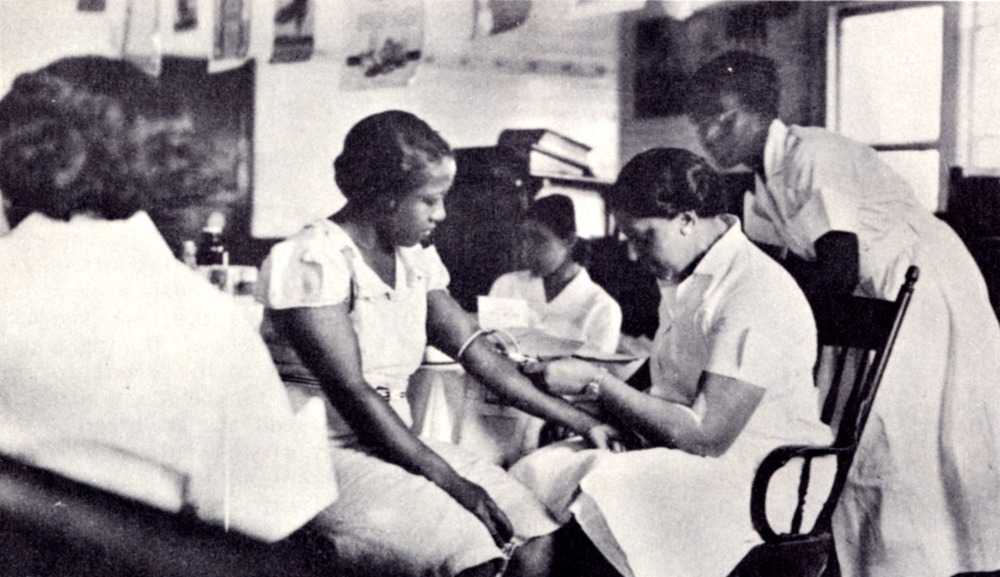
Image context: the cover is a real 1938 photograph of Ferebee drawing blood during the project. The modest room, waiting patient, nearby staff, and supplies show care as organized work—not as an abstract symbol of medical charity.[5]
Before the caravan, a lesson in institutional exclusion
Ferebee was born in Norfolk, Virginia, in 1898 and educated in Boston. She graduated from Tufts University School of Medicine with honors in 1924, but her record did not overcome the racial barrier at white hospitals offering internships. She completed her training at Freedmen’s Hospital in Washington, D.C., one of the few institutions under Black administration where Black physicians could train and Black patients could reliably seek care.[1][3][4]
That exclusion shaped the kind of physician she became. After her internship, Ferebee practiced in Southeast Washington and helped establish a neighborhood institution that joined clinical care to playgrounds and day care. Medicine, in that setting, could not be separated cleanly from transport, work, food, or child supervision. She learned to organize donors and volunteers as well as appointments. She also learned that an available service was not the same thing as an accessible one.[1][3]
Black women’s organizations gave that work a larger operating base. In 1934, Alpha Kappa Alpha president Ida Louise Jackson led a summer education project in Holmes County. The condition of children arriving hungry and malnourished made the educational plan look incomplete. By December, the sorority had approved a health project, pledged $1,500, and appointed Ferebee to lead it. The intervention was therefore never a solo invention. Jackson identified the need; chapters supplied money and people; Ferebee turned that network into a clinical operation.[1]
During the first half of 1935, while practicing medicine and raising young twins, Ferebee drafted budgets, sought donations, ordered supplies, recruited 11 volunteers, and negotiated with federal, state, and county health officials. The group included nurses, clerical workers, and a dietitian. Its initial target was concrete: immunize 3,000 children against smallpox and diphtheria in a county whose health officer said it lacked the funds to do the work adequately.[1]
Howard University’s digital archive preserves both a 1935 project report and Ferebee’s scrapbook covering the rural teachers’ school and the health project through 1940.[2][6] Their survival matters. They keep the story attached to planning, annual work, and institutional memory rather than letting the mobile clinic dissolve into a single heroic anecdote.
The first clinic failed before the medicine did
The team had designed a service, but plantation power decided whether patients could use it. Many Holmes County sharecroppers lived where housing, wages, debt, and movement were bound to a landowner. When owners declined to release workers and their children for clinic visits, they exposed a category error in the original plan. The volunteers had treated a controlled population as if it possessed ordinary freedom of travel.[1][3]
Ferebee and the county health officer visited plantation owners to negotiate access. The owners suspected the visitors of political agitation. Ferebee had to insist that the work concerned health and accept surveillance of the activity before some relented.[1] The bargain opened a narrow lane for vaccines and examinations, but it did not remove the underlying coercion. Care was permitted so long as it did not challenge the labor arrangement that had obstructed care in the first place.
The cars changed the geometry. Six days a week, the volunteers packed equipment and supplies, crossed poor roads in summer heat, and made temporary clinics from the spaces available. Mobility did not merely shorten the distance between doctor and patient. It bypassed the requirement that the patient first win time away from the field. The automobile became a clinical tool because the fixed-site model had assumed a freedom that sharecroppers did not have.[1]
By the end of the six-week inaugural project, the team had immunized more than 2,600 children, performed more than 200 physical examinations, distributed 6,800 pieces of health literature, and driven over 5,300 miles within its medical caravan. Those figures are not decorative scale. Together they reveal the intervention’s mechanism: vaccine supply, examination, health teaching, and transport had to move as one package.[1]
Reach is evidence, but it is not an outcome study
Alpha Kappa Alpha funded the project for seven more summers. Ferebee led teams in Bolivar County from 1936 through 1941; the program ran once more in 1942, although other responsibilities kept her from returning that year. By 1940, volunteers had reportedly immunized about 14,500 children against smallpox and diphtheria, treated thousands of adults, screened for sexually transmitted infections, and taught health classes. The Smithsonian’s account places total reach across the project above 15,000 residents.[1][5]
These are strong measures of activity and access. They do not, by themselves, establish how many deaths the project prevented, how long protection lasted, or whether county-level disparities narrowed. The surviving accounts do not provide a comparison population, complete follow-up, or a denominator for every community served. Contemporary admirers credited the project with saving large numbers of children, but that praise should not be converted into a modern causal estimate.[1]
The same caution applies to a vivid travel story attached to the first summer. Later accounts said a racist railroad agent’s refusal to sell the women tickets forced them to drive south. Historian Vanessa Northington Gamble notes that the episode does not appear in contemporary project reports or Black newspaper coverage and may be apocryphal.[1] The broader danger of Jim Crow travel is well documented; this particular origin story remains uncertain. Preserving that boundary makes Ferebee’s verified work stronger, not smaller.
Nor were the volunteers free of hierarchy. Gamble records paternalistic class language in the sorority’s own publications about the rural people it intended to help.[1] Black women were confronting white supremacy while also arriving as educated professionals from outside the Delta. The project’s record therefore resists a simple division between enlightened rescuers and passive recipients. Its clinics delivered needed care, but its social vision did not automatically grant equal authority to the people being served.
A summer service became evidence for a public claim
Ferebee did not treat volunteerism as proof that government could withdraw. The Mississippi work gave her direct evidence that medical need was greatest where segregation left the fewest services. In 1938, Alpha Kappa Alpha created a national public-affairs council to lobby on Black health and other issues. In March 1940, Ferebee testified before a U.S. Senate subcommittee considering hospital construction and pressed for an antidiscrimination provision.[1]
That move from caravan to hearing room is the deeper arc of the biography. The project first compensated for a missing system, then used what it found to indict the conditions that made compensation necessary. Ferebee later directed health services at Howard University and, from 1949 to 1953, led the National Council of Negro Women, carrying health education into a broader civil-rights program.[3][4]
The Mississippi project ended in 1942. Wartime gasoline rationing mattered, but so did eroding support from state health officials who wanted closer control over the sorority’s work.[1] The shutdown exposes the fragility of the model. Cars could carry vaccines around a local gatekeeper; they could not guarantee fuel, funding, public authority, or continuity. A volunteer caravan could demonstrate what organized care looked like without becoming the institution obliged to provide it year after year.
Ferebee’s most durable lesson is therefore not that determination defeats every barrier. It is that delivery design must begin with an honest map of power. A clinic placed nearby can remain unreachable when employers control time, officials ration cooperation, roads punish travel, and patients are denied a voice in the service built for them. In 1935, Ferebee and her colleagues made care move. Their work also showed why mobility alone could never be the final cure for exclusion.
Sources
- Vanessa Northington Gamble, “Outstanding Services to Negro Health: Dr. Dorothy Boulding Ferebee, Dr. Virginia M. Alexander, and Black Women Physicians’ Public Health Activism,” American Journal of Public Health 106, no. 8 (2016) — archival history of the project’s planning, first-summer operations, outputs, political constraints, and evidentiary disputes.
- Moorland-Spingarn Research Center, Howard University, “Mississippi Health Project Annual Report No. 2” (1935) — catalog page for an early Alpha Kappa Alpha project report.
- U.S. National Library of Medicine, “Biography: Dr. Dorothy Celeste Boulding Ferebee” — official biography, oral-history transcript, and project photographs.
- National Park Service, “Dr. Dorothy Boulding Ferebee” — documented chronology of Ferebee’s medical training, Mississippi work, and later National Council of Negro Women leadership.
- Smithsonian National Museum of African American History and Culture, “The Mississippi Health Project II: AKA Revisits Its Model for Community Health Care” — project overview and source page for the 1938 archival photograph used as the article image.
- Moorland-Spingarn Research Center, Howard University, Dorothy Ferebee’s The Summer School for Rural Negro Teachers and the AKA Mississippi Health Project Scrapbook, 1934–1940 — catalog record for the project’s primary visual and documentary archive.