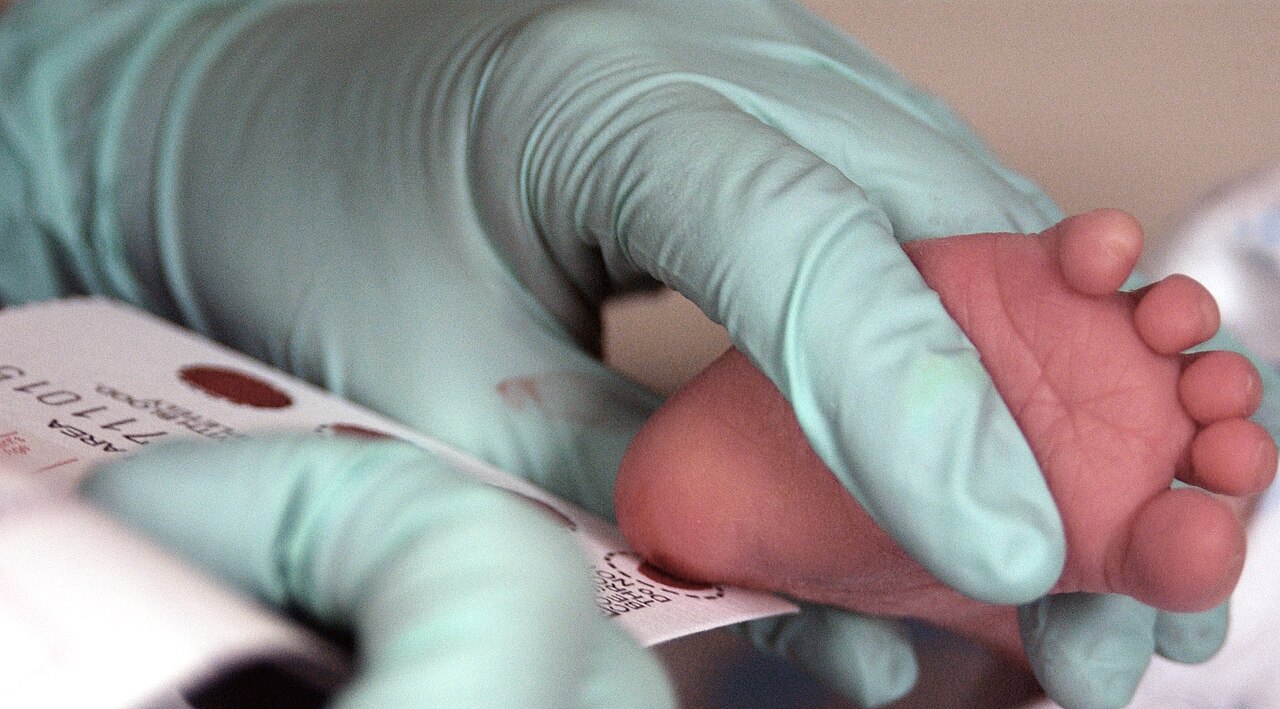
The history of newborn screening can look deceptively small: a baby's heel, a paper card, a laboratory result. The reconstruction is more interesting. Robert Guthrie's PKU test mattered because it converted a rare metabolic disease into a routable public-health event. A disorder that showed no symptoms until injury had already begun could be made visible during the first days of life, provided the system around the test moved fast enough and knew what to do next.[1][2][3]
That is the central hinge. Guthrie did not merely invent a clever assay. He helped connect a bacterial inhibition test, dried blood spots, maternity-hospital collection, state mandates, laboratory reporting, and low-phenylalanine diet follow-up into one delivery chain. The card was humble technology, but it changed the unit of action. PKU was no longer only a diagnosis waiting for a symptomatic child. It became a screenable risk attached to every newborn.
Image context: the cover photograph shows blood being collected from an infant for PKU screening. It is the right documentary image because the article's subject is not an abstract genetics concept; it is a repeatable care process built from heel, paper, transport, laboratory interpretation, and follow-up.[6]
Timeline anchors
- Early 1960s: Guthrie developed a simple blood test for PKU using heel-prick blood on paper and bacterial growth as the readout.[2]
- 1961: the National Human Genome Research Institute places Guthrie's first newborn metabolic screen in its timeline of genomics history.[1]
- 1963: Massachusetts became the first U.S. state to require PKU testing for all newborns after federal Children's Bureau-supported work found the test safe and effective.[2]
- By 1967: mass PKU screening had become routine enough that 37 states had laws requiring newborn screening.[1]
- By the 1970s: NICHD describes PKU screening as commonplace across the United States, paired with early diet therapy.[2]
- 2006 and after: the Recommended Uniform Screening Panel gave states a standardized national reference point for what newborn screening programs should include.[4][5]
These dates keep the story out of gadget history. The real event was not a single lab moment. It was the assembly of a system that could act before symptoms.
The problem was timing
PKU is a useful case because the disease punishes delay. The metabolic defect involves phenylalanine, an amino acid that can build to harmful levels when the body cannot process it normally. NICHD's historical account explains the intervention logic plainly: if infants were identified early, they could begin a special low-phenylalanine diet, and follow-up research showed that diet improved outcomes.[2]
That makes PKU different from many conditions that are detectable but not yet actionable. Screening only earns public-health force when detection opens a real path to prevention, treatment, or monitoring. The Guthrie test sat at that threshold. It found a condition before visible damage, and the diet gave clinicians something to do with the result.[1][2]
The hard part was that the window sat in ordinary birth care. A test dependent on a large blood draw, fragile transport, or a specialized hospital could not easily become universal. Guthrie's operational insight was to make the sample small and mobile. Heel-prick blood could be dried on filter paper and sent to a lab. That collection method sounds mundane now because newborn screening has absorbed it into routine. In the early 1960s, it was the bridge between biochemical knowledge and population practice.[2][3]
The paper card changed the logistics
The card solved several problems at once. It gave hospitals a collectable specimen that did not require keeping liquid blood stable. It allowed centralized laboratories to receive samples from many birth sites. It made the infant, the maternity ward, and the public-health lab part of one workflow. And it created a durable object that could carry identity, timing, and blood spots through a system.
This is why a "simple" test deserves careful reading. Simplicity was not a lack of sophistication. It was the condition of scale. The bacterial assay mattered scientifically, but the dried-blood-spot format mattered administratively. Without the card, the test could have remained a specialist tool. With the card, it could become state infrastructure.[1][2][3]
The University at Buffalo's account of Guthrie's legacy emphasizes this delivery dimension: within a few days after birth, babies undergo a heel prick, and a blood drop is used to detect genetic disorders so treatment can start from birth when a condition is found.[3] The same article notes that Guthrie developed the blood-spot test while a University at Buffalo faculty member and physician at the children's hospital. That institutional setting matters because the invention had to move between laboratory microbiology, pediatrics, hospitals, and state health departments.[3]
Law turned a test into a population event
The decisive turn came when screening stopped depending only on whether one clinician happened to order it. NICHD states that in 1963 Massachusetts became the first state to pass a law requiring PKU testing for all newborns.[2] NHGRI adds that by 1967, 37 states had screening laws.[1] Those are not decorative numbers. They mark the movement from medical availability to public expectation.
Mandatory screening has always carried governance questions: parental consent, specimen retention, state variation, false positives, follow-up capacity, privacy, and how to decide which conditions belong on a panel. But the early PKU story shows why mandate logic gained force. A newborn cannot advocate for a test. Symptoms arrive too late. The cost of missing a treatable case falls across a lifetime. When those conditions align, public health tends to move from optional availability toward default capture.
That move also exposed the system's dependency chain. A law could require screening, but it could not by itself ensure clean specimen collection, fast transport, accurate laboratory interpretation, family notification, diet access, metabolic-clinic follow-up, and long-term adherence. The Guthrie card made screening possible; the delivery system had to make it meaningful.
Follow-up was the second half of the test
The common mistake is to treat screening as ending at the laboratory result. PKU makes that mistake visible. A positive screen is not treatment. It is a signal that must be confirmed, explained, and connected to a diet that families can actually sustain. NICHD's account tracks that second half: after newborns were identified by the test, research on the low-phenylalanine diet showed improved intellectual outcomes, and later research clarified the importance of continuing diet therapy across life and around pregnancy.[2]
That is why the event reconstruction should include diet follow-up as part of the screening invention. Without treatment, screening risks becoming early knowledge without remedy. Without screening, treatment begins after preventable harm. The useful system is the pair: early identification plus a pathway that changes the child's developmental trajectory.[2][5]
The U.S. Preventive Services Task Force's evidence review captures the mature form of that logic. It notes that PKU screening was required in all 50 states plus the District of Columbia at the time of its review, and that the test is most accurate after 24 hours of life but before 7 days.[5] That time window is the operational residue of the original lesson: the newborn body, the hospital stay, the lab schedule, and the family's first week all have to line up.
The expansion problem
Once the card worked for PKU, it invited a larger question: what else should be screened from the same spot of blood? NICHD's brief history of newborn screening describes the federal route into standardization: HRSA's Maternal and Child Health Bureau asked the American College of Medical Genetics to develop guidelines, the ACMG reviewed 81 conditions, and 29 were placed in the original core panel.[4] The U.S. Preventive Services Task Force evidence review captures the same mature logic from another angle: screening methods, timing, state requirements, and treatment follow-up have to be evaluated together.[5]
That expansion preserved the Guthrie logic while complicating it. The original system was built around one condition with a comparatively clear treatment path. Modern newborn screening panels cover many disorders with different technologies, timelines, confirmatory tests, treatments, and uncertainty profiles. The card still starts the process, but the governance burden is heavier. Each added condition asks whether early detection improves outcomes enough to justify universal screening, whether states can perform the test reliably, and whether families can reach follow-up care after a positive result.[4][5]
This is the strongest way to read Guthrie's legacy. The point is not nostalgia for a simpler era of medicine. The point is that a small specimen created a public-health grammar: screen only when the result can move through a system that protects a child before disease becomes visible.
What the Guthrie card teaches
The Guthrie card remains powerful because it shows that prevention often depends on boring infrastructure. A breakthrough assay is necessary but insufficient. The lifesaving part emerges when the assay is attached to collection timing, transport reliability, laboratory capacity, legal authority, clinical follow-up, nutritional access, and parental understanding.
The card's genius was that it made that chain physically manageable. A few drops of blood could travel farther than a newborn. A state lab could see risk before a pediatrician saw symptoms. A family could receive a diet plan before brain injury had become the evidence. In that sense, the Guthrie card did more than screen for PKU. It gave public health a durable model for turning silent risk into an actionable first-week obligation.[1][2][3][4][5]
Sources
- National Human Genome Research Institute, "1961: First Screen for Metabolic Defect in Newborns" - timeline entry on Guthrie's PKU screen and the spread of state screening laws by 1967.
- NICHD, "Phenylketonuria (PKU) and Newborn Screening" - federal history of Guthrie's test, Massachusetts' 1963 law, diet follow-up, and later PKU pregnancy research.
- University at Buffalo, "Guthrie Symposium brings together researchers, families to discuss advances in newborn screening" - institutional account of Guthrie's Buffalo work and the heel-prick blood-spot workflow.
- NICHD, "Brief History of Newborn Screening" - federal overview of newborn screening expansion, the ACMG review of 81 conditions, and the original 29-condition core RUSP.
- U.S. Preventive Services Task Force, "Final Evidence Review: Phenylketonuria in Newborns: Screening" - PKU screening methods, recommended timing, and all-state requirement context.
- Wikimedia Commons, "File:Phenylketonuria testing.jpg" - U.S. Air Force photograph of infant blood collection for PKU screening, used as the article image source.