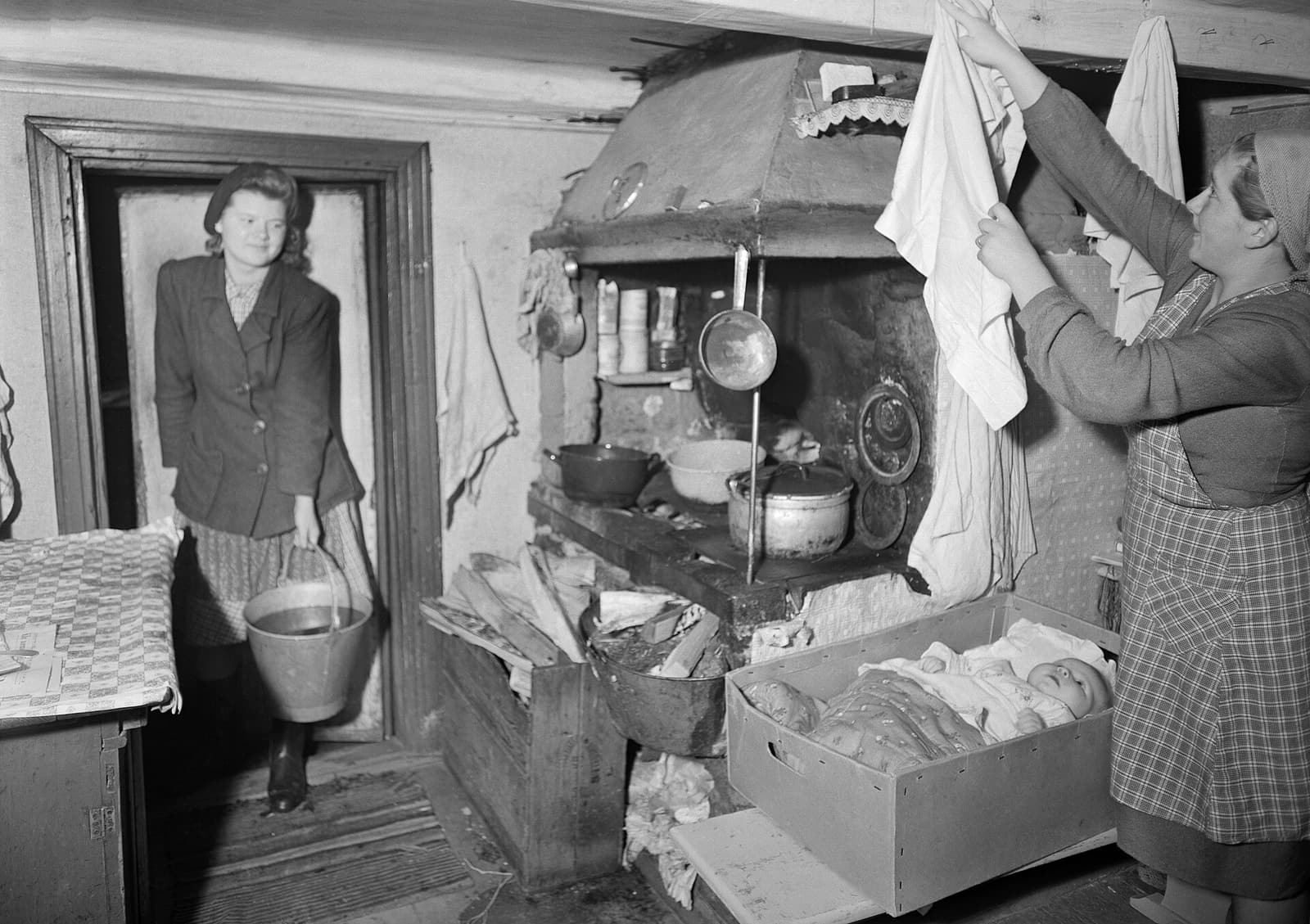
In Pekka Kyytinen's 1948 photograph from Nerkoo, Finland, a baby lies awake in a shallow cardboard box near a broad masonry hearth. Her mother lifts a small white garment into the light. Another woman has entered carrying a metal pail. The room contains the whole appeal of Finland's maternity package in one frame: useful things arriving where care actually happens, with the box itself becoming furniture.[6]
It is also the kind of photograph that makes a causal story feel obvious. Finland once had high infant mortality. The state gave families baby boxes. Infant mortality fell. Put those three facts in sequence and the cardboard begins to look like a life-saving technology.
That familiar story compresses at least four different interventions into one photogenic object: a maternity grant, a choice of goods or cash, a cardboard container sometimes used for sleep, and a growing network of antenatal and child-health clinics. They did not all begin at the same moment. They did not act through the same mechanism. Most importantly, the best modern attempt to measure their mortality effect could not separate them from war, postwar recovery, family allowances, sanitation, nutrition, vaccination, and rapidly expanding maternity care.[1][2][3]
The myth is not that Finland's maternity package mattered. It plainly mattered as material support and as a durable encounter with the welfare state. The myth is narrower and more seductive: that the cardboard box itself has been proved to reduce infant deaths. The evidence supports a better story—less magical, more systemic, and ultimately more useful to anyone hoping to learn from Finland.
Image context: Kyytinen photographed Rauni Ball and her daughter Raija Helena in 1948, one year before the maternity grant became universal. The Finnish Heritage Agency record identifies the people, place, date, and package; the photograph documents real household use rather than a staged modern reconstruction.[6]
Three things hidden inside one nickname
The chronology immediately loosens the box from the policy. Finland enacted its Maternity Grants Act in 1937 and distributed the first grants in 1938 to low-income mothers. About two-thirds of new mothers received the benefit that first year. Kela's history records a value of 450 Finnish markka, a little more than one-third of an industrial worker's average monthly wage, available as money, goods, or a combination.[1]
But the cardboard box was not there at the beginning. The 2023 natural-experiment study of the policy reports that care items were packaged in a box from 1942 onward; before then, goods were supplied without that container. It also notes that the package was not initially designed as an infant bed. Families made that use themselves. The sleeping box, the kit of supplies, and the grant are therefore related but not interchangeable interventions.[2]
A second system was expanding beside them. Finland's maternity-clinic movement began in the 1920s, and a 1944 law required every community to open a child-health clinic. The system was preventive by design: free checkups and practical childcare advice were meant to reach families across income groups, not merely treat illness after it appeared.[3]
Then came universality. In 1949, Finland extended the maternity grant beyond its earlier income test. Eligibility was tied to an antenatal examination, turning the benefit into an invitation to enter care before birth. That link survives in current rules: Kela says a claimant must have a medical examination by a doctor or at a maternity and child-health clinic no later than the 18th week of pregnancy.[1][4]
Calling all of this “the baby box” is convenient. It is also analytically expensive. A grant can relieve scarcity. A kit can supply clothing and bedding. A condition can change care-seeking. A clinic can detect risk, offer advice, vaccinate, and maintain follow-up. A box can hold those goods and, in some homes, hold a sleeping baby. If infant deaths fall, the nickname does not tell us which pathway deserves the credit.
The 1938 break does not look like a miracle
Ronan McCabe and colleagues tested the popular claim with national data covering every infant born in Finland from 1922 through 1975. They treated the 1938 introduction and the 1949 universalization as two separate natural experiments, using interrupted time-series models to ask whether infant mortality changed abruptly or changed trend after each policy point.[2]
If the original, targeted grant had produced a large immediate survival benefit, 1938 was a promising place to look. It reached mothers with low incomes, whose families plausibly had the most to gain from cash or supplies. Infant mortality had been 68.6 deaths per 1,000 live births in 1937, the year before introduction.[2]
The model did not show a drop. It estimated an immediate increase of 14.59 deaths per 1,000, with a 95% confidence interval from 4.30 to 24.89. In 1939, mortality was 13.8 deaths per 1,000—or 23%—above the level predicted from the earlier trend.[2]
That result is not evidence that maternity grants harmed babies. It is evidence that a calendar break is not a laboratory. Finland entered the Winter War in 1939; the Continuation War ran from 1941 to 1944, followed by the Lapland War into 1945. Services, food, housing, and population life were all under pressure. A beneficial grant could coexist with rising mortality if those forces were larger. The first breakpoint therefore breaks the fairy tale in both directions: sequence alone cannot prove benefit, but neither can a crude before-and-after reversal prove harm.[2]
The 1949 drop is striking—and crowded
The second result looks much closer to the celebrated story. Infant mortality stood at 51.9 per 1,000 in 1948. At the 1949 universalization point, the main model estimated an immediate decline of 14.35 deaths per 1,000, with a 95% confidence interval from 7.76 to 20.94 fewer deaths. In 1950, the observed rate was 13.54 per 1,000 below the model's expectation, a 27% difference.[2]
But the estimate became smaller and statistically imprecise when the researchers shortened the pre-intervention comparison window: 7.09 fewer deaths per 1,000, with a confidence interval running from 19.35 fewer to 5.18 more. Their synthetic-control models could not find a credible combination of other European countries whose earlier mortality trend matched Finland well enough to serve as a counterfactual. The apparent break is real in the series; its ownership is not.[2]
Several rival explanations arrived almost on top of it. A tax-free child allowance began in 1948. General antenatal care had rolled out from 1945. The study cites historical records showing antenatal attendance leaping from 31.3% of mothers in 1944 to 86.4% in 1945. Meanwhile, municipalities were building the clinic network required by the 1944 law, and the country was emerging from wartime disruption.[2][3]
There are thus two serious interpretations. The object-centered interpretation says the supplies—and perhaps a separate place for sleep—directly reduced household risks, with universalization extending those benefits. That is plausible, but the historical data do not isolate package recipients, actual box sleepers, or causes of death. The system-centered interpretation says universality worked chiefly as one layer of a wider settlement: material aid, early contact with maternity care, municipal clinics, cash support, hygiene, nutrition, and vaccination. The chronology fits that account better, but it still cannot assign a clean share of saved lives to each layer.[1][2][3]
The responsible verdict is not “the box failed.” It is effect not separately identified.
The strongest mechanism is a doorway
Kela's own account describes the grant as an inducement for expectant mothers to enter health services early. That design matters because it joins an immediate, legible benefit to a less visible preventive encounter. A family receives cash or useful goods; the system gains a chance to examine a pregnancy, provide advice, and connect parent and child to continuing care.[4]
The package also set a material floor. Fabric, clothing, bedding, and care items could reduce the first costs of infancy, especially when the original benefit was means-tested. When the grant became universal, it changed social meaning too: the package was no longer only poor relief but a shared entitlement. None of those benefits needs a mortality estimate to be real. Dignity, preparedness, contact with services, and reduced household expense are legitimate policy outcomes in their own right.[1][4]
This is why copying only the container is such a weak imitation. A box mailed without trusted clinics, affordable follow-up, income support, or a clear theory of use reproduces Finland's most visible artifact while leaving its operating system behind. The cardboard travels easily; the relationship between family and public service does not.
The sleep claim is a separate claim
The 1948 photograph proves that at least one Finnish family used the package as a bed. It does not prove that the practice caused the national mortality decline, prevented sudden infant death, or outperformed a regulated cot. Those are comparative safety claims, and they require comparative safety evidence.[2][5][6]
A scholarly review in the NCBI Bookshelf makes the boundary explicit. It notes that the Finnish decline coincided with the package's history but says there is no evidence that cardboard baby boxes themselves were instrumental. The authors consider a firm, flat, separate space potentially safer when the alternative is an adult bed, yet they also call the evidence base unclear and argue that the sleep-box intervention needs direct evaluation.[5]
That distinction is not pedantry. “A family found this box useful” is an observation. “This box reduces infant mortality” is a causal population claim. “This box meets current safe-sleep standards” is a product-safety claim. One cannot borrow proof from another.
What would make the causal picture sharper
The historical study lacked individual records showing who received the grant, who chose goods rather than cash, who used the container for sleep, who attended clinics because of the condition, and what infants later died from. Early uptake data are incomplete, and families selecting the package may have differed from those selecting money. Even a tempting package-versus-cash comparison would therefore need careful adjustment for income, housing, parity, geography, health, and care access.[2]
A stronger record would connect those elements at the family level. A convincing modern evaluation would also state its intended mechanism before distribution: material security, antenatal engagement, safer sleep, or some combination. It would measure each intermediate step, compare against a credible alternative, report adverse events, and follow health outcomes rather than treating receipt of a box as success by definition.
For the Finnish history, evidence that package uptake predicted cause-specific infant survival after comparable care access and household conditions would strengthen the object-centered case. Evidence that mortality improvements followed clinic expansion regardless of package choice would strengthen the system-centered case. The surviving national time series can show when the slope shifted. It cannot reconstruct all the missing household pathways.
Give the system its share of the photograph
The baby box endures as an icon because it is concrete, intimate, and unusually easy to photograph. A municipal network is not. Neither are a prenatal examination, a vaccination schedule, cleaner water, food security, or a cash transfer. The image places the object in the foreground and leaves the institutions outside the frame.
Reading the evidence does not diminish Finland's achievement. It redistributes credit. The maternity package was valuable not because cardboard possessed a proven protective force, but because material help was joined to universality, care, and continuity. Its most transferable principle is not that every newborn needs the same box. It is that a public benefit can make the first contact with care easier, more equal, and worth accepting.
In Kyytinen's 1948 room, the box is doing several jobs at once: parcel, supply kit, makeshift bed, and visible sign that help has arrived.[6] That is enough. We do not need to turn it into a cure to understand why it mattered.
Sources
- Kela, “History of the maternity grant” — official chronology of the 1937 law, the targeted 1938 grant, its original value, and universalization in 1949.
- Ronan McCabe et al., “Impact of the Finnish Maternity Grant on infant mortality rates in the 20th century: a natural experimental study,” Journal of Epidemiology and Community Health 77 (2023) — open institutional record and full-text link for the interrupted time-series results, sensitivity analyses, and causal limits.
- Finland Promotion Board, “Maternity and Child Health Clinics” — official background on the 1920s clinic movement, the 1944 community-clinic law, and the system's preventive checkups and practical advice.
- Kela, “Frequently asked questions about the Finnish maternity package (baby box)” — current official explanation of the benefit's healthcare incentive, eligibility examination, cash choice, and changing contents.
- Peter Sidebotham et al., “Preventive Strategies for Sudden Infant Death Syndrome,” in SIDS Sudden Infant and Early Childhood Death (University of Adelaide Press, 2018) — NCBI Bookshelf review of cardboard-box sleep schemes and the boundary between plausible benefit and demonstrated mortality effect.
- Wikimedia Commons, “File:Äiti, tytär ja äitiyspakkaus.jpg” — Finnish Heritage Agency source page for Pekka Kyytinen's 1948 archival photograph of Rauni Ball and her daughter Raija Helena used as the article image.