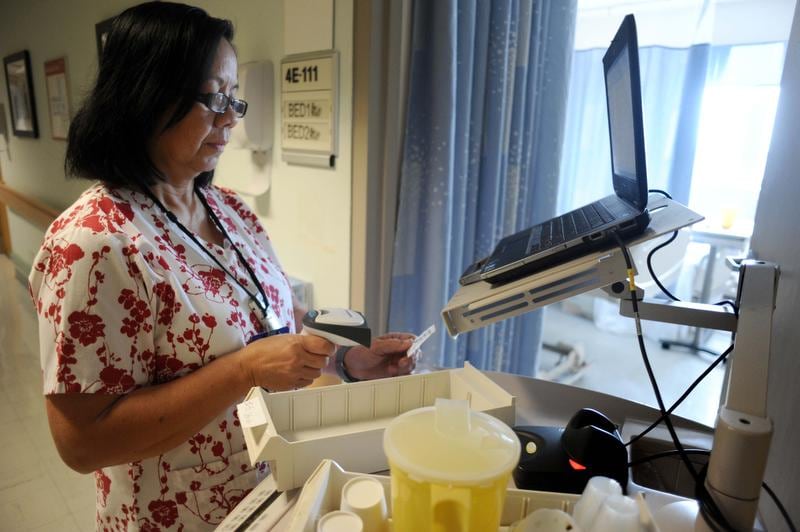
Bar-code medication administration looks like a small technical gesture. A nurse scans a wristband. A scanner reads a package. The screen accepts, warns, or blocks. The deeper intervention is not the barcode itself. It is the moment when a bedside routine becomes a checkable loop: the patient identity, medication, dose, route, scheduled time, active order, and documentation record all have to line up before the pass can move forward.[1][3]
That is why BCMA belongs in health history as a causal mechanism rather than as a gadget story. The system does not make medication error impossible. It does something narrower and more useful: it makes several common error pathways harder to complete silently. A wrong-patient dose, a transcription slip, a missed timing window, or an unrecorded administration has to pass through an extra machine-readable gate. When the gate is designed well and used honestly, it changes the shape of bedside risk.[3][4][5]
Image context: the cover uses a real 2013 VA medication-scanning photograph, republished by Federal Times with a VA credit. It fits this article because BCMA is not merely a label requirement. Its safety value appears in the clinical scene: the scanner must be present, the barcode must read, the workstation must know the current order, and the nurse must still judge what to do with the result.[7]
The mechanism started as nursing workflow, not retail theater
The most useful origin story is practical. VA describes Sue Kinnick's nursing-informatics idea as beginning in the early 1990s, with a prototype at the Colmery-O'Neil VA Medical Center in Topeka and wider VA implementation by 1999.[1] NCBI's implementation case places the first development in 1995 and notes nationwide introduction in 2000 across Veterans Health Administration facilities.[2] That sequence matters because BCMA did not begin as a freestanding consumer technology dropped into medicine. It began as a nursing workflow problem: how to make the medication pass safer at the exact point where the order leaves the chart and enters a body.
The FDA's 2004 bar-code rule then pushed the supply side. AHRQ PSNet's record of the rule says certain human drug and biological product labels had to contain bar codes, with the rule aimed at reducing medication errors by letting health professionals use scanning equipment for necessary verification.[4] That did not by itself create BCMA at the bedside. It made a key input more reliable. If packages cannot be read consistently, the bedside loop breaks before it starts.
The loop itself has more pieces than the public phrase "scan the med" suggests. NCBI's VA implementation chapter describes BCMA as a system using barcode technology plus real-time network connectivity, provider order entry, pharmacist verification, a virtual due list, bedside scanning, and automatic documentation.[2] In plain language: the scanner has to ask a live system whether this patient is supposed to receive this medication now.
The closed loop changes where mistakes can hide
Medication errors often survive because the work is distributed. A prescriber enters an order, a pharmacist verifies or prepares it, a cart is stocked, a nurse retrieves a dose, a wristband identifies a patient, and a medication administration record is updated. Paper systems can make each step look locally reasonable while still allowing a mismatch to travel downstream. BCMA is an attempt to collapse the final handoff into one visible test.
That test has three basic questions. First, is this the intended patient? Second, is this the intended medication and dose? Third, is this administration consistent with the current record, including timing and route? Leapfrog's 2025 fact sheet states the practical workflow clearly: the nurse scans the patient's wristband and then scans the medicine to verify the medication, dose, time, and route, with the electronic medication administration record documenting the event.[6]
The important word is "event." BCMA turns administration into a recorded transaction rather than a memory-supported act that is documented later. That difference is easy to undervalue. In a busy ward, the risk is not only that a nurse reaches for the wrong package. It is also that a correct dose is given but not recorded, a held dose is not explained, a missing dose is worked around informally, or a time pressure turns a near miss into an invisible deviation.[2][5]
What the 2010 evidence proved, and what it did not
The strongest compact evidence still comes from the 2010 New England Journal of Medicine study by Poon and colleagues. The study observed 14,041 medication administrations and reviewed 3,082 order transcriptions in an academic medical center before and after bar-code eMAR implementation.[3] Non-timing medication administration errors fell from 11.5% without bar-code eMAR to 6.8% with it, a 41.4% relative reduction. Potential adverse drug events from those non-timing errors fell from 3.1% to 1.6%, a 50.8% relative reduction.[3]
The transcription result is the cleanest illustration of the mechanism. On units without bar-code eMAR, transcription errors occurred at a 6.1% rate; on units using bar-code eMAR, those transcription errors were eliminated in the reviewed orders.[3] That is not because the barcode made nurses more careful in some vague moral sense. It is because the system removed a fragile manual bridge between physician order and administration record. A live medication-administration record is harder to mistranscribe than a handwritten order copied into another paper layer.
But the same study also sets boundaries. Timing errors fell by 27.3%, yet potential adverse drug events associated with timing errors did not change significantly.[3] The study was single-site, before-and-after, and conducted in an environment that already had other electronic systems. It measured potential harm as judged by reviewers, not only confirmed injury. Those limitations do not erase the result. They define the lane: BCMA is strong at intercepting mismatch and transcription pathways, but it is not a universal medication-safety machine.
The failure mode is the workaround
The best evidence against lazy enthusiasm comes from implementation. NCBI's VA ICU case is valuable because it shows a system that worked nationally but struggled in a high-acuity local environment. The ICU stopped using BCMA eight months after initial implementation in 2000 because of functionality gaps around intravenous fluids, urgent medication documentation, and workflow fit; it reimplemented the system in 2002 after enhancements, while keeping dual paper documentation for a transition period.[2]
That story is not an indictment of BCMA. It is a warning about the actual mechanism. If the barcode does not scan, the formulary mapping is wrong, the software cannot handle urgent one-time doses, or nurses have to maintain duplicate records, the system quietly teaches people to route around it.[2] A safety technology can become a safety theater if its official path is slower, less accurate, or less clinically usable than the workaround.
More recent observational work makes the same point in contemporary language. AHRQ PSNet's summary of Mulac and colleagues' 2021 mixed-methods study says researchers observed nurses and identified task-related, organizational, technological, environmental, and nurse-related BCMA policy deviations.[5] The categories are the lesson. Workarounds are not merely individual bad behavior. They are often symptoms of carts, labels, software, staffing, room layout, alert design, scanner reliability, and local norms not matching the work.
That is why Leapfrog's standard does not stop at "have BCMA." Its 2025 fact sheet points to implementation across key units, both patient and medication scans in 95% of bedside administrations in implemented units, decision support elements, and anti-workaround processes.[6] The threshold is useful because it recognizes the real problem: a hospital can buy the scanner and still fail to make scanning the ordinary, low-friction path.
The scanner cannot own clinical judgment
BCMA is strongest when it is treated as a hard stop for identity and order mismatch, not as a replacement for clinical reasoning. A scanner can say that a package matches an active order. It cannot know by itself that the patient's condition changed five minutes ago, that a drug should be held after a new lab result, that a route is clinically inappropriate in this moment, or that an order itself was wrong upstream.
This boundary is not a weakness. It is the design contract. The machine is good at fast comparison across structured records. The clinician is responsible for context, assessment, escalation, and judgment when the structured record and the patient do not tell the same story. A mature BCMA program makes that division explicit: scan the wristband and medication every time, respond to alerts without ritual dismissal, but keep the nurse's clinical attention on the patient rather than on satisfying the computer.
The opposite failure is also common: treating every alert as equal. If a system fires noisy warnings for low-risk timing issues but is clumsy at high-risk mismatches, staff learn to discount it. If a late administration demands more documentation than a dangerous near miss, the workflow pushes attention toward compliance optics. BCMA works best when the alert burden matches actual risk and when reporting scan failures leads to label, formulary, hardware, or software repair.[2][5][6]
What changed
BCMA changed medication administration by making the bedside less private to error. The medication pass used to depend heavily on memory, handwriting, local familiarity, and after-the-fact charting. The bar-code loop turned part of that work into a real-time query: does this patient, this medication, this dose, this route, and this time match the active record?
That query is not glamorous. It is repetitive by design. Its value comes from forcing a pause at exactly the point where routine is most dangerous: familiar drugs, familiar rooms, familiar patients, crowded schedules, and a sense that the next pass is ordinary. BCMA succeeds when the wristband becomes a hard stop in that ordinary flow.
The practical lesson is therefore modest and demanding. Do not worship the scanner. Do not bypass it. Build the surrounding system so the safest path is also the easiest path to follow: readable medication labels, reliable wristbands, live orders, responsive pharmacy mapping, usable carts, sensible alerting, and a culture that treats scan failures as system data rather than as a nurse's nuisance. The barcode is only a stripe. The safety intervention is the closed loop that keeps asking, at the bedside, whether the story still matches the patient.[1][2][3][5][6]
Sources
- U.S. Department of Veterans Affairs, "VA nurse's idea: bar code scanning to support patient care" (2020) - official VA history of Sue Kinnick's nursing-informatics idea, Topeka prototype, VA-wide implementation, and reported dispensing-error reduction.
- Patterson ES et al., "Barcode Medication Administration: Lessons Learned from an Intensive Care Unit Implementation," Advances in Patient Safety, NCBI Bookshelf - VA implementation history, bedside workflow, five-rights logic, ICU rollout failure, reimplementation, scan failures, and workaround risks.
- Poon EG et al., "Effect of bar-code technology on the safety of medication administration," Johns Hopkins research record for the 2010 New England Journal of Medicine study - observed administrations, transcription reviews, error-rate reductions, and evidence boundaries.
- AHRQ PSNet, "Bar code label requirement for human drug products and biological products" - record of the FDA's 2004 Federal Register rule requiring bar codes on certain human drug and biological product labels, with the medication-error reduction rationale and April 26, 2004 effective date.
- AHRQ PSNet, "Barcode medication administration technology use in hospital practice: a mixed-methods observational study of policy deviations" - summary of Mulac et al. 2021 on BCMA deviations, unintended consequences, and implementation strategies.
- The Leapfrog Group, "Factsheet: Bar Code Medication Administration" (last revised April 1, 2025) - current purchaser-facing BCMA definition, five-rights workflow, adoption standard, scan threshold, decision support, workaround controls, and implementation costs.
- Federal Times, "VA hopes to convince tech workers that public service matters" (2024) - source page and caption for the VA photograph of a nurse scanning medication at the Washington D.C. VA Medical Center on June 29, 2013.