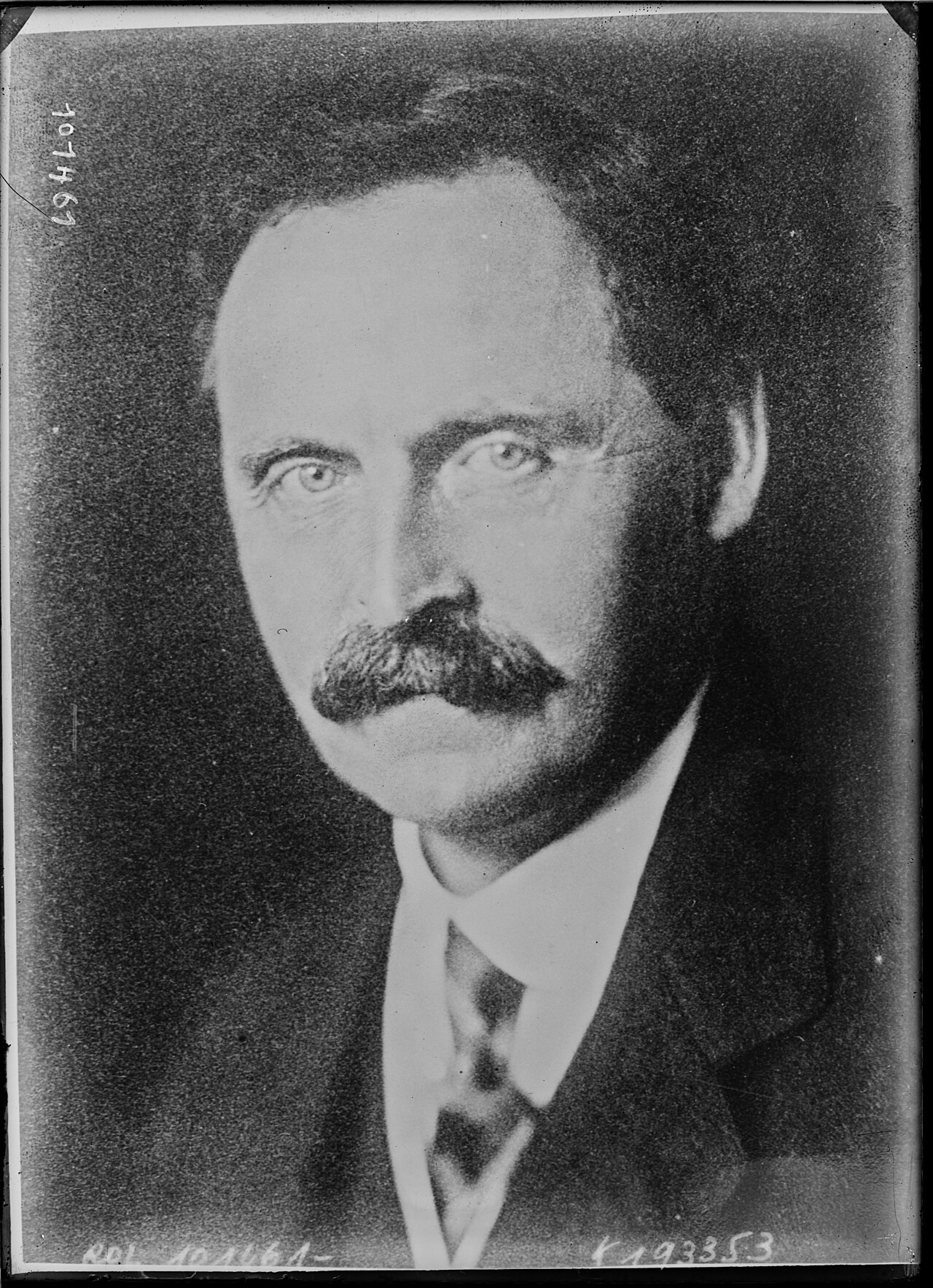
The portrait isolates one physician against a dark backdrop. The report named for him tried to solve the opposite problem: medicine conducted as a collection of isolated desks, surgeries, hospitals, clinics, and public offices.
In May 1920, the Consultative Council on Medical and Allied Services, chaired by Lord Dawson of Penn, delivered an interim report to the new Ministry of Health for England and Wales. Its most famous legacy is a pair of labels—primary and secondary health centres—that now sound almost inevitable. Read in full, however, the document is not mainly a naming exercise or a plan for impressive new buildings. It is a theory of movement.[1]
The journey begins at home. A doctor, nurse, midwife, dentist, pharmacist, or health visitor connects the household to a GP-led primary centre. Difficult cases travel onward to a specialist secondary centre and, when necessary, a teaching hospital. Consultants also travel outward. Records and clinical learning flow back. Patients return toward home after the acute stage of illness. An ambulance holds the geography together.[1]
That reciprocal movement is the report's sharpest idea. The familiar tier diagram can make Dawson's system look like a ladder, with prestige accumulating at the top. The prose describes something more demanding: a network is integrated only when expertise, responsibility, information, and patients can make the return trip.
Five dates place the document in its proper gap
- October 1919: Health Minister Christopher Addison asked the new council for a scheme to provide medical and allied services systematically within a defined area.[1]
- May 1920: the interim report appeared, after the council said the urgency of reconstruction made it unwise to wait for a final answer.[1]
- 12 June 1920: the British Medical Journal published a contemporaneous account of Dawson presenting the council's proposals.[2]
- 6 November 1946: the National Health Service Act received royal assent for England and Wales. Section 21 assigned local health authorities a duty to provide health centres, but the act did not reproduce Dawson's proposed single area authority.[4]
- 5 July 1948: the NHS began in England and Wales. Care was now available to all and generally free at the point of use, yet hospitals, general practice, and local-authority community services entered the service through separate administrative channels.[5]
The twenty-eight years between report and service tempt a simple origin story: Dawson drew the blueprint, then the NHS built it. The resemblance is real. The differences are more revealing.
The diagnosis was organisational
The report opens with a problem created by medical success. Appendicitis, it notes, had moved from poultices and drugs in the home to an operation requiring equipment and a team. Lung disease might now call for a pathologist and radiologist as well as a bedside examination. Knowledge had made care more effective, more specialized, and more expensive—but the machinery for distributing that knowledge had not kept pace.[1]
This is a subtle reversal. Specialization itself is not treated as fragmentation. The failure occurs when specialized capacity cannot be reached, shared, or returned to ordinary care. In the council's logic, a new machine in a city hospital improves population health only if there is a route by which a patient can reach it and a route by which the result can re-enter continuing care.
The proposed remedy was therefore geographical as well as professional. Services should be distributed according to community need, adapted to local conditions, and surveyed against population and transport. The report's worked example was not an imaginary circular city. It used Gloucestershire: an area roughly 30 miles north to south and 24 miles east to west, divided by the Severn, containing industrial towns, mining districts, and sparsely populated countryside. Primary centres of different sizes would feed a secondary centre in Gloucester, which would connect to the teaching hospital in Bristol.[1]
Historian Martin Gorsky's reconstruction shows why that example mattered. Gloucestershire was already experimenting with links among GPs, tax-funded public-health services, and voluntary hospitals. Its out-stations and referral arrangements offered evidence that coordination could be built locally. They also exposed the limit of voluntary agreement: institutions with different revenues, governing bodies, and professional interests could cooperate without becoming one durable system.[3]
“Primary” meant first relationship, not thin care
Dawson's system begins explicitly with domiciliary service: doctor, dentist, pharmacist, nurse, midwife, and health visitor. The home is called the periphery, but it is also the first element. A primary centre supports that local relationship rather than automatically replacing it.[1]
The proposed centre was far more substantial than a modern image of a small consultation suite. Depending on local need, it could contain inpatient and maternity beds, an operating room, radiography, a simple laboratory, a dispensary, dental services, rehabilitation equipment, and rooms for antenatal care, child welfare, tuberculosis assessment, and occupational health. Smaller centres would omit some facilities and draw support from better-equipped neighbours.[1]
The defining feature was not the equipment list. General practitioners would staff the centre, retain continuing responsibility for their patients, work with nurses and visiting specialists, and participate in both individual treatment and communal prevention. Separate public-health and curative services were to be brought into one organisation. The proposal even placed a common room beside standardized clinical records, because the council understood professional isolation as a quality problem.[1]
That room explains the model better than the grander architectural plans. Dawson imagined what he called “intellectual traffic”: local doctors comparing cases, meeting consultants, pursuing postgraduate study, and following what happened after referral.[1] The centre was meant to increase the reach of expertise without dissolving the relationship closest to the patient.
The ladder had to carry people both ways
A group of primary centres would connect to a town-based secondary centre with consultants, specialist departments, laboratories, outpatient clinics, and beds. Secondary centres would in turn relate to a teaching hospital and medical school. Certain services—tuberculosis, infectious disease, mental illness, epilepsy, and orthopaedics among them—might operate across a wider area.[1]
If the report stopped there, it would be a conventional hierarchy. It does not. Consultants were expected to hold clinics at the secondary centre, visit primary centres periodically, and sometimes go to a patient's home. GPs were to stay in touch with patients receiving specialist treatment and resume supervision after discharge. Less complex cases would remain at, or return to, primary centres so the specialist institution did not become the default destination for every need.[1]
The ambulance service is equally easy to underestimate. In the report it is not merely an emergency vehicle stationed beside a building. It maintains communication between homes, primary centres, and secondary centres; in sparsely populated places, motor transport might become a travelling clinic. Transport turns an organizational chart into a service area.[1]
Records were also supposed to circulate. Teaching hospitals would help direct record systems within their regions so that accumulated observations produced useful knowledge rather than dead statistics. The report wanted “complete and reciprocal communication” among the home service, primary and secondary centres, and teaching hospitals.[1] My reading of the document rests on those reciprocal verbs—refer, visit, follow, receive, resume—rather than on the tiers alone.
The machinery was detailed; the settlement was incomplete
The word available does crucial boundary work in the report. Services were to be open to every class, but the council immediately said that availability did not mean free treatment. It set aside the overall payment question, then returned with a majority recommendation for standard charges in public wards and for other curative services, usually met through insurance. Some council members instead wanted curative care free to the patient.[1]
The professional settlement was just as cautious. Patients would retain freedom to choose a doctor. Most GPs would continue working from their own surgeries as well as centres. The majority rejected a wholly salaried state medical service; consultants could hold part-time public posts while maintaining private practice. These provisions were not minor administrative blanks. They were attempts to gain coordination without breaking the professional and financial arrangements from which the fragmented service had grown.[1]
Governance was more concrete than the word coordination suggests. Each area would have one health authority. Three fifths of its members would be elected; the other two fifths would bring specialist knowledge, with medical representatives forming a majority of that group. A medical advisory council of roughly ten to twenty locally elected doctors would nominate representatives and advise the authority. Beneath a principal medical officer, two chief assistants would divide oversight of curative and preventive services.[1]
The report left one constitutional fork open: whether that authority should be a statutory committee of an existing local authority or a new, independent body created for health alone. The gap between design and settlement is precise, not total. Dawson specified a preferred employment pattern and much of the governing machinery, while stopping short of a comprehensive financing mechanism and the authority's exact legal form.[1]
That precision sharpens the comparison with 1948. The NHS in England and Wales delivered universal entitlement and generally free access, which the 1920 report had not promised. The 1946 act also authorized local authorities to provide health centres.[4] But hospitals, family doctors, and local-authority community services opened under separate administrations rather than Dawson's single area authority.[5] Calling the report a blueprint is therefore true only at one scale: it supplied a durable spatial vocabulary and a logic of referral, not the founding service's financial or administrative settlement.
A building can gather services without integrating them
The first NHS years made the distinction visible. Six months before launch, the Ministry judged widespread health-centre construction premature because building conditions were difficult and the best model was uncertain. GP suspicion tied health centres to fears of state employment. Two purpose-built centres opened in 1952; only 17 opened during the NHS's first fifteen years.[5]
Expansion eventually came. By 1977, England had 731 health centres housing about 3,800 GPs, roughly one fifth of the GP workforce. Yet a King's Fund review found that these buildings generally brought GP and community services under one roof without achieving Dawson's broader primary–secondary integration.[6]
That is the report's most useful test of its own afterlife. Co-location is a fact about rooms. Integration is a fact about work: who can refer, who visits, who keeps responsibility, whether a result returns, whether records can be used across boundaries, and whether transport makes the service reachable. A centre may improve premises and still leave the patient's journey to bridge the institutions.
The report also deserves distance, not reverence. Its language belongs to an era of paternal administration and “physical culture.” It says little about patients as participants in governance. Its faith in orderly professional coordination understates conflicts over money, status, local authority, and who controls scarce beds. The Gloucestershire experiment and the NHS's slow health-centre rollout show that those conflicts were not details waiting to be drawn in later.[3][5]
Even the name compresses a collective document into one eminent man. Dawson chaired a council of twenty whose members included physician and epidemiologist Janet Lane-Claypon and surgeon Mary H. F. Ivens.[1] The solitary portrait is useful partly because the contrast is so plain: the text beneath Dawson's name argues that no solitary practitioner, profession, or institution can deliver modern medicine alone.[7]
The report's enduring question is not whether today's facilities resemble its floor plans. It is whether the system completes the return journey. A patient reaches specialist knowledge; the local team remains connected; information comes back; recovery continues nearer home; patterns observed in many cases improve the next decision. In 1920, Dawson's council understood that access to medicine was becoming a problem of relationships as much as supply. The health centre was only the place where those relationships might finally meet.
Sources
- Ministry of Health, Interim Report on the Future Provision of Medical and Allied Services (Cmd. 693, May 1920), transcribed by the Socialist Health Association and preserved by the Nuffield Trust — full primary text, membership, service model, payment proposals, Gloucestershire example, and architectural appendix.
- British Medical Journal, “Future Provision of Medical Services: Lord Dawson on the Consultative Council's Report” (12 June 1920) — contemporaneous published account of Dawson's presentation of the council's proposals.
- Martin Gorsky, “The Gloucestershire Extension of Medical Services Scheme: An Experiment in the Integration of Health Services in Britain before the NHS,” Medical History 50 (2006) — archival reconstruction of the local scheme used in Dawson's report and the mixed-economy barriers to durable integration.
- UK Parliament, National Health Service Act 1946 (9 & 10 Geo. 6, c. 81), enacted text — statutory structure and section 21 duty concerning local-authority health centres.
- Geoffrey Rivett, “1948–1957: Establishing the National Health Service,” Nuffield Trust — the early tripartite service, health-centre responsibility, construction pause, and first-fifteen-year rollout.
- Candace Imison, Chris Naylor, and Jo Maybin, Under One Roof: Will Polyclinics Deliver Integrated Care? The King's Fund, 2008 — assessment of Dawson's afterlife and the difference between later health-centre expansion and primary–secondary integration.
- Bibliothèque nationale de France/Agence Rol, “Lord Dawson de Penn” (June 1925 press photograph), via Wikimedia Commons — provenance page for the article's archival portrait.