DASH is easy to misremember because the name now sounds like a diet brand. Read the original trial more closely and the stronger point is less glamorous: the Dietary Approaches to Stop Hypertension trial made food behave like an intervention by controlling the meals, stabilizing weight, measuring blood pressure repeatedly, and testing a pattern rather than a single nutrient.[1][2]
That matters because nutrition claims often blur into advice before they become evidence. Eat more vegetables, eat less fat, watch salt, lose weight, move more: each can be reasonable, but stacked together they make it hard to know what changed the blood pressure number. DASH narrowed the question. In 459 adults with systolic blood pressure below 160 mm Hg and diastolic pressure between 80 and 95 mm Hg, the investigators compared three diets after a run-in period: a control diet, a fruit-and-vegetable diet, and a combination diet rich in fruits, vegetables, and low-fat dairy with less saturated and total fat.[1][2]
The close-reading lesson is that DASH was not merely "healthy eating works." It was "a food pattern can be tested if the delivery system is disciplined enough." The original result - lower blood pressure after 8 weeks on the combination diet - sits inside that design. Without the controlled-feeding frame, the same foods would have been an anecdote. Inside it, they became a measurable treatment signal.[1][2]
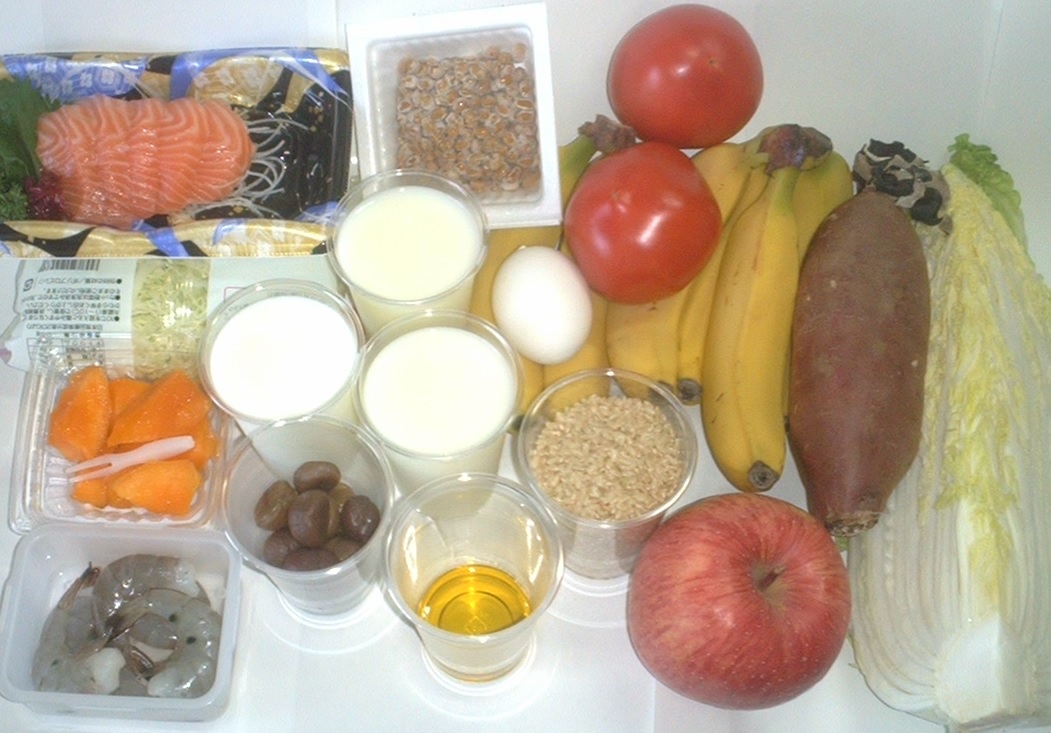
Image context: the cover photograph shows real foods commonly associated with DASH: produce, low-fat dairy, fish, nuts, grains, and vegetable oil. It is a photographic food pattern rather than a chart because the article is about the practical conversion of meals into controlled clinical evidence.[6]
Timeline anchors
- 1993: DASH began as a multicenter controlled-feeding trial designed to test dietary patterns rather than isolated nutrients.[2]
- 1997: the main DASH results were published, reporting blood-pressure reductions from the combination diet after an 8-week intervention.[1]
- 2001: DASH-Sodium extended the question by assigning 412 participants to DASH or control diets and feeding each group three sodium levels for 30 days each.[3][4]
- 2026: NHLBI still presents DASH as a flexible eating plan built around food-group targets, including 4-5 daily servings each of vegetables and fruit for a 2,000-calorie pattern and a sodium target of 2,300 mg, with 1,500 mg lowering blood pressure further for many people.[5]
The title is about approaches, not one ingredient
The first word to notice is plural: approaches. DASH was designed at a moment when blood pressure was already linked to weight, sodium, potassium, calcium, alcohol, and broader diet quality. The trial could have isolated one mineral or one forbidden food. Instead, it asked whether a plausible whole pattern could move blood pressure while calories were held steady.[1][2]
That design choice changes the interpretation. If weight loss had been allowed to drive the result, DASH would have been another weight-loss story. If pills had been mixed into the protocol, it would have been a medication-titration story. If participants had been left entirely on their own, it would have been a behavior-adherence story. The trial instead treated food supply, menu composition, and weight stability as part of the intervention's infrastructure.[1][2]
This is why the result traveled. The combination diet did not ask clinicians to believe in a mysterious superfood. It described a pattern: more fruits and vegetables, low-fat dairy, fish and poultry, nuts and legumes, less saturated fat, and a lower-fat profile than the average control pattern. NHLBI's current public guidance still reflects that translation from trial menu to food-group goals rather than to a branded product or supplement.[5]
The blood-pressure signal was clinically legible because the experiment was narrow
The main DASH trial enrolled adults whose blood pressure was elevated enough to matter but not so severe that the experiment became a medication-withholding problem. BioLINCC summarizes the entry range as systolic below 160 mm Hg and diastolic 80 to 95 mm Hg.[2] That boundary is not trivia. It defines what kind of claim DASH can support: prevention and early treatment leverage, not a replacement for urgent hypertension care.
Within that boundary, the combination diet produced a blood-pressure reduction that was large enough to be clinically readable. The original report is often summarized as showing that a diet rich in fruits, vegetables, and low-fat dairy, and reduced in saturated and total fat, substantially lowered blood pressure.[1] Subgroup analyses made the point sharper: effects were larger among participants with hypertension than among those without hypertension, which fits the broader clinical pattern that higher starting pressure often gives an intervention more room to move.
The most important caution is the same as the most important strength. DASH showed what happened when food was provided and the protocol was closely managed. It did not prove that every person handed a pamphlet would reproduce the same effect in a free-living kitchen. That is not a flaw in the trial. It is the boundary that keeps the evidence honest. The trial establishes biological and dietary plausibility under controlled conditions; implementation has to solve shopping, cooking, cost, taste, family routines, food access, medication plans, and follow-up measurement.[1][2][5]
DASH-Sodium separated the pattern from the salt dial
DASH-Sodium is the necessary second reading because it prevents a common simplification. If blood pressure falls on DASH, is the diet doing something beyond sodium reduction? If sodium falls, does the rest of the pattern still matter? The 2001 trial made those questions testable by assigning participants to either a control diet or DASH, then cycling them through high, intermediate, and low sodium levels for 30 consecutive days each.[3][4]
The sodium targets are the key architecture. BioLINCC describes the study as comparing two dietary patterns at three sodium levels: a higher level comparable to usual U.S. intake, an intermediate level reflecting recommended limits, and a lower level expected to reduce blood pressure further.[4] The NEJM abstract reports the same basic conclusion: lowering sodium and eating the DASH diet both reduced blood pressure, and the combination produced greater effects than either move alone.[3]
That result is more useful than a slogan about salt. It says the sodium dial and the dietary-pattern dial are related but not identical. A high-sodium DASH pattern is not the same as a low-sodium control pattern; a low-sodium DASH pattern tests the combined strategy. For clinical advice, that means DASH should not be reduced to "just eat less salt," and sodium advice should not be hidden inside vague "eat clean" language.[3][4][5]
The strongest claim is practical, not miraculous
DASH became durable because it made a middle claim. It did not say food replaces antihypertensive medication in every patient. It did not say one mineral explains hypertension. It did not depend on weight loss to look useful. Its claim was that a repeatable eating pattern can lower blood pressure enough to matter, especially when sodium is also reduced, and that the effect can be measured in weeks under controlled feeding.[1][3]
That middle claim is exactly why DASH remains useful in ordinary care. It gives clinicians and patients a non-drug lever that can coexist with medication, home blood-pressure monitoring, sleep apnea treatment, alcohol reduction, exercise, and kidney-risk management. It also gives public-health programs a food-group language instead of a supplement language: vegetables, fruit, low-fat dairy, whole grains, legumes, nuts, fish, poultry, oils, sweets limits, and sodium limits.[5]
The implementation trap is to treat DASH as a list of virtuous foods rather than as a pattern with constraints. The trial logic depends on substitution. Adding fruit to a high-sodium, high-saturated-fat, calorie-surplus diet is not the same intervention. Pouring olive oil over an otherwise unchanged menu is not the same intervention. Swapping in low-fat dairy while restaurant sodium stays high is only part of the intervention. DASH asks for a meal architecture, not a garnish.[1][3][5]
What the primary sources still teach
Read together, DASH and DASH-Sodium teach three durable lessons about evidence. First, diet can be tested seriously when the study controls what people actually eat. Second, food patterns matter because people eat meals, not isolated nutrients. Third, sodium remains a separate, measurable pressure lever even inside a healthier pattern.[1][3][4]
The modern public version of DASH is necessarily looser than the feeding trials. Nobody lives inside a metabolic kitchen forever. But the looseness should not erase the original discipline. The reason DASH is more than a wellness slogan is that the original investigators made diet boring enough to test: defined menus, defined blood-pressure eligibility, defined sodium levels, defined intervention periods, and defined outcomes.[1][2][3][4]
That is the best way to use the name now. DASH is not a promise that one shopping trip will normalize blood pressure. It is evidence that the structure of meals can move a cardiovascular risk factor when the pattern is real enough, sustained enough, and measured carefully enough to be more than intention.[1][3][5]
Sources
- DASH Collaborative Research Group, "A clinical trial of the effects of dietary patterns on blood pressure" (New England Journal of Medicine, 1997; PubMed record).
- NHLBI BioLINCC, "Dietary Approaches to Stop Hypertension (DASH)" - study record for the original controlled-feeding trial, including enrollment and design summary.
- DASH-Sodium Collaborative Research Group, "Effects on blood pressure of reduced dietary sodium and the Dietary Approaches to Stop Hypertension (DASH) diet" (New England Journal of Medicine, 2001; PubMed record).
- NHLBI BioLINCC, "Dietary Approaches to Stop Hypertension - Sodium Study (DASH-Sodium)" - study record for the two-pattern, three-sodium-level feeding design.
- National Heart, Lung, and Blood Institute, "DASH Eating Plan" - current public guidance translating DASH into food-group and sodium targets.
- Wikimedia Commons, "File:DASH01.jpg" - photographic source page for the cover image.