April 1955 is usually remembered as a clean triumph: Salk's field trial worked, the country exhaled, parents lined up children for shots. The Cutter incident makes the more useful memory harder. In less than a month, the first mass polio-vaccination program in the United States moved from national release to emergency suspension because some supposedly inactivated vaccine still carried live virus. The event matters not because it disproved vaccination, but because it showed that vaccine efficacy and vaccine manufacturability are different questions, and the second one can break public trust on the same calendar as the first.[4][5]
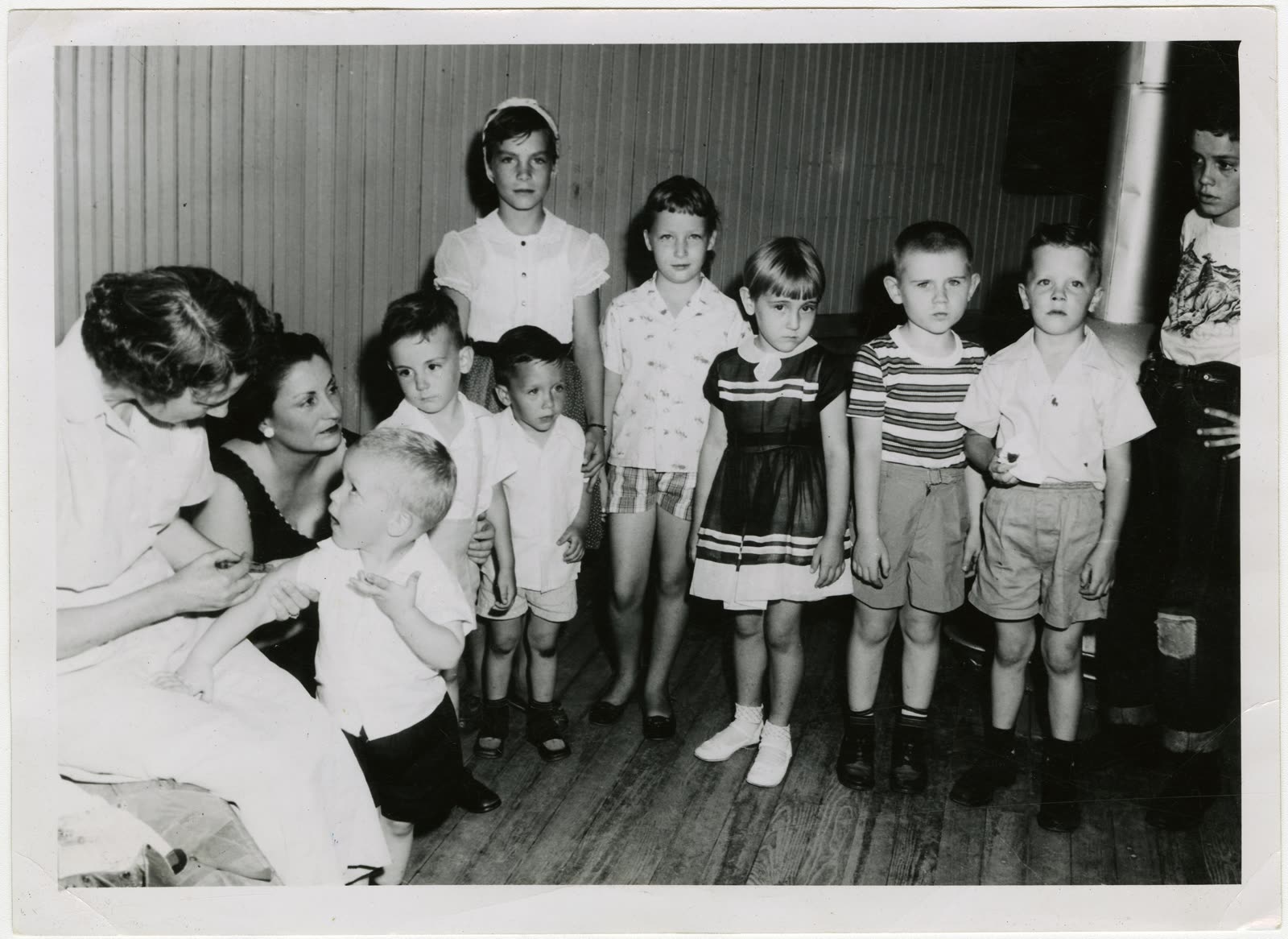
Lead image: a 1956 Mississippi polio-vaccination photograph. It fits this reconstruction because the campaign did resume after the rupture, but only after the safety architecture around release, inspection, and lot confidence was tightened.[6]
Timeline anchors: how the rollout broke
- April 12, 1955: after a field trial involving 1.8 million children, Salk's inactivated polio vaccine is declared safe and effective, and rollout accelerates.[4]
- By May 2, 1955: CDC surveillance has already accepted 29 post-vaccination polio cases, 26 of them linked to Cutter-made vaccine.[2]
- May 7, 1955: the U.S. Surgeon General recommends suspending all polio vaccinations while plants and testing procedures are re-inspected.[4]
- Fall 1955: after stronger oversight and revised controls, vaccinations resume.[1]
- December 1955: CDC surveillance is again comparing vaccinated and unvaccinated attack rates rather than treating vaccination itself as the immediate emergency question.[3]
1) The first problem was scale, not only contamination
The April 12 announcement created a national speed problem. FDA's historical account emphasizes the size of the field trial, 1.8 million children, and the urgency surrounding polio in the early 1950s.[4] That scale mattered because once the vaccine was licensed, manufacturing and release moved from controlled trial conditions to industrial throughput. The public heard one sentence, "safe and effective"; institutions had to answer a different one: whether every producer could make a killed-virus vaccine that remained fully inactivated at volume.
Later historical review makes the mismatch stark. Michael Fitzpatrick's summary of Offit's account reports that in April 1955 more than 200,000 children in five Western and Midwestern states received vaccine in which the inactivation process had failed.[5] That number is not just epidemiologic background. It explains why the incident was immediately national in meaning even though the defective product came from one company. A failure at this step was never going to look local.
2) The signal surfaced through cluster recognition, not full certainty
The May 2 CDC surveillance report reads like a system trying to distinguish rumor from pattern in real time. It warns that the data are preliminary, then records 29 accepted cases in vaccinated children, 27 paralytic and 2 non-paralytic; 26 had received Cutter vaccine and the cases were already spread across 5 states.[2] That is the key reconstruction point. Authorities did not wait for a perfectly settled causal paper. They saw a geographically distributed cluster, a manufacturer concentration, and repeated correlation between inoculation and first paralysis in some new cases.[2]
This is one reason the Cutter incident still matters for health governance. In high-consequence rollout settings, the practical threshold for intervention arrives before the academic threshold for closure. A surveillance system earns its value by finding the pattern early enough that action can still change the curve.
3) Why one manufacturer's failure became a national stop
The most tempting interpretation is the narrowest one: Cutter made bad vaccine, therefore Cutter was the problem. There is truth in that. The peer-reviewed historical summary notes that three larger companies produced safe polio vaccine under Salk's protocol, while Cutter's lack of experience and expertise proved disastrous.[5] FDA's retrospective likewise states that two batches of Cutter vaccine were found to contain live poliovirus and that more than 260 people contracted polio from vaccine produced by Cutter Labs.[4]
But stopping at the company line misses the institutional logic of what followed. The Surgeon General did not suspend only Cutter's product on May 7; he recommended pausing all polio vaccinations until each manufacturing facility had been inspected and each safety-testing procedure reviewed.[4] That move shows what federal officials had inferred: even if the detected harm concentrated at one manufacturer, public trust in a killed-virus campaign could not survive piecemeal reassurance without a system-wide recheck. The failure exposed a release-governance problem, not only a bad lot.
4) The damage was severe, but it was not an argument to abandon vaccination
The Cutter incident is often retold as if it nearly ended polio vaccination altogether. The historical record supports a narrower and more interesting reading. Fitzpatrick's summary reports the eventual human cost in blunt terms: about 40,000 cases of polio, 200 children left with varying degrees of paralysis, and 10 deaths from the defective vaccine episode.[5] CDC's modern retrospective compresses the same episode into "over 250 cases of polio" attributed to Cutter-produced vaccine and stresses that recall followed as soon as cases were detected.[1]
Those numbers explain why the stop was unavoidable. They do not prove that the underlying vaccination strategy had failed. By December 1955, CDC's surveillance reporting had shifted toward comparative disease burden. In preliminary Illinois data for children aged 5 to 9, attack rates were 21.6 per 100,000 among the vaccinated versus 37.4 per 100,000 among the unvaccinated.[3] That is not a final causal verdict on its own; the report explicitly warns against over-reading uncontrolled surveillance.[3] But it does show why public-health authorities returned to vaccination instead of abandoning the field. Once manufacturing controls tightened, the disease risk from no vaccination still remained large enough to dominate the policy problem.
5) What the incident changed in operating terms
CDC's retrospective says the Cutter incident "led to the creation of a better system of regulating vaccines."[1] FDA's historical account is more operational: vaccination resumed only after inspection of every manufacturing facility and review of safety-testing procedures had been completed.[4] Put together, the sources support a precise inference. The post-Cutter fix was not a generic promise to "be more careful." It was a shift toward release discipline at the level of plant, process, and lot.
That matters because inactivated vaccines have a peculiar trust problem. A patient or clinician cannot inspect viral inactivation by sight. Confidence therefore has to be manufactured institutionally, through validated process, lot testing, documented release criteria, and the ability of regulators to stop distribution fast when cluster surveillance signals break against expectation.
This is the durable policy yield of the incident. The event linked three functions that are often discussed separately:
- surveillance, which recognized the early cluster;
- regulatory authority, which halted the program and forced reinspection;
- manufacturing control, which had to become demonstrably reliable before vaccination could resume.
The essay's strongest claim is an inference from that chain: the Cutter incident helped establish modern biologics oversight as a release-confidence system, not just a licensing formality.[1][4]
6) Two interpretations, and what would change the assessment
Interpretation A: Cutter was an isolated industrial failure inside an otherwise sound rollout
This view points to the fact that other manufacturers produced safe vaccine under the same basic Salk framework and that vaccination resumed within the same year.[1][4][5] On this reading, the right lesson is tighter screening of weak manufacturers, not a broader reinterpretation of rollout governance.
Interpretation B: Cutter revealed a systems failure in the bridge from trial success to mass manufacture
This view is better supported by the actual federal response. A national pause, whole-plant inspection, and revised safety review imply that authorities saw the vulnerability in the handoff from scientific success to industrial reproducibility.[4] The public-health lesson is therefore broader: a field trial can validate a biological idea without fully validating every manufacturing pathway that will carry it into mass use.
What would change this assessment? Evidence showing that Cutter's defect could have been reliably contained without a system-wide pause would strengthen Interpretation A. The historical sequence we have instead points the other way: once the cluster appeared, national confidence required system-level repair.
Why this reconstruction still matters
The Cutter incident remains one of the clearest demonstrations that successful public health depends on two different forms of proof. One is proof that a vaccine works. The other is proof that every released lot reliably matches the biological promise the trial established. In April and May 1955, the United States learned that confusing those proofs can turn a triumph into a trust rupture almost overnight. The reason the program survived was not denial of the failure. It was visible redesign.
Sources
- Centers for Disease Control and Prevention, "Historical Vaccine Safety Concerns" (Cutter incident summary, recall, and fall 1955 resumption).
- Communicable Disease Center, Poliomyelitis Surveillance Report Number 2 (May 2, 1955; accepted cases in vaccinated children and manufacturer clustering).
- Communicable Disease Center, Poliomyelitis Surveillance Report (December 9, 1955; cumulative accepted cases and preliminary vaccinated vs unvaccinated Illinois attack rates).
- U.S. Food and Drug Administration, Science and the Regulation of Biological Products from a 200 Year Perspective (1.8 million-child trial, Cutter live-virus batches, and May 7 suspension).
- Michael Fitzpatrick, "The Cutter Incident: How America's First Polio Vaccine Led to a Growing Vaccine Crisis" (Journal of the Royal Society of Medicine, PMC review of Offit's history).
- Wikimedia Commons, "File: Polio vaccine, 1956 (16635529011).jpg" (Mississippi Department of Archives and History photograph used for the article image).