
CDC's 44-second contact lens video works because it treats lens safety as a routine, not as a lecture. The clip is built around a simple promise: contact lenses can be comfortable and useful, but only if the wearer keeps germs, water, and old solution out of the handling chain.[1][2] That is a public-health message aimed at bathrooms, dorm rooms, gym bags, travel sinks, and late nights, not at an exam room alone.
The reason this is worth annotating is that contact lenses occupy an awkward category. They feel like consumer products because people buy boxes, cases, and solution; they feel like beauty or convenience products because they disappear into daily life; but they are medical devices worn directly on the eye.[3] The CDC video tries to close that gap. It does not make contact lens care look dramatic. It makes the right steps look normal enough to repeat.
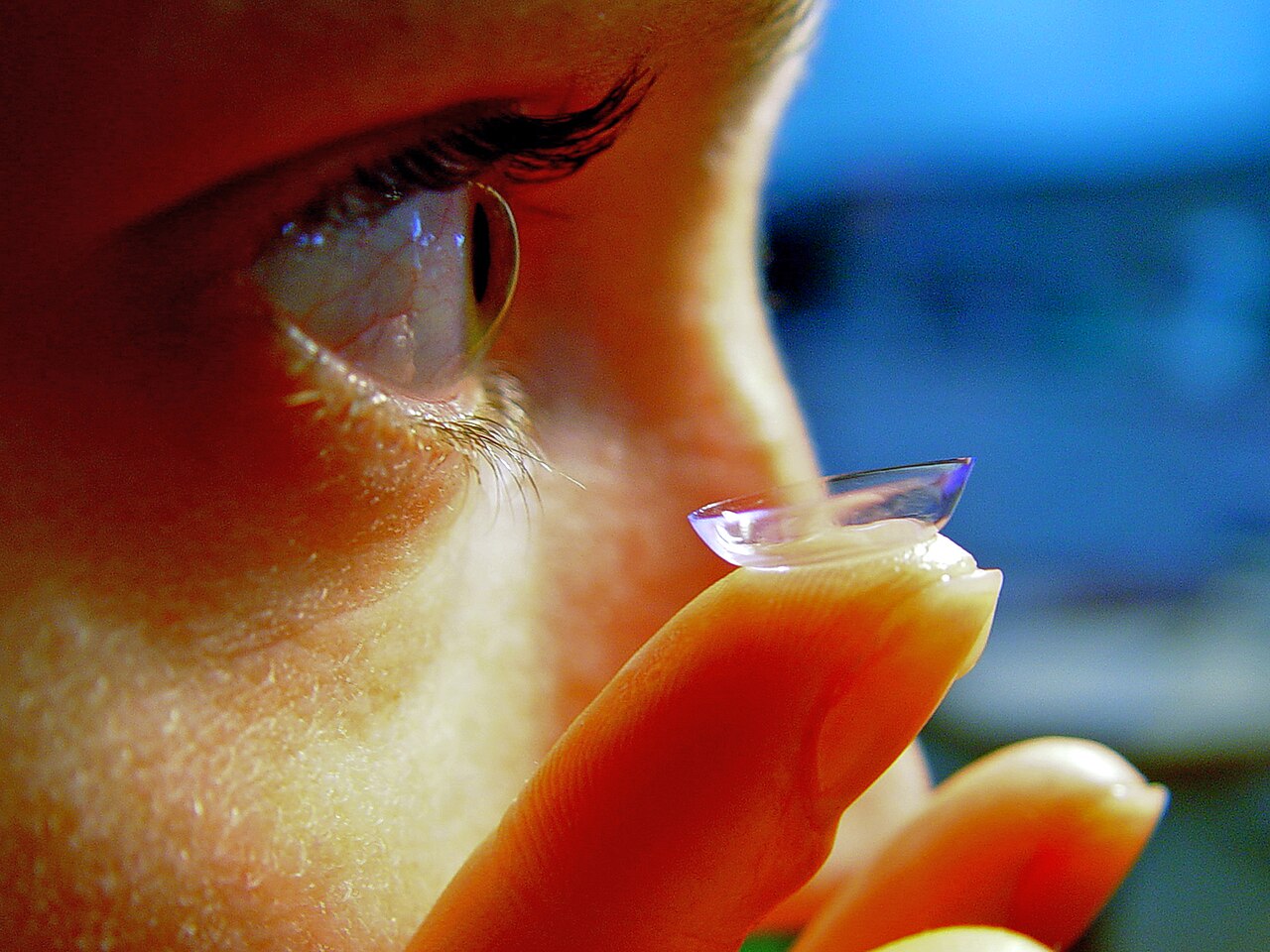
Image context: the cover photograph is a Wikimedia Commons photograph of a person holding a contact lens on a fingertip before insertion. It is a real photograph, not a diagram or generated visual, and it belongs here because the article is about the ordinary handling moment where clean hands, lens condition, and water avoidance all converge.[7]
The short makes hygiene physical
The first useful thing about the video is its scale. It does not ask the viewer to learn a disease taxonomy before touching a lens. Instead, it organizes prevention around reachable objects: hands, lenses, solution, a case, and an eye. That matters because CDC's current overview frames contact lenses as safe and effective for vision correction when they are worn and cared for properly, while warning that poor wear, cleaning, and storage can raise the risk of microbial keratitis and other eye infections.[3]
The phrase "healthy habits" is doing real work here. A habit is not a fact someone agrees with once. It is a repeated sequence that survives hurry, travel, fatigue, and false confidence. The video's best lesson is therefore not merely "wash your hands." It is: make the whole lens routine resistant to shortcuts. Hands need washing and drying before touching lenses. Solution should be fresh, not topped off with yesterday's fluid. The case should not become a permanent wet container. Contacts should not be treated as if tap water, shower water, swimming pools, and hot tubs are harmless.[2][4]
Around the middle of the clip, the pace matters more than any single image. The steps arrive quickly enough to feel like a checklist, but not so quickly that they become decoration.[1] That is a good match for the actual risk problem. CDC's MMWR survey found that large shares of contact lens wearers reported at least one behavior that increased infection risk: 85% of adolescents, 81% of young adults, and 88% of older adults in the surveyed groups.[6] The behavior pattern was not obscure. It included sleeping or napping in lenses, swimming in lenses, and replacing lenses or cases later than recommended.[6]
Water is the hidden antagonist
The strongest annotation to add after watching the video is this: water is not neutral just because it is clean enough to drink. CDC's water-specific guidance says contact lenses and water are a bad combination, including showering, swimming, and hot tubs.[4] The risk is partly mechanical and partly microbial. Soft lenses can change shape, swell, and stick to the eye after water exposure, creating discomfort and possible corneal scratches. Water can also carry organisms, including Acanthamoeba, that can cause a severe keratitis that is painful, hard to treat, and sometimes vision-threatening.[4]
That is why "do not rinse contacts in water" is not a fussy rule. It is a boundary line. The eye's clear front surface is not protected by the same assumptions as a kitchen sink or a drinking glass. CDC's prevention guidance makes the same practical boundary explicit: remove lenses before sleeping, showering, or swimming; use recommended solution; rub and rinse lenses with disinfecting solution; avoid mixing old and new solution; clean the case with solution; store it upside down with caps off; and replace it at least every three months.[5]
The video does not have time to explain Acanthamoeba, corneal ulcers, or biofilm in a lens case. That is fine. Its job is to give the viewer a durable behavioral script. The writing has to supply the reason the script is strict. Water can look harmless and still be the wrong fluid for a device that sits against the cornea.
The case is part of the device
Contact lens safety is easy to misread as a lens-only issue: Is the lens clean? Is it torn? Is it inside out? The CDC video quietly broadens the frame by including the case and solution.[1][2] That is important because the case is not just a container. It is a wet surface that is handled repeatedly, stored in bathrooms, refilled, and sometimes forgotten. If it is not cleaned, dried, and replaced, it can become part of the contamination route.
This is where the MMWR findings turn the video from common sense into a population-level problem. CDC reported that lens wearers commonly slept or napped in lenses, swam in them, and delayed replacing both lenses and storage cases.[6] The report specifically says prevention efforts should encourage regular case replacement and avoidance of sleeping or napping in contacts.[6] In other words, the most valuable messages are not rare emergency instructions. They are reminders about the dull objects and predictable shortcuts that surround daily wear.
That is also why the video's ordinary tone is a strength. If a message feels like it belongs only after an infection scare, it arrives too late. Better lens care has to happen when nothing hurts, when the eye looks fine, and when the wearer is tempted to save a minute.
What to do when the routine breaks
The video is built around prevention, but a complete interpretation also needs an escalation rule. CDC's prevention page tells wearers to remove lenses and contact an eye care provider if they experience discomfort, and it recommends backup glasses so a person can take lenses out without becoming functionally stranded.[5] The important behavioral point is not to diagnose yourself in the mirror. It is to stop wearing the lens and get the problem assessed.
That escalation rule changes how the CDC video should be watched. The steps are not cosmetic neatness. They are a way to keep a medical device from becoming a source of injury. When they fail, the correct response is not to power through redness, sleep it off with the lens still in, or rinse with tap water. The correct response is to remove the lens, use glasses if needed, and seek guidance.[5]
The clip's lasting value is its compression. It makes a whole risk system small enough to remember: dry hands, clean lenses, fresh solution, clean case, no water, no sleeping unless specifically directed, and prompt help for pain or redness.[1][3][4][5] A reader who never watches the video should still take away the central lesson. Contact lens care is not a personality test for careful people. It is an everyday engineering problem at the scale of a fingertip: keep the wrong organisms out, keep the device clean, and treat symptoms as a reason to stop wearing the lens rather than as an inconvenience to ignore.
Sources
- Centers for Disease Control and Prevention, "Healthy Habits Mean Healthy Eyes," YouTube video, released Aug. 20, 2018.
- Centers for Disease Control and Prevention, "Videos/TV | Contact Lenses" - CDC archived video catalog with runtime, release date, and description for "Healthy Habits Mean Healthy Eyes."
- Centers for Disease Control and Prevention, "About Contact Lenses" (May 27, 2025) - current overview of contact lenses as medical devices and infection-risk prevention.
- Centers for Disease Control and Prevention, "Healthy Habits: Keeping Water Away from Contact Lenses" (May 27, 2025) - water exposure, lens deformation, Acanthamoeba keratitis, and prevention habits.
- Centers for Disease Control and Prevention, "Preventing Eye Infections When Wearing Contacts" (May 27, 2025) - sleeping, showering, swimming, solution, case care, replacement schedule, discomfort response, and backup-glasses guidance.
- Cope JR, Collier SA, Nethercut H, et al., "Risk Behaviors for Contact Lens-Related Eye Infections Among Adults and Adolescents - United States, 2016," CDC MMWR 66(32), 841-845 (Aug. 18, 2017).
- Wikimedia Commons, "File:Contact Lens Ayala.jpg" - photograph used as the article image.