Lowering colorectal-cancer screening from age 50 to 45 is often framed as a simple policy update. It is better understood as a three-link mechanism:
- Epidemiology shifted in younger cohorts.
- Modeling showed meaningful net benefit from earlier start.
- Real-world prevention still depends on completion, not recommendation text.
That third link is where many systems are still underperforming.
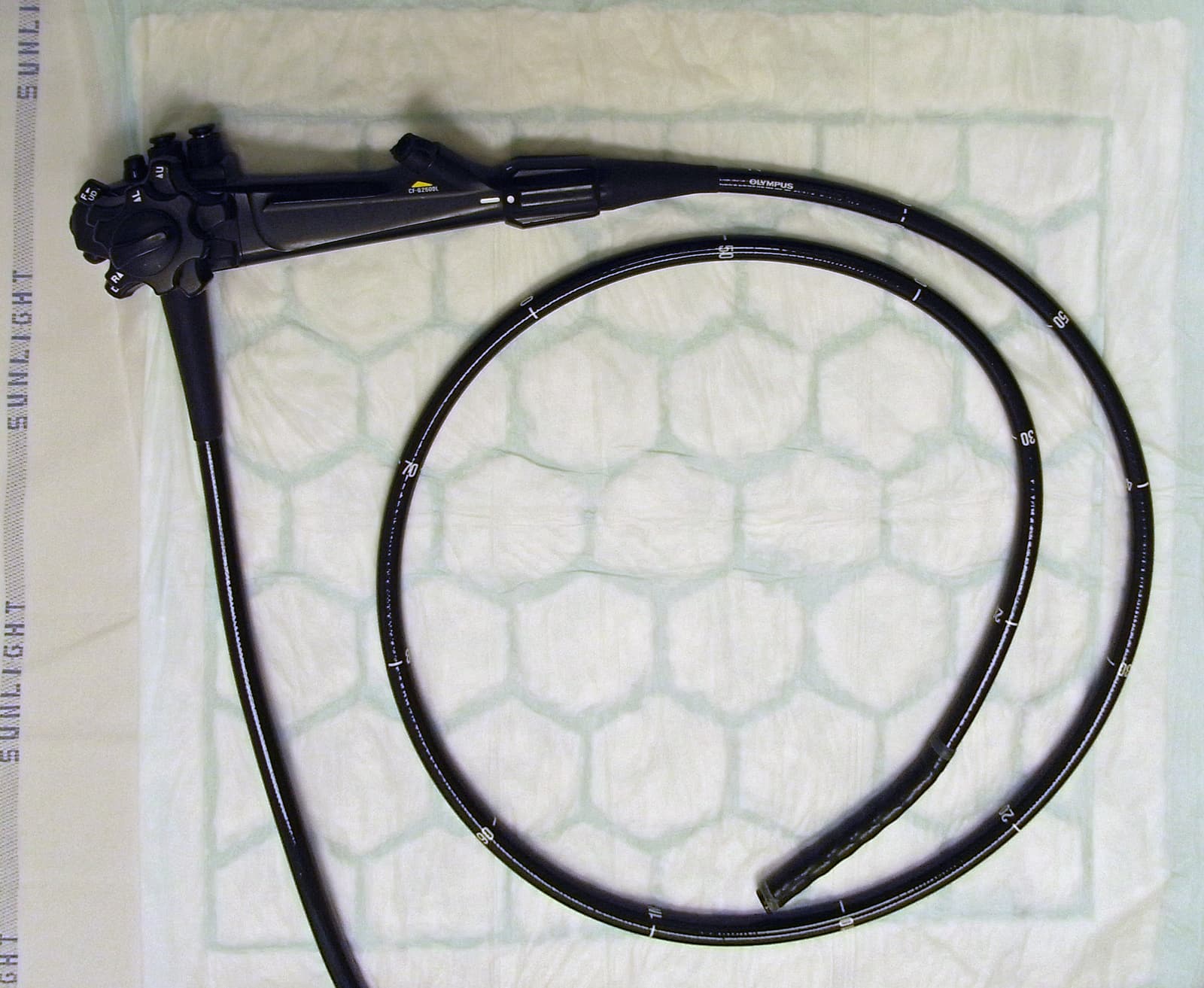
Image context: the hero image shows a colonoscope, matching the article’s core point that screening benefit is operational, not rhetorical—program quality and completion drive outcomes.
The policy shift was not arbitrary: risk signals moved first
The USPSTF changed its recommendation in May 2021, expanding routine screening to adults 45–75 (Grade B for 45–49, Grade A for 50–75).[1] This was not a branding move. It followed a measurable drift in disease burden toward younger age bands and a modeling-based judgment that beginning earlier creates additional net benefit.
The evidence package behind that shift included three practical facts:
- Colorectal cancer remains a major mortality burden (estimated 52,980 U.S. deaths in 2021 in the USPSTF statement).[1]
- A non-trivial share of incident disease is now occurring before age 50 (USPSTF cites 10.5% of new cases in people younger than 50).[1]
- U.S. screening coverage was already incomplete even in the old target ages (USPSTF cited 31.2% not up to date in 2018).[1]
In other words, the policy problem was not only "what age to start"; it was "how to reduce avoidable late-stage diagnosis when uptake is uneven and risk is no longer confined to older cohorts."
Mechanism layer 1: cohort risk migration changed the denominator
The NCI PDQ summary (updated 2025) describes a split trend that matters for policy design: from 2012–2021, overall CRC incidence declined about 1% per year, but this decline was concentrated in older groups; incidence increased by 2.4% per year in people younger than 55 and by 0.4% per year in ages 50–64.[2]
That shift does not imply most cases now occur in younger adults; they do not. Age is still a dominant risk factor. But it does invalidate a lazy assumption that pre-50 disease is too rare to matter for population strategy.
A useful way to think about this is denominator management:
- If you start at 50, your program misses a growing pre-50 risk window by design.
- If you start at 45 but fail to execute, you still miss the benefit in practice.
Guideline age opens the door. System throughput determines whether anyone walks through it.
Mechanism layer 2: benefit depends on test pathways, not one test ideology
Clinical debates often over-index on "colonoscopy versus stool tests." The better framing is pathway completion.
USPSTF and ACS both support multiple valid entry routes at average risk: annual FIT/gFOBT, stool DNA-FIT at interval, colonoscopy every 10 years, or other approved visualization pathways.[1][3] The mechanism is straightforward:
- A person who completes a high-quality stool pathway and follows positive results with colonoscopy can still realize substantial prevention benefit.
- A person who is "eligible" but never screens gets no benefit from any modality.
NCI’s synthesis reinforces that stool and endoscopic strategies have different evidence maturity but share the same practical objective: reduce incidence via polyp detection/removal and reduce mortality via earlier-stage detection.[2]
This is why programs that increase first-step participation while ensuring fast diagnostic follow-up can outperform systems that simply recommend colonoscopy but lose people in scheduling and prep friction.
Mechanism layer 3: the 45–49 implementation gap is now the binding constraint
CDC’s 2022 BRFSS baseline (published 2025) provides the most actionable readout after the recommendation expansion:
- Only 61.4% of adults 45–75 were up to date (below Healthy People 2030 target 72.8%).[4]
- In adults 45–49, only 29.8% were up to date.[4]
- In that same 45–49 group, 65.7% had never been screened.[4]
- Across all 45–75 adults, about 28 million reported never being screened.[4]
Those numbers explain why many clinicians feel that policy changed faster than operations. The limiting factor is no longer consensus on age alone; it is whether systems can move newly eligible adults through reminder, test completion, result communication, and follow-up colonoscopy when indicated.
Why this still matters despite improving long-run survival
SEER and CDC data show meaningful progress over decades. Five-year relative survival is around 65% at the population level, and localized-stage disease has much higher survival than distant-stage disease.[5][6]
But that progress hides a structural vulnerability: if screening uptake stalls in younger-eligible adults while burden shifts toward those cohorts, late detection can re-accumulate in exactly the populations now being added.
Put differently, lowering screening age without improving completion logistics can create the appearance of modernization without the full mortality payoff.
What good programs do differently (and why)
High-performing systems generally treat CRC screening as a workflow problem rather than a single clinic encounter.
1) They lower initiation friction
Offering stool-based options at the first touchpoint increases participation among people who would defer a procedural test. This is not "second best" if follow-up is reliable; it is often the fastest way to enter the prevention pathway.[1][3]
2) They protect follow-up continuity
A positive non-invasive result must trigger colonoscopy completion, not administrative drift. Benefit collapses when this handoff fails.
3) They segment newly eligible adults
Adults 45–49 are behaviorally different from long-screened cohorts: lower perceived risk, less routine preventive engagement, and less familiarity with prep logistics. Generic reminders underperform unless paired with practical navigation.
4) They track process numerically
Programs improve when they monitor at least four operational metrics: invitation reach, test return/completion, positive-result follow-up interval, and stage at diagnosis trend. These are controllable levers; "guideline awareness" alone is not.
Bottom line
The move to age 45 reflects a real epidemiologic and policy signal, not fashion. But in 2026, the decisive mechanism is execution:
- risk has shifted,
- recommendations have shifted,
- yet uptake—especially in 45–49—still lags.
The prevention dividend comes from completing the full chain from eligibility to diagnostic resolution. If that chain is weak, the age change remains mostly symbolic.
Sources
- USPSTF recommendation statement — Colorectal Cancer: Screening (May 2021)
- NCI PDQ — Colorectal Cancer Screening (updated evidence summary)
- American Cancer Society guideline page — average-risk screening from age 45
- CDC Preventing Chronic Disease (2025) — BRFSS 2022 baseline screening estimates ages 45–75
- CDC U.S. Cancer Statistics Colorectal Cancer Stat Bite (2025)
- NCI SEER Stat Facts — Colon and Rectum Cancer