A hearing aid and a cochlear implant can look like neighboring answers to the same problem. Both are worn with external parts. Both are adjusted by audiology teams. Both can help people with hearing loss participate in speech and ordinary sound. Historically, though, they belong to different mechanical worlds.
The hearing aid is an amplification tool: it makes sound louder so a damaged auditory system may still detect it. The cochlear implant is a coding system: it bypasses damaged portions of the ear and sends electrical stimulation toward the auditory nerve through an implanted receiver and electrode array.[1][2] That comparison is the most useful way to understand why cochlear implants became one of medicine's defining neural prostheses. They did not restore normal hearing. They made useful hearing possible by translating acoustic pressure into a learnable electrical signal.[1][2][4]
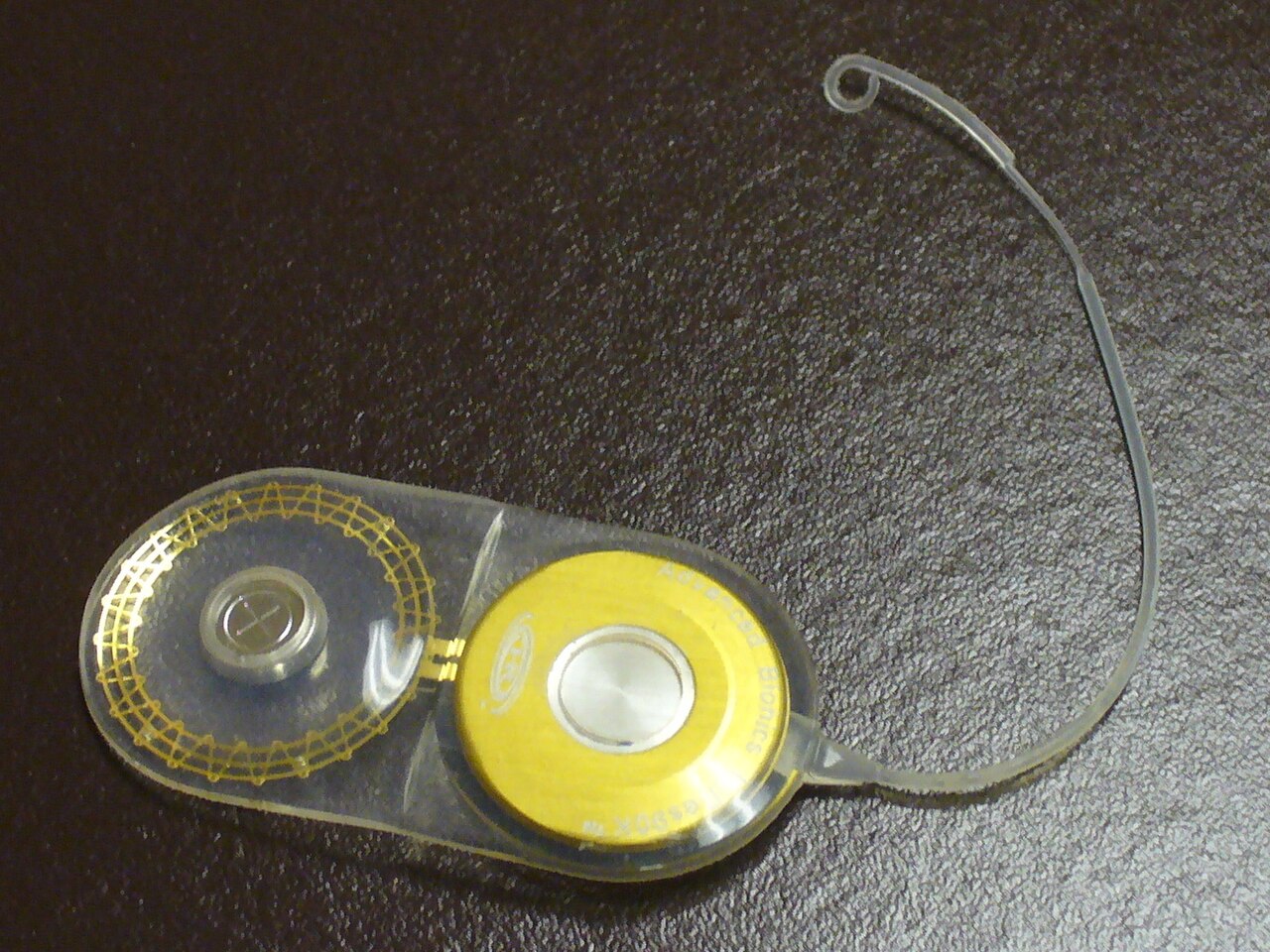
Image context: the cover image is a real photograph of an implanted cochlear implant component, not a diagram. The visible receiver body and electrode lead keep the article grounded in the device's physical route: external sound capture, implanted electronics, and electrical stimulation inside the cochlea.[8]
Timeline anchors
- 1950s: NIDCD places the first FDA approvals in the mid-1980s, while the NCBI Bookshelf history shows the longer scientific background: electrical stimulation of hearing had been investigated well before commercial devices became plausible.[1][3]
- 1972: a patient-wearable, single-electrode cochlear implant was first used at the House Ear Institute, according to a 1985 technical description of the 3M House system.[5]
- December 1977 and August 1978: Ingeborg and Erwin Hochmair's and Graeme Clark's multichannel prototypes were first implanted, marking the turn from awareness-plus-lip-reading toward more speech-oriented electrical hearing.[4]
- 1985: FDA gave its inaugural approval to a multichannel cochlear implant for adults who could hear before they went deaf; NIDCD separately summarizes the first FDA approvals as arriving in the mid-1980s.[1][4]
- 1991: Blake Wilson and colleagues published a new processing strategy for multielectrode implants that became central to modern speech-recognition performance.[4][7]
- 2019-2024: NIDCD reported about 736,900 registered devices implanted worldwide as of December 2019, with FDA-approved pediatric use beginning at 9 months for eligible children since 2020; the page was last updated in June 2024.[1]
Amplification runs out when the inner ear cannot use the sound
Hearing aids are most intuitive because they stay close to ordinary hearing. Sound enters the ear. Electronics make selected frequencies louder. The goal is still to use the ear's remaining structures. That can be powerful when enough hair-cell and neural function remains, but it has a hard boundary. If severe-to-profound sensorineural hearing loss leaves the inner ear unable to convert amplified sound into usable nerve signals, more volume may not solve the problem.[1][2]
NIDCD draws the contrast cleanly: hearing aids amplify sounds so damaged ears may detect them, while cochlear implants bypass damaged portions of the ear and directly stimulate the auditory nerve.[1] StatPearls states the same mechanism from the device side. A cochlear implant has external and internal components that convert sound into electrical signals, transmit them to the cochlea, and stimulate the auditory nerve.[2]
The comparative history starts there. The key question changed from "Can the ear hear a louder signal?" to "Can a device create a signal the auditory nerve and brain can learn to treat as sound?" That is why the technology became inseparable from coding strategy, electrode placement, rehabilitation, and patient selection. Louder sound is still sound. Cochlear stimulation is a representation of sound.
The single-electrode era proved possibility before it solved speech
The early breakthrough was not full speech understanding. It was proof that electrical stimulation could be made wearable, implantable, and clinically useful enough to keep improving. The 3M House system's technical abstract is modest but historically important: a patient-wearable, single-electrode implant was first used in 1972, and the system combined an implanted receiver with a patient-worn signal processor, transmitter, and microphone.[5]
That was already a major departure from hearing aids. A single electrode could provide sound awareness and support lip-reading, but it could not reproduce the cochlea's frequency map in a rich way. The NCBI history captures the older problem behind that limitation: experiments with electrical hearing could produce recognizable sensations, but quality and speech detail were difficult.[3] Electrical hearing existed before it was clinically fluent.
The single-electrode story matters because it prevents a too-neat hero narrative. The cochlear implant was not born modern. It had to pass through a feasibility phase in which safety, packaging, signal transmission, surgical route, and patient training were all unsettled. Its first clinical value was partial and uneven. That partial success was enough to make the next comparison unavoidable: if one electrode could create useful awareness, could multiple electrodes create useful speech?
Multichannel implants made the cochlea into a place-coded interface
The multichannel turn used a basic fact of cochlear organization. Different regions of the cochlea respond preferentially to different frequencies. StatPearls describes the cochlea's tonotopic organization: higher pitches are represented toward the base, lower frequencies toward the apex.[2] Lasker's account of the modern implant frames Clark and Hochmair's contribution in the same terms: multiple electrodes targeted different sites along the cochlea, routing speech information by frequency region.[4]
That was the historical break from amplification. A hearing aid still depends on the damaged ear's acoustic-to-neural conversion. A multichannel implant builds an artificial conversion path. Microphone input becomes processed information. The processor chooses how sound should be arranged. The transmitter and receiver/stimulator convert that arrangement into electrical impulses. The electrode array distributes those impulses to different regions associated with different frequencies.[1][2]
The 1980s were therefore not just an approval decade. They were a definition decade. By 1985, FDA approval of a multichannel implant signaled that the coding-and-electrode approach had crossed from experimental promise into regulated clinical use for a defined adult population.[1][4] By 1988, Lasker notes, an NIH consensus statement concluded that multichannel stimulation would probably produce better speech recognition than single-channel stimulation.[4] The direction of travel was clear: the implant's future belonged to richer coding, not simply stronger current.
The processor became as important as the implant
Once cochlear implants became multichannel devices, the history moved from hardware alone into signal strategy. Wilson and colleagues' 1991 Nature paper is a hinge because it described better speech recognition with multielectrode implants through a new processing strategy.[7] Lasker's summary explains the practical reason this mattered: continuous interleaved sampling supplied timing and place-coding information while avoiding simultaneous electrode stimulation that could blur the signal.[4]
This is where the comparative history becomes especially sharp. A hearing aid can be very sophisticated in its own right, with compression, directional microphones, and noise management. But a cochlear implant's processor carries a more radical burden. It must decide how to turn sound into a sequence of electrical pulses that the brain can learn to use. The external component is not just a volume manager. It is part of the sensory interface.
That also explains why users can improve after activation. Mayo Clinic notes that hearing the signals as words takes time and training, with many users making large speech-understanding gains within 3 to 6 months of use.[6] NIDCD similarly stresses that hearing through an implant takes time to learn or relearn.[1] The device provides access to a signal. The patient, brain, audiologist, family, school, or rehabilitation team helps turn that signal into practical hearing.
The boundary is clinical, cultural, and personal
The technology's success should not flatten its limits. NIDCD states that a cochlear implant does not restore normal hearing; it can provide a useful representation of environmental sounds and help with speech understanding.[1] Mayo Clinic lists variability in outcomes and names risks such as meningitis, bleeding, facial paralysis, infection, balance problems, dizziness, taste problems, tinnitus, cerebrospinal-fluid leak, residual-hearing loss, and device failure.[6]
Those limits are not footnotes. They are part of the device's identity. StatPearls and Mayo Clinic both emphasize that candidacy and outcomes depend on severity and duration of hearing loss, anatomy, audiometric and radiologic evaluation, follow-up, rehabilitation, and whether hearing aids still provide meaningful benefit.[2][6] In other words, the implant is not a universal switch. It is a technical route whose result depends on biology, timing, surgery, programming, and learning.
There is also a cultural boundary that a purely engineering history can miss. Some deaf or severely hard-of-hearing people choose not to receive implants, and NIDCD explicitly notes that decision-making should involve medical specialists while recognizing that individuals may decline for personal reasons.[1] A comparative history should therefore avoid treating cochlear implantation as the natural or superior endpoint for every person with hearing loss. The better claim is narrower and stronger: for many people with severe-to-profound sensorineural hearing loss who get limited benefit from hearing aids, cochlear implants created a different pathway to auditory information.[1][2][6]
What changed was the question
The cochlear implant's great historical achievement was to change the care question. Before the implant, severe inner-ear loss could force clinicians and patients to ask how much sound could be amplified and how much communication could be built around what remained. The implant asked whether sound could be re-encoded as electrical stimulation and delivered past damaged structures to the auditory nerve.[1][2]
That is why the story is best told comparatively. Hearing aids are not failed cochlear implants, and cochlear implants are not stronger hearing aids. They solve different problems at different points in the auditory pathway. The hearing aid trusts surviving acoustic hearing and makes sound more available. The cochlear implant accepts that ordinary acoustic transduction may be too damaged, then builds a new electrical representation that must be surgically placed, programmed, and learned.
The device in the photograph looks small because the final object has become familiar. The deeper history is larger. It runs from experiments in electrical hearing, to a single-electrode proof of feasibility, to multichannel place coding, to signal-processing strategies that made speech recognition more practical, to current clinical use where candidacy, timing, rehabilitation, risk, and personal choice still decide what the technology can mean.[1][2][3][4][5][6][7]
Sources
- National Institute on Deafness and Other Communication Disorders, "Cochlear Implants" (last updated June 13, 2024) - mechanism, hearing-aid comparison, device counts, FDA timing, pediatric eligibility, and learning requirements.
- Andrew E. Sutton, Ryan J. Krogmann, and Yasir Al Khalili, "Cochlear Implants" (StatPearls, NCBI Bookshelf; last updated January 22, 2025) - bypass mechanism, external/internal components, tonotopic organization, candidacy, surgical route, follow-up, and rehabilitation.
- Stuart S. Blume, "Cochlear Implantation: Establishing Clinical Feasibility, 1957-1982," in Sources of Medical Technology: Universities and Industry (NCBI Bookshelf, 1995) - early electrical-hearing experiments, otology context, and clinical-feasibility history.
- Lasker Foundation, "Modern cochlear implant" (2013 Lasker-DeBakey Clinical Medical Research Award profile) - Clark, Hochmair, Wilson, multichannel place coding, 1977/1978 implant milestones, 1985 FDA approval, 1988 NIH consensus, and CIS significance.
- R. J. Fretz and R. P. Fravel, "Design and function: a physical and electrical description of the 3M House cochlear implant system" (Ear and Hearing, 1985; PubMed abstract) - 1972 single-electrode House Ear Institute use and 3M House system components.
- Mayo Clinic, "Cochlear implants" - severe-hearing-loss indication, hearing-aid boundary, device pathway, training and rehabilitation, expected learning period, risks, residual-hearing loss, device failure, and outcome variability.
- Blake S. Wilson et al., "Better speech recognition with cochlear implants" (Nature, 1991; DOI page) - landmark multielectrode speech-processing paper.
- Wikimedia Commons, "File:Advanced Bionics cochlear implant.jpg" - photographic source page for the implanted cochlear implant component used as the cover image.