Cicely Saunders is still easy to misremember as a figure of atmosphere: kind voice, bedside presence, lamp-lit corridors, the founder saint of hospice. That picture keeps the moral force and loses the engineering. Saunders changed modern health care because she refused to leave the dying at the edge of medicine. She turned terminal care into a field with method: regular oral morphine instead of panic dosing, careful listening instead of euphemism, family care instead of patient-only care, and an institution designed to teach, document, and spread what worked.[1][3][4][5]
That is why her story still matters in 2026. The basic problem she confronted has not vanished. WHO's current fact sheet estimates that 56.8 million people each year need palliative care, while only about 14% receive it.[6] Saunders' history therefore belongs to more than memorial culture. It belongs to the unfinished question of how medicine treats suffering when cure is limited, impossible, or no longer the whole point.[1][6]
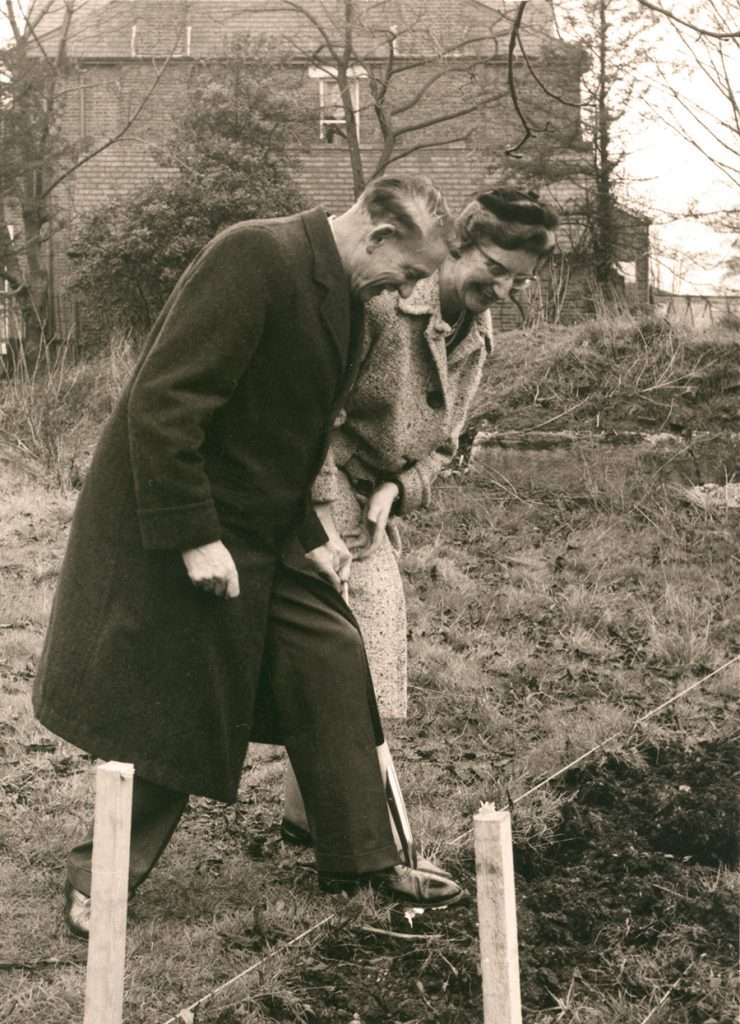
Image context: the cover uses a real archival photograph of Saunders digging the first spit for St Christopher's. That choice keeps the article anchored to construction rather than legend. Her breakthrough took institutional form: a building, a service model, a research agenda, and then a way of carrying that work into people's homes.[2][7]
Timeline anchors before interpretation
- 1948: after wartime nursing and social-work experience, Saunders became involved in caring for patients with terminal illness, the point from which she later dated the beginning of her life's work.[1][3]
- 1951-1957: after qualifying first in nursing and then as a medical social worker, she trained in medicine at St Thomas's Hospital Medical School and qualified MB, BS in 1957.[1]
- 1958: she began the St Joseph's Hospice phase of clinical care and research that underpinned her later claims about pain relief and terminal-care method.[3]
- 1964: supporters had already raised more than £330,000 toward a modern research-led hospice before the building opened.[2]
- 13 July 1967: St Christopher's admitted its first patient, Mrs Medhurst.[2]
- 24 July 1967: the hospice was officially opened; Saunders later described it as opening with 54 patients, a 16-bed residential wing, a nursery for staff children, and a planned bereavement service.[2][3]
- 1968-1969: the service quickly widened into three inpatient wards of 18 beds each, an outpatient clinic, longer-term residential care, and then the first home-care team in 1969.[1][2]
- 2020 WHO fact-sheet baseline: WHO described palliative care as a human-rights-linked service that should address physical, psychosocial, and spiritual suffering and be integrated early rather than saved for the final hours.[6]
Those dates show where the hinge actually sits. Saunders' importance does not begin and end with the opening ceremony in 1967. The real turn runs from bedside observation in the late 1940s to a demonstrable institutional model in the late 1960s.
1. Before the hospice building, Saunders was assembling a method
Saunders' own 2001 retrospective is valuable because it strips away the smooth legend and restores the sequence.[3] In 1948, she describes herself as carrying wartime nursing experience into social-work contact with patients and families "devastated by unrelieved pain in terminal cancer."[3] That sentence matters because it places pain control, not architecture, at the beginning of the story. The institution came later. The first problem was that terminal patients were suffering inside a medical culture that still treated dying as a zone of abandonment or embarrassed silence.[1][3]
She also records the personal catalyst that later biographies repeat: the encounter with a dying Polish Jewish patient whose words about being "a window" in her future home helped sharpen her sense that terminal care required openness, scientific seriousness, and room for the inner life of the patient.[3] Norman Barrett then pushed her toward medicine with a harder lesson: if doctors deserted the dying, she needed medical authority as well as compassion.[3] That is the second correction to the soft-focus version of Saunders. She did not drift into hospice by temperament alone. She retooled herself to make the argument harder to ignore.
The St Joseph's years explain why. Saunders writes that after seven years of voluntary nursing work she moved into clinical care and research at St Joseph's from 1958, where the team used small regular doses of oral morphine, detailed recording, and day-to-day care of patients with advanced malignant disease across 45 beds.[3] The analysis of 1,100 cases gave her something far more durable than anecdote.[3] It let her show that patients could be pain free and still alert, responsive, and themselves, cutting directly against the old fear that appropriate opioid use would simply sedate, addict, or erase the person.[1][3]
2. "Total pain" changed the unit of care
By the early 1960s, Saunders was arguing that pain could not be handled as a purely bodily signal.[5] The Leeds historical essay summarizes the shift cleanly: she presented pain as having physical, psychological, social, and spiritual dimensions, a framework later known as "total pain."[5] That concept matters because it changed what counted as treatment. Analgesia stayed central, but analgesia alone was not enough. Fear, family rupture, financial strain, loneliness, and the patient's understanding of what was happening all shaped the suffering being treated.[1][4][5]
Seen from that angle, St Christopher's was never supposed to be a nicer building for the same old medicine. It was a place organized around a different unit of care. The founder page from St Christopher's says Saunders came to see the dying person and the family as the unit of care and developed bereavement services so support would continue after the patient's death.[1] Shotter's obituary makes the same point from another side: Saunders' lectures and ward practice responded not only to physical pain but also to mental and spiritual pain, broken relationships, and the condition of the family at the bedside.[4]
This is where the phrase "holistic" becomes more than soft rhetoric. Saunders used it to widen clinical responsibility.[1] If pain has multiple layers, then medicine cannot stop at the syringe or pill cup. It has to ask whether the patient knows the prognosis, whether the family can bear the room, whether the staff can sustain the work, and whether the person who is dying still has enough steadiness to remain recognizably themselves.[3][4][5] "Total pain" was not an escape from clinical rigor. It was a demand that rigor reach further.
3. What opened in 1967 was a system, not only a hospice
St Christopher's history page is unusually useful because it keeps the institutional details visible.[2] The first patient arrived on 13 July 1967; the official opening followed on 24 July 1967.[2] Saunders' own retrospective adds what the building contained: space for 54 patients, a 16-bed residential wing for elderly people, a nursery for staff children, and a planned bereavement service.[3] That bundle is revealing. The point was not only to manage dying inside a dedicated place. The point was to gather pain control, family support, staff life, and grief work into one reproducible model.[2][3]
The growth in the next two years makes the design logic clearer still. By 1968, St Christopher's was running three inpatient wards of 18 beds each, plus an outpatient clinic and longer-term residential care.[2] By 1969, Saunders had pioneered the first home-care team, carrying the hospice's philosophy into the community rather than confining it to the ward.[1][2] That is a major reason she matters in health-systems history. She built a service that could move across settings. The ward was important. The home visit made the model scalable.
Saunders herself later warned against mistaking palliative care for a building alone.[3] Her 2001 essay says the concentration in a building sometimes outweighed the emphasis on home care, and insists that palliative care is a philosophy based on attitudes and skills rather than on facilities.[3] That self-critique is part of what makes the history strong. She was not founding a shrine. She was testing a service pattern and then trying to prevent the pattern from hardening into mere architecture.
4. The afterlife of St Christopher's was educational and international
One reason the Saunders story remains larger than one London institution is that she built for transfer. Her 2001 essay describes an eight-week United States tour in 1963, ongoing transatlantic correspondence, and later sabbatical visits to St Christopher's that helped seed palliative-care developments in Connecticut, New York, and Montreal.[3] Those early patterns varied, from home-care teams to hospital consult services to units inside teaching hospitals, which is exactly the point. Saunders was exporting principles, not a single blueprint.[3]
The long arc from demonstration project to recognized specialty is visible inside her own account. She writes that the patient-centered treatment first demonstrated at St Joseph's and later at St Christopher's contributed to the establishment of a recognized specialty in 1987 in Australia, New Zealand, and the UK.[3] The obituary by Shotter adds the educational layer: she lectured under the London Medical Group from 1963 to 1989, and generations of students encountered palliative care not as resignation but as a new form of clinical seriousness.[4]
The strongest two interpretations
Interpretation A: Saunders' main achievement was moral witness at the bedside
This reading survives because it captures something real. Saunders' authority did grow from bedside work, direct speech about dying, and a refusal to treat terminal patients as medically finished.[1][3][4] Without that moral witness, there would have been no movement to build on.
Interpretation B: Saunders' decisive breakthrough was turning terminal care into a disciplined service model
This interpretation fits the record better. The sequence runs through regular oral morphine, systematic case recording, "total pain," family-centered and bereavement care, a hospice built for teaching and research, and then home care and international replication.[1][2][3][5] The bedside gave the movement its ethical charge. The method gave it durability.
Interpretation A explains the reverence. Interpretation B explains why the work outlived the founder.
Why this microhistory still matters
Saunders still matters because the world continues to reproduce the gap she named. WHO's current palliative-care fact sheet describes a service that should begin early, relieve physical and psychosocial suffering, reduce unnecessary hospital admissions, and support families, yet most people who need it still do not get it.[6] Restrictive opioid rules, weak training, and health systems that still imagine palliative care as a final-room service rather than a continuum problem keep the gap open.[6]
Her microhistory offers a colder and more useful lesson than inspiration alone. Better end-of-life care did not emerge from sentiment by itself. It emerged when observation, pain control, communication, family support, teaching, and service design were bound together tightly enough to travel. Saunders built that bundle. That is why her story belongs in the history of medicine, not only in the history of kindness.
Sources
- St Christopher's Hospice, "Dame Cicely Saunders" - official founder biography, training sequence, 1948 care work, 1967 founding, home-care milestone, and biographical notes.
- St Christopher's Hospice, "Our history" - 1964 fundraising, 13 July 1967 first admission, 24 July 1967 opening, 1968 inpatient structure, and 1969 home-care milestone.
- Cicely Saunders, "The evolution of palliative care" (Journal of the Royal Society of Medicine, 2001; PMC) - 1948 catalyst, St Joseph's morphine and case-recording work, 1967 opening details, home-care spread, and specialty afterlife.
- E. F. Shotter, "Dame Cicely Saunders" (Journal of Medical Ethics, 2006; PMC) - obituary focused on teaching, terminal-pain lectures, and the emergence of palliative care as a specialty.
- Ben Wright, "'Total Pain' Theory: Cicely Saunders and the rise of the hospice movement" (University of Leeds, 2021) - accessible historical synthesis of the total-pain framework and its place in hospice care.
- World Health Organization, "Palliative care" fact sheet - current need estimates, access gap, multidisciplinary scope, opioid-policy barrier, and early-care rationale.
- St Christopher's Hospice archival image, "Dame Cicely Saunders digging the first spit at St Christopher's Hospice" - cover photograph used for this article.
Editor’s Pick Review
This article takes today’s merged standard/add-on editor-pick slot because it turns a familiar founder narrative into a source-disciplined operating history readers can actually use: timeline precision, causal mechanism clarity, and explicit institutional transfer logic from ward care to home-care scale-up. In the 24-hour pool, it posted the strongest combined quality profile under the stricter rubric — deep evidentiary spine, high numeric anchor density, clear uncertainty boundaries, and a topic-grounded immersive archival cover image with no analytical visual fallback. The Chinese edition also holds the same argument structure with natural cadence, stable policy-term mapping, and low translationese, so bilingual readability stays high without diluting technical precision.