Chicago's July 1995 heat disaster is easy to misremember as a thermometer story. The numbers were brutal: Midway Airport reached 106 F on July 13, the heat index was reported as high as 126 F, and nights stayed in the 80s when bodies needed recovery most.[1][5] But the stronger reconstruction begins after the weather report. Heat became lethal because it entered apartments, elevators, power systems, emergency rooms, morgue bays, and social networks that were not ready to recognize it as a citywide health emergency.
The disaster unfolded as a sequence. From July 12 to July 16, 1995, a slow, hot, humid air mass settled over the upper Midwest. On July 13 and July 14, the peak heat pressed into Chicago's brick flats, high-rises, single-room occupancy hotels, and senior buildings. On July 15, heat-related death certifications peaked, two days after the heat index peak in the CDC's account. By July 20, later mortality analysis found hundreds more deaths than a normal week would have predicted.[2][3]
That timeline matters because it corrects the comforting idea that extreme heat kills like a flash flood. It usually kills through delay. The room warms, the body fails to cool, chronic disease narrows physiologic margin, a phone call is not made, a neighbor does not knock, an ambulance arrives late, a hospital goes on bypass, and a death certificate later tries to name what happened.
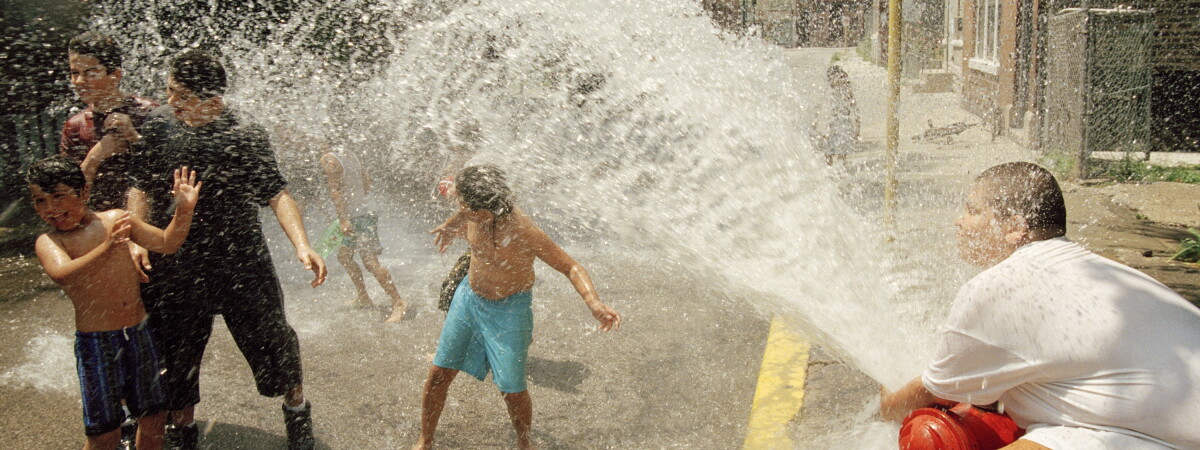
Image context: the cover is a real July 14, 1995 Chicago photograph by Charles Bennett, republished by WBEZ. It belongs here because it captures a public cooling ritual while the article follows the less visible pathway: people without safe cooling, social contact, mobility, or rapid medical rescue.[6]
The weather made relief disappear
NOAA's post-disaster survey treated the July 1995 event as rare not only because afternoons were hot, but because maximum temperatures, minimum temperatures, and humidity lined up in the same bad direction.[1] That combination is the first health mechanism. A dry hot day can still be dangerous, but high humidity interferes with evaporative cooling. A hot night removes the body's recovery interval. Several hot days in a row turn private indoor space into stored heat.
The National Weather Service later summarized the peak as July 13-14, when very hot air and high dew points produced extreme heat stress.[1] The NOAA survey also emphasized urban effects. Chicago's pavement, buildings, and dense infrastructure did not merely host the weather; they modified it. The city held heat after sunset, which meant people who had survived the afternoon could still be in danger at 2 a.m.
This is why the event belongs in health history. Heat illness is not just exposure to a high outdoor temperature. It is a breakdown of thermoregulation under local conditions: air temperature, humidity, ventilation, clothing, medications, cardiovascular reserve, kidney function, cognition, mobility, and access to cool space. In 1995, many of those variables pointed the wrong way at the same time.
The death count depended on how the city could see
The official numbers were not simple. The Cook County Medical Examiner's Office certified 465 heat-related deaths during July 11-27, using criteria that included core body temperature of at least 105 F, strong environmental evidence, or decomposition with evidence that the person had last been seen alive during the heat-wave period.[2] That definition was practical and timely, but it could not capture every death accelerated by heat.
Later excess-mortality analysis widened the frame. Whitman and colleagues reported 514 heat-related deaths and 696 excess deaths in July 1995; for July 14-20, they found 739 excess deaths and 485 heat-related deaths.[3] The distinction is not a clerical detail. "Heat-related death" depends on what investigators can prove at the scene or in the body. "Excess death" asks how many more people died than expected. During a heat disaster, both views matter.
CDC's MMWR account shows why certification was so difficult. The report notes that death criteria varied across jurisdictions and that a strict temperature threshold could miss deaths when no core temperature was measured near the time of death.[2] In practical terms, an older person with cardiovascular disease found in a sealed, overheated apartment might not fit a narrow clinical definition if measurement came too late. The public-health system therefore had to count an event that was partly clinical, partly environmental, and partly hidden behind closed doors.
The lag made the disaster harder to govern. CDC reported that deaths peaked two days after the heat index peak, rising from 49 heat-related deaths on July 14 to 162 on July 15.[2] By the time the pattern was unmistakable, the exposure chain had already done much of its work.
The apartment became the exposure site
The most important risk factor was not ignorance of summer. Chicagoans knew heat. The problem was that many residents had no safe way to turn knowledge into protection. Air conditioning was unevenly available, expensive to run, or absent. Fans could move hot humid air without lowering core risk. Some people kept windows closed because they feared crime. Others lived alone, could not easily leave, did not want to abandon belongings, or did not have anyone close enough to intervene.
A later CDC review, summarizing investigations of the 1995 and 1999 Chicago heat waves, reported that heat-death risk increased for people with cardiac disease or psychiatric illness and for people who lived alone. It also identified a working air conditioner and participation in group activities where illness might be noticed as major protective factors.[4] That is the article's central reconstruction: extreme heat became a clinical emergency through housing and isolation. The room itself became an exposure site, and the absence of a visitor or call became part of the mechanism.
Eric Klinenberg's social-autopsy account sharpened the same point from the neighborhood level. The University of Chicago Press description of Heat Wave stresses that the disaster exposed social and institutional conditions: seniors living and dying alone, abandoned neighborhoods, fear, weakened public support, and sealed apartments rather than one simple failure by a single official.[5] His later interview is even more direct about why mortality varied by neighborhood: density, street life, stores, public space, and social ties changed whether vulnerable people were noticed.[5]
That does not make weather secondary. It means weather needed a social route into the body. The heat wave supplied atmospheric pressure; the city supplied unequal shelter, unequal cooling, unequal safety, and unequal contact.
Emergency response arrived after the signal had turned clinical
By the second and third days, the health system was no longer dealing with isolated calls. The NOAA survey describes the early crisis signal as an enormous increase in emergency-room admissions; at one point, 18 Chicago-area hospitals were in bypass or unable to admit more people. Klinenberg's interview account adds the downstream morgue pressure: the medical examiner's office exceeded ordinary capacity as bodies accumulated.[1][5] The NOAA survey reached a systems-level conclusion: severe heat was not yet clearly recognized as a public-health emergency, and Chicago and Milwaukee were not prepared to respond as if heat could become a citywide disaster.[1]
This is the second mechanism. Heat deaths are often preventable only if action starts before the body count proves the danger. Waiting for visible catastrophe is late by design. Once older residents are already hyperthermic in sealed rooms, the response has moved from prevention to rescue. Once rescue depends on overloaded ambulances and hospitals, the margin narrows again.
Cooling centers illustrate the problem. Opening a cool room is not the same as getting the right people into it. An isolated resident may not hear the message, trust it, have transportation, feel safe leaving home, or understand that symptoms are urgent. A serious heat plan has to solve those last-mile problems: alerts, phone checks, door knocks, transit, building-level knowledge, utility coordination, and authority to treat heat as an emergency before the morgue becomes the dashboard.
NOAA's recommendations after the event pointed in that direction. The survey urged emergency response organizations to recognize severe heat waves as potential natural disasters and to develop plans that target groups most often affected, including elderly people living alone and people with chronic cardiovascular or pulmonary disease.[1] That recommendation sounds obvious now because the disaster made it obvious.
The lesson was a public-health operating system
Chicago's later playbook changed because 1995 exposed the missing operating system. Indiana University's Environmental Resilience Institute summarizes the post-1995 approach as a shift toward community preparedness, cooling centers, emergency notification, 311 well-being checks, outreach, and targeted vulnerability planning.[7] Those tools are not cosmetic. They answer specific failures in the 1995 chain.
Alerts answer the recognition lag. Cooling centers answer the indoor heat trap, but only if transportation and hours match need. Well-being checks answer isolation. Building-level outreach answers the fact that many heat deaths happen indoors, privately, and quietly. Green infrastructure and heat-island work answer the longer urban exposure problem, though they cannot replace acute emergency response during a dangerous week.[7]
The 1995 disaster therefore should not be filed only as weather history. It is a health-system case study in how a city learns to see an exposure before it becomes a death certificate. The thermometer mattered. So did the dew point, the night, the apartment, the unpaid electric bill, the locked door, the missing neighbor, the bypassed hospital, and the definition written on the death certificate.
The hard lesson is that heat kills through ordinary urban arrangements. A city does not need to be surprised by that anymore. It needs to know who is alone, who cannot cool a room, who cannot leave a room, which buildings fail first, which calls must be made before the peak, and when a forecast should trigger public-health operations rather than public-weather advice. Chicago in 1995 did not die only outside in the sun. Much of it died indoors, after the city failed to turn warning into contact.
Sources
- NOAA/National Weather Service, Natural Disaster Survey Report: July 1995 Heat Wave (December 1995) - official survey of meteorology, health impacts, warning performance, findings, and recommendations.
- Centers for Disease Control and Prevention, "Heat-Related Mortality - Chicago, July 1995," MMWR - death-certification criteria, timing, demographic data, and public-health interpretation.
- Steven Whitman et al., "Mortality in Chicago attributed to the July 1995 heat wave," American Journal of Public Health 87, no. 9 (1997) - excess mortality estimates and heat-related death counts.
- Centers for Disease Control and Prevention, "Heat-Related Deaths - Chicago, Illinois, 1996-2001, and United States, 1979-1999," MMWR - accessible CDC summary of heat-death risk factors, protective factors, and 1995/1999 Chicago comparisons.
- University of Chicago Press, Eric Klinenberg, Heat Wave: A Social Autopsy of Disaster in Chicago - publisher page and linked interview framing the disaster through social isolation, neighborhood conditions, and institutional response.
- WBEZ Chicago, "New Documentary Explores 1995 Chicago Heat Wave" - source page for Charles Bennett's July 14, 1995 hydrant photograph used as the article image and documentary context.
- Indiana University Environmental Resilience Institute, "Chicago, Illinois Adapts to Improve Extreme Heat Preparedness" - summary of post-1995 preparedness changes including alerts, cooling centers, 311 checks, outreach, and vulnerability planning.