In outbreak work, some events matter less for raw case totals than for what they force institutions to admit. Amoy Gardens in spring 2003 was one of those events. The cluster was not just large; it was shaped in a way that made the usual explanation feel incomplete.
A single residential estate in Hong Kong recorded 321 SARS cases by 15 April 2003, with a heavy concentration in one block and spillover across others.[1] The official investigation quickly described a plausible chain involving an index patient, contaminated sewage pathways, dry floor-drain traps, bathroom exhaust flow, and building aerodynamics.[1][2] But subsequent analyses of case geography and early viral-load patterns argued that aerosolized spread likely played a major role in how transmission scaled across space.[3][4]
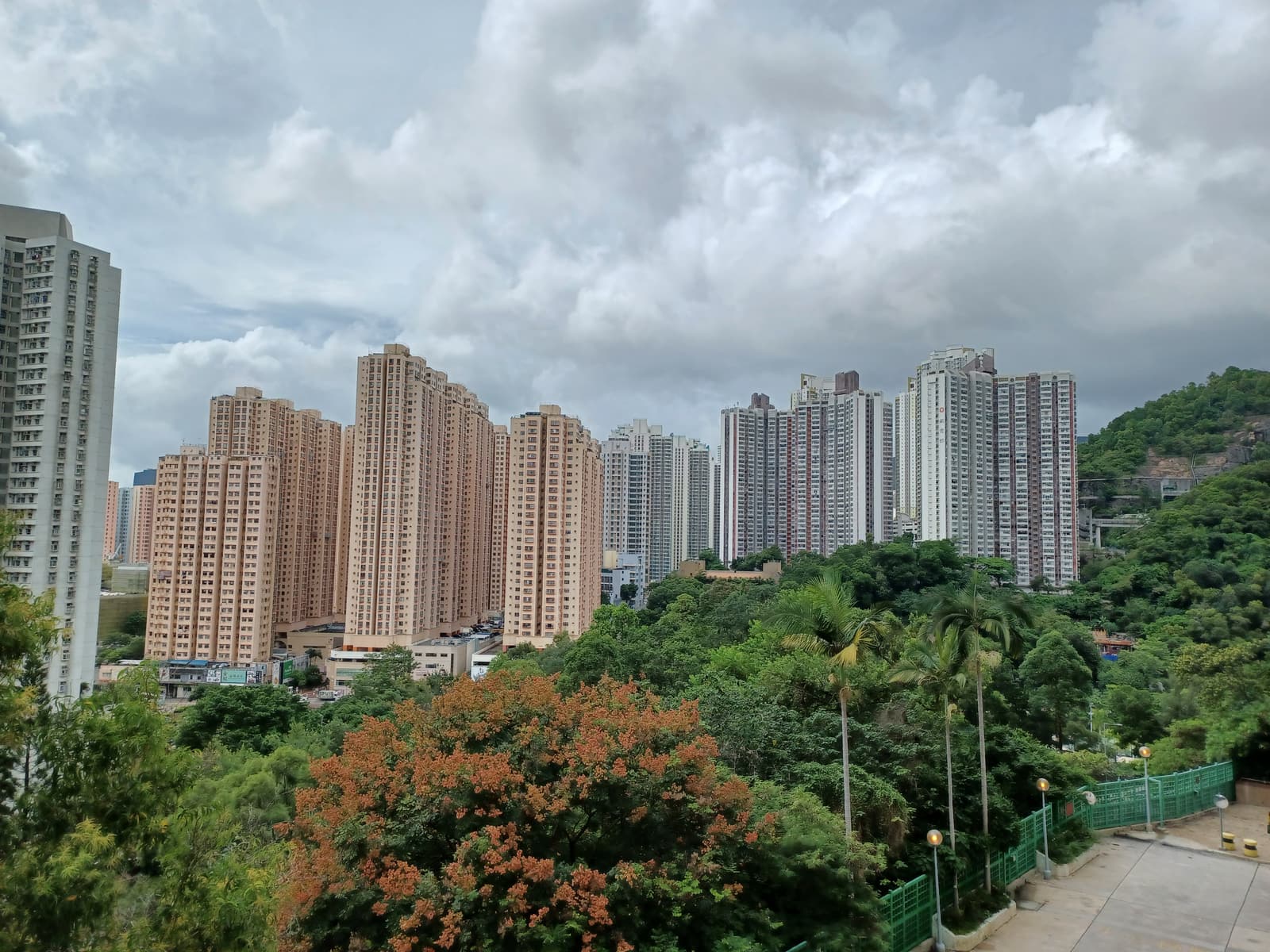
Image context: The hero image shows Amoy Gardens and adjacent estates as a dense vertical housing system, which is exactly the environmental context needed to understand why this outbreak could not be explained by simple close-contact assumptions alone.
This reconstruction follows what is strongly evidenced, where interpretation diverged, and why the event still matters for respiratory-outbreak planning.
Timeline anchors: the short window that changed the model
- 14 March 2003: A 33-year-old man linked to the Prince of Wales Hospital outbreak developed SARS symptoms; he visited relatives in Block E of Amoy Gardens on 14 March and 19 March, and had diarrhea during this period.[1][2]
- 21-24 March 2003: Community transmission accelerated; official analysis later identified a peak of onset around 24 March.[1]
- 15 April 2003: Cumulative Amoy Gardens total reached 321 cases.[1]
- 17 April 2003: Hong Kong released its multidisciplinary investigation findings.[1]
- 18 April 2003: WHO outbreak update treated sewage/U-trap/lightwell dynamics as plausible while noting more work was needed for firm conclusions.[2]
- May 2003 onward: Peer-reviewed spatial and virologic analyses strengthened the case that airborne spread had to be considered in this cluster’s expansion dynamics.[3][4]
The important operational detail is timing: a narrow exposure window produced a broad and structured attack pattern across a high-rise environment. That combination is what made the cluster analytically decisive.
Event reconstruction, step by step
1) Seeding event: clinically plausible, geographically specific
The index case narrative is unusually concrete. Investigators identified a symptomatic visitor with diarrheal illness, two visits to the same block, and immediate epidemiologic links to household and hospital contacts.[1][2] This gave responders a clear origin hypothesis without proving the full downstream mechanism.
What mattered next was that case distribution did not look random. By 15 April, 41% of Amoy cases were in Block E, with additional concentrations in Blocks C (15%), B (13%), and D (13%).[1] That pattern suggested both local amplification and directional spread.
2) Clinical signal: gastrointestinal involvement was not a footnote
A Department of Health survey reported diarrhea in roughly 66% of cases in this cluster.[1] This mattered because stool shedding had already become a biological concern in SARS work, and it made wastewater-linked pathways more plausible than they would have been in a purely upper-airway phenotype.
At the same time, the same survey found only 4% of patients reported direct contact with known SARS patients, and 8% reported recent mainland travel in the focal period.[1] Those proportions were too small to support a simple story of mostly person-to-person household seeding.
3) Environmental pathway: plumbing and airflow became outbreak variables
The Hong Kong investigation emphasized three interacting building features:[1]
- Dry U-traps in floor drains allowing backflow pathways into bathrooms.
- Bathroom exhaust flow generating negative pressure that could draw contaminated droplets/aerosols into occupied space.
- Lightwell aerodynamics that could move contaminated material vertically and laterally under certain wind conditions.
The report also documented a cracked vent pipe in Block E and described a measured “chimney effect” in the lightwell, while acknowledging limits in directly quantifying live-virus emission from these mechanical pathways.[1] In other words: strong environmental plausibility, imperfect direct virologic closure.
4) First interpretation layer: plausible mechanism, cautious language
WHO’s 18 April update reflected this transitional phase well: the sewage/U-trap/lightwell chain was described as plausible, but conclusions were framed as provisional.[2] This was institutionally sensible. In real-time outbreak response, overconfident mechanism claims can misdirect controls.
The same update also reflected early uncertainty about airborne involvement.[2] That uncertainty is historically important because it shows where evidence thresholds sat during fast-moving operations.
5) Second interpretation layer: spatial epidemiology pushed harder
A later New England Journal analysis examined the first 187 cases by date and location and found patterns consistent with a common source plus airborne dispersion dynamics.[3] Key observations included:
- all but 5 of those early cases lived in Blocks A-G,
- 99 patients were in Block E,
- risk gradients by floor and unit orientation aligned with modeled aerosol plume behavior.[3]
This did not erase the plumbing pathway. It reframed it: plumbing and air movement were likely linked parts of one transmission system in a dense vertical setting.
6) Virologic gradient evidence: dose-pattern support
An Emerging Infectious Diseases analysis of the first 79 admitted Amoy patients found a geographic gradient in early nasopharyngeal viral loads, with higher median initial loads in Block E (5.09 log10 copies/mL) versus non-E blocks (0 log10 copies/mL).[4] The authors argued that this pattern supported a point-source exposure model with environmental spread characteristics, not just random resident-to-resident chaining.[4]
No single study closed every causal gap. But the triangulation mattered: clinical timing, building mechanics, case geography, and viral-load distribution all pointed in the same direction.
Where the debate stayed open
Amoy Gardens also produced minority hypotheses, including proposals of animal-vector involvement.[5] Those arguments highlighted real uncertainties (dose, timing, and spatial spread constraints), but they never displaced the dominant environmental-plus-aerosol framing in operational practice.
For today’s reader, the lesson is methodological: when events are unusual, it is rational to hold competing explanations briefly. It is not rational to treat all explanations as equally weighted once converging evidence starts to accumulate.
Why this event still matters in 2026
1) It widened what “contact tracing” had to mean
In dense housing, a close-contact list is necessary but insufficient. Response teams also need immediate audits of trap seals, ventilation behavior, drainage integrity, and airflow directionality. Amoy showed that transmission risk can map to shafts, stacks, and pressure gradients, not only social graphs.
2) It linked engineering lag to epidemiologic lag
Mechanical details that look like facilities-maintenance trivia can become outbreak multipliers. If building teams, infection-control teams, and public-health investigators do not share a common incident clock, interventions arrive late even when each team acts competently inside its own silo.
3) It exposed a communication risk
Early outbreak communication often collapses into binary messaging (“droplet” versus “airborne”). Amoy was a reminder that real transmission systems can be mixed-mode and context-dependent. Public messages that are too simplified can delay practical mitigations in high-risk environments.
4) It anticipated later respiratory-emergency arguments
Long before COVID-era ventilation debates became mainstream, Amoy had already shown that environmental mechanics can change outbreak shape. Treating architecture as passive background is an analytic error.
Decision-grade takeaways for modern preparedness
If a similar cluster appears today in a high-rise setting, the first 48 hours should include all of the following in parallel:
- rapid epidemiologic line-listing by unit/floor/shaft adjacency,
- immediate floor-drain trap-seal and vent integrity checks,
- temporary ventilation and pressure-management controls in affected stacks,
- environmental sampling with explicit limits stated up front,
- communication language that separates confirmed facts from mechanism hypotheses.
Amoy Gardens is best understood not as a historical curiosity but as a stress test that upgraded the default model of respiratory outbreak control.
What would weaken this reconstruction
This reconstruction would need revision if credible re-analysis demonstrated that the observed floor-and-block risk gradients can be fully reproduced by contact-network effects alone, without environmental transport pathways. Existing published evidence does not support that narrower explanation.
Sources
- Hong Kong Department of Health et al. (17 Apr 2003), Main Findings of an Investigation into the Outbreak of SARS at Amoy Gardens
- WHO Disease Outbreak News (18 Apr 2003), SARS multi-country outbreak — Update 33
- Yu ITS et al. (NEJM, 2004), Evidence of airborne transmission of the severe acute respiratory syndrome virus (PMID: 15102999)
- Chu C-M et al. (Emerging Infectious Diseases, 2005), Viral Load Distribution in SARS Outbreak
- Ng SKC (Lancet correspondence, 2003), Possible role of an animal vector in the SARS outbreak at Amoy Gardens (PMC)
- Peiris JSM et al. (Lancet, 2003), Clinical progression and viral load in a community outbreak of coronavirus-associated SARS pneumonia (PMID: 12781535)
- WHO (data as of 31 Dec 2003), Summary of probable SARS cases with onset from 1 Nov 2002 to 31 Jul 2003