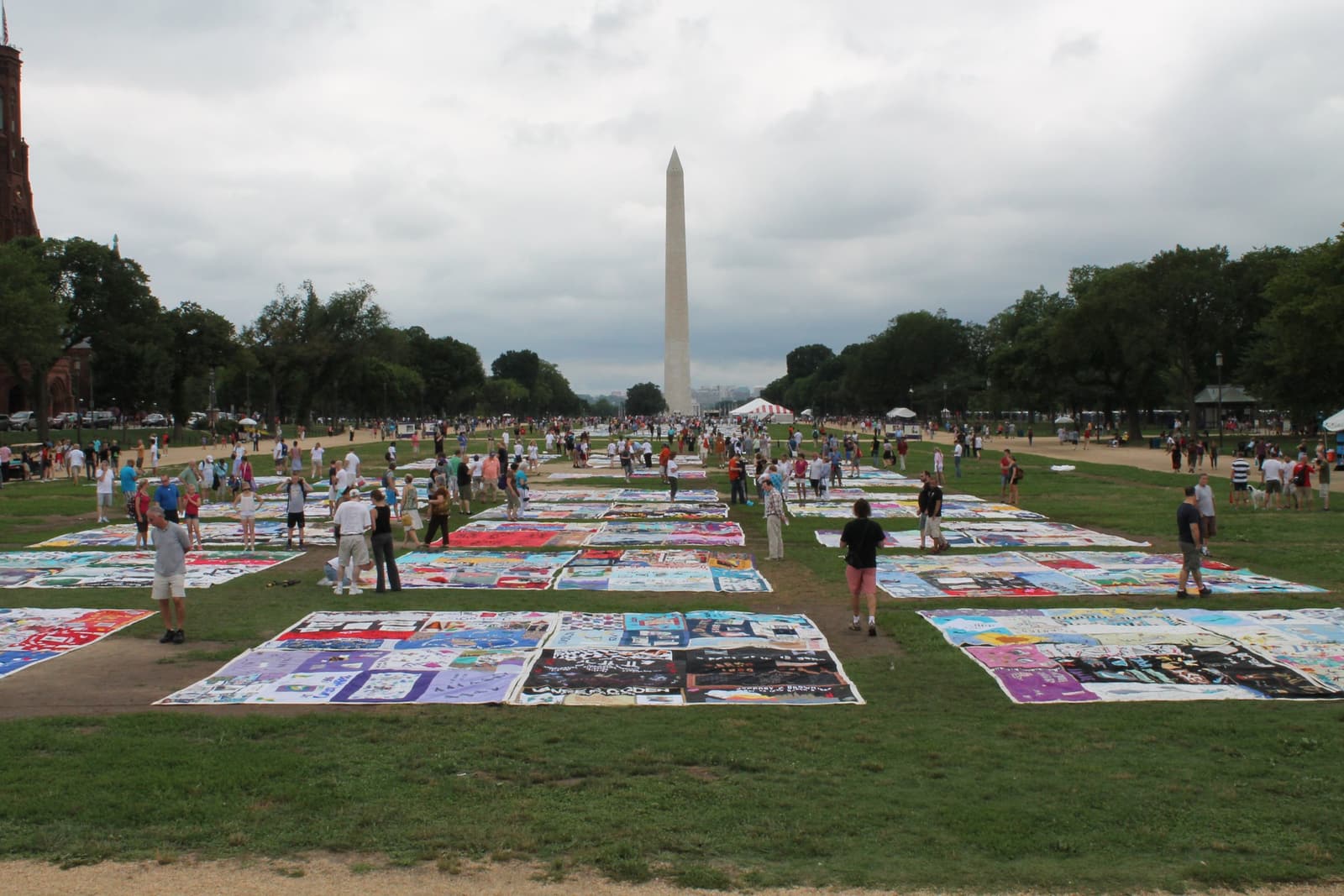
In health policy, people usually ask a technical question first: what intervention lowered incidence, admissions, or mortality? The AIDS Memorial Quilt forces a different but equally practical question: what happens to prevention and care systems when loss becomes publicly legible at national scale?
This is a memory-and-commemoration story, not a claim that ritual replaced medicine. The useful historical task is to separate mechanisms: what commemoration moved, what treatment moved, and how those channels interacted across institutions.
1) 1981: a surveillance signal before a social language
On 5 June 1981, CDC’s MMWR documented unusual Pneumocystis pneumonia cases in five previously healthy young men in Los Angeles.[1] That report created an epidemiologic signal, but not yet a durable public vocabulary for scale, grief, or obligation.
In practical terms, the early 1980s had a policy-friction profile familiar to later health crises:
- high uncertainty,
- stigmatized risk groups,
- weak federal coordination in the first phase,
- and a public sphere that could still treat deaths as statistically distant.
That last point matters for governance. Systems respond differently when a risk is numeric versus when it is socially embodied.
2) 1985–1987: from names on paper to a national visual ledger
The Quilt’s origin sequence is unusually well documented: Cleve Jones’s 1985 memorial naming practice in San Francisco, formal NAMES Project organization in 1987, and the first National Mall display on 11 October 1987.[2][3]
The first Mall display unfolded 1,920 panels, drew over 500,000 visitors, and institutionalized name-reading as a repeated civic ritual.[2][3] That changed the information environment in at least three ways:
- Scale translation: deaths moved from abstract totals to person-level entries.
- Attention persistence: repeated displays created recurring media and civic cycles instead of one-off coverage spikes.
- Coalition broadening: families, religious groups, local service organizations, and non-LGBT audiences could enter via mourning practice even when policy language remained polarized.
By 1988 and 1989, the Quilt’s touring model was also raising money for AIDS service organizations while expanding panel volume across cities.[2]
3) 1990s policy and treatment: where mortality bends, and why
The policy timeline and epidemiologic timeline are not identical, but they overlap in informative ways.
- 1990: Ryan White CARE Act established a large federal care-financing architecture (initially about $220.5 million).[6]
- 1996: CDC reported an estimated AIDS-death decline in first-half 1996 versus first-half 1995 (about 13%), with uneven subgroup patterns.[4]
- 1997: federal timeline records the first substantial U.S. AIDS-death decline, largely associated with combination antiretroviral therapy diffusion.[6]
- Late 1990s onward: CDC’s long-run surveillance summary describes sharp declines in incidence/deaths and then higher prevalence of people living with AIDS as survival improved.[5]
Those turns strongly support a treatment-and-care mechanism for mortality change. Commemoration did not generate antiretroviral efficacy. But commemoration may have changed political and civic throughput: who paid attention, who organized, who donated, who accepted sustained budget commitments, and who could no longer deny scale.
4) The disputed question: did memory move policy, or mostly mirror it?
This episode has two serious interpretations.
Interpretation A: commemoration was a causal policy input
In this view, the Quilt was not only symbolic. It functioned as public-health infrastructure for attention:
- converting stigma-suppressed deaths into visible civic records,
- supporting a broad service-organization fundraising ecology,
- and creating repeated public pressure windows around AIDS response.[2][3]
Under this interpretation, memory work helped keep financing and implementation coalitions alive through periods when technical progress alone could not guarantee equitable delivery.
Interpretation B: commemoration was mainly representational, while treatment/care architecture drove outcomes
In this view, mortality inflection is mostly explained by biomedical and delivery changes (combination ART, evolving care systems, surveillance maturity), with memorialization carrying social meaning but limited marginal effect on epidemiologic curves.[4][5][7]
What evidence would change the balance?
To move from plausibility to stronger causal attribution for commemoration, we would want stronger quasi-experimental evidence linking Quilt exposure intensity to later measurable policy outputs (appropriation persistence, service capacity growth, testing uptake, treatment retention), after controlling for baseline epidemic burden and existing activist infrastructure.
Absent that, the most defensible conclusion is mixed: medicine bent mortality fastest; commemoration helped sustain the political and civic field in which medicine could be funded, accepted, and delivered at scale.
5) Why this matters now: memory as a governance layer
For current health threats, the Quilt episode suggests one operational lesson: do not treat remembrance as post-hoc ceremony. In long crises, memory can operate as governance infrastructure with concrete effects on:
- legitimacy (who is seen as countable and grievable),
- continuity (whether attention survives beyond first-wave panic),
- allocation durability (whether budgets and service systems survive political turnover).
Public health still needs surveillance, trial evidence, and delivery execution first. But when stigma and fatigue are high, durable response also requires social forms that keep loss visible without reducing people to dashboards.
That is the durable technical insight from the Quilt era: effective health systems are built from both biomedical efficacy and memory institutions that keep societies willing to act.
Sources
- CDC MMWR (June 5, 1981), Pneumocystis Pneumonia — Los Angeles
- National AIDS Memorial, History of the Quilt
- Smithsonian Institution Archives, The AIDS Memorial Quilt on the National Mall
- CDC MMWR (1997), Update: Trends in AIDS Incidence, Deaths, and Prevalence — United States, 1996
- CDC MMWR (2001), HIV and AIDS — United States, 1981–2000
- HIV.gov, A Timeline of HIV and AIDS (entries for 1981/1990/1996/1997)
- Holtgrave DR (2005), Causes of the decline in AIDS deaths, United States, 1995-2002: prevention, treatment or both? (PubMed)
- Wikimedia Commons file metadata, AIDS Quilt at 2012 International AIDS Conference