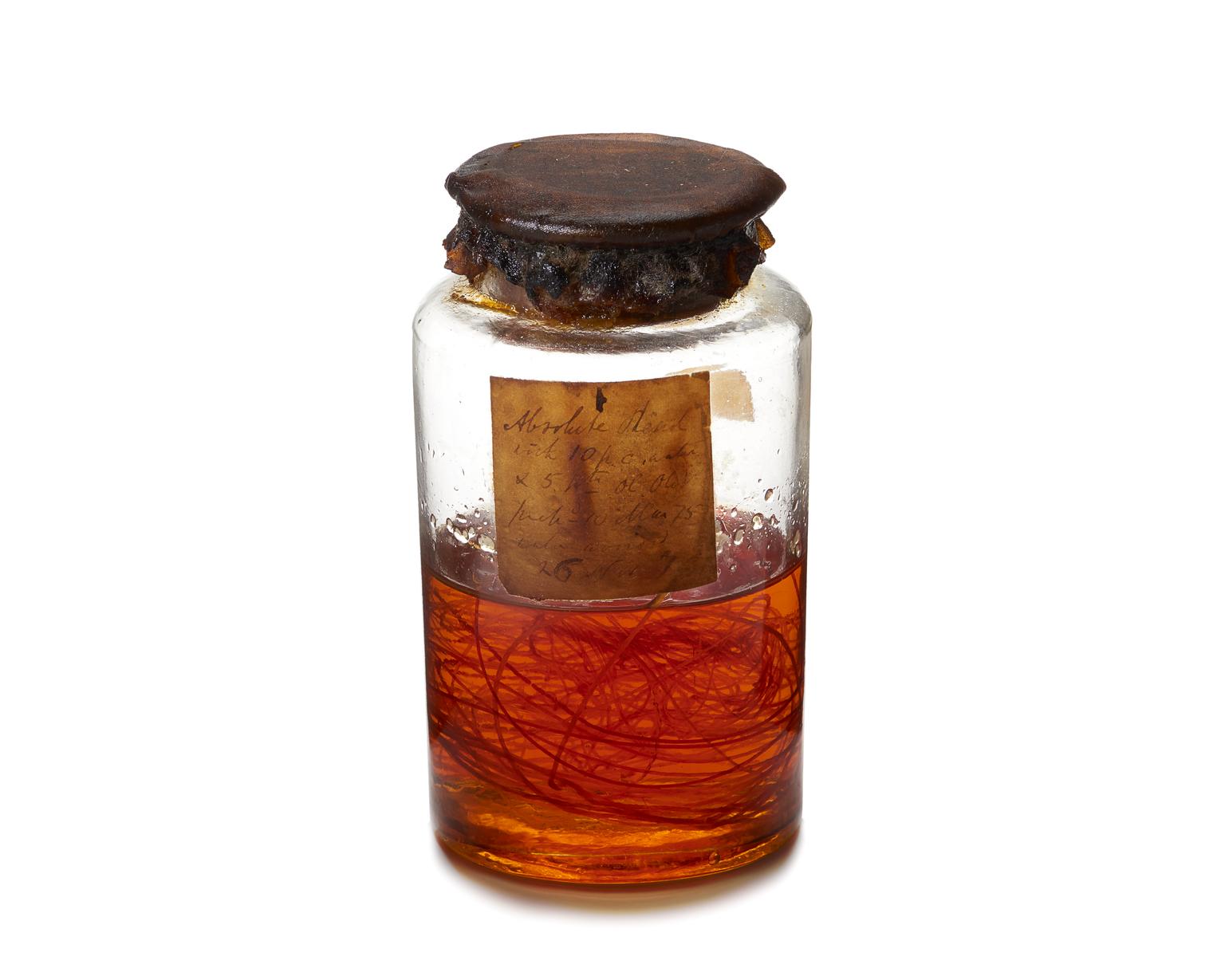
A small glass bottle in the Science Museum holds a problem that surgery could never solve with a knot alone. Joseph Lister prepared its catgut in Edinburgh on 10 March 1875, treating the material with carbolic acid, water and oil to prevent infection. The thread came from animal intestine; its preparation was part of making it safe to leave inside a patient.[1]
A century later, a manufactured polymer offered another absorbable stitch. Comparing the materials reveals the demands inside that word: support healing tissue, behave tolerably while it remains, and eventually break down.[2]
A material with a biological timetable
Catgut's useful structure is collagen, a connective-tissue protein. Preparing it involves processing intestinal tissue into a strand. Chemical treatment, including chromium salts in chromic catgut, changes its properties. Animal origin still entails manufacture.[2]
Once implanted, catgut breaks down through processes involving enzymes. Conditions around the stitch therefore influence its loss of strength. Synthetic absorbable polyesters such as polyglycolic acid, or PGA, break down through hydrolysis: water participates in breaking their chemical bonds. In its 1998 assessment of alternatives to catgut, a European Commission scientific committee emphasized the more consistent properties available from synthetic manufacture.[2]
Strength retention and complete absorption are separate measurements. A thread can remain after losing useful strength; its presence alone cannot establish its load-bearing capacity.[2]
The synthetic promise was consistency
The patent granted to Edward Emil Schmitt and Rocco Albert Polistina on 10 January 1967 makes an unusually practical argument for synthetic absorbable sutures. Animal material varied in dimensions, texture, strength and absorption. A polymer could be formed under controlled conditions and produced as a continuous strand.[3]
The inventors also distinguished average strength from the strength a surgeon could rely on in a particular stitch. Their argument was that a more uniform material might be useful even without winning a contest of average breaking strength. A knot made from an unexpectedly weak length of thread would matter more than the performance of the rest of the batch.[3]
This was a manufacturer's case for an invention, not proof of better patient outcomes. But it identifies the question subsequent experiments needed to answer: how dependably would the material behave after it entered the body? Handling and knot security belonged in that investigation alongside chemistry.[3]
Muscle and stomach gave different answers
In October 1970, R. W. Postlethwait reported experiments comparing sutures implanted in rabbit muscle. PGA lost approximately one-third of its original strength in one week and 80 percent by two weeks. Catgut lost strength more slowly in that experiment. The tissue reaction to PGA was limited, and the synthetic material was generally absorbed faster.[4]
Those findings resist an easy progress story. The newer thread did not simply lose strength more slowly. Nor can rabbit-muscle measurements establish which material would produce fewer complications in a particular human operation. They describe performance in a specified environment.[4]
A. B. Cassie's 1977 investigation changed that environment. Samples of chromic catgut and PGA were attached to gastric tubes and recovered from human stomachs over the first five postoperative days. Investigators then measured the force required to break them. Catgut's remaining strength varied widely, while PGA behaved more consistently.[5]
Crucially, these were samples exposed inside the stomach, rather than stitches being tested as a completed surgical repair. The experiment helped explain why a material's surroundings mattered; it did not directly measure whether an intestinal join leaked or a wound healed better. Small numbers at later time points further limit what can be read from the comparison.[5]
Placed together, the studies suggest why the location and method of testing belong beside every claim about a suture. “Lasts longer” leaves too much unsaid: longer in which tissue, under what conditions, and measured as remaining thread or remaining strength?[4][5]
Patients supplied another measure
At University Hospital in Kuala Lumpur, Wong Wai Ping and Teoh Soong Kee compared PGA with chromic catgut for repairing episiotomies, the incisions made during some vaginal births. Their December 1975 report included 122 patients, 61 in each group. Early assessments recorded no episiotomy pain in 8 PGA recipients and 1 catgut recipient. At discharge, all repair lines remained intact.[6]
Comfort therefore revealed a difference that an intact wound alone did not capture. The authors also reported that PGA was initially harder to handle and that its first knot tended to be loose. The change of material asked something of the operator as well as offering something to the patient.[6]
The study deserves its limits: the allocation method and blinding were not clearly described, and only about 60 percent attended the six-week review. It provides a historically useful comparison, not a complete account of long-term recovery or a rule for every operation.[6]
From Lister's bottle to the recovered gastric samples, the comparison keeps returning to the interval after the surgeon ties the knot. An absorbable stitch has a working life before its material is gone. Synthetic manufacture expanded the control available over that life; experiments and patient follow-up were still needed to establish what the control achieved. Disappearance was only the final part of the job.
Sources
- Science Museum Group, “Catgut suture,” object A41382 — Lister's preparation of 10 March 1875, material provenance and photograph.
- European Commission, Scientific Committee on Medicinal Products and Medical Devices, opinion on alternatives to animal-intestine sutures, adopted 16 September 1998 — manufacture, strength retention, enzymatic breakdown and hydrolysis.
- Edward Emil Schmitt and Rocco Albert Polistina, “Surgical sutures,” US Patent 3,297,033, granted 10 January 1967 — the inventors' claims about synthetic manufacture, uniformity and knot performance.
- R. W. Postlethwait, “Polyglycolic Acid Surgical Suture,” Archives of Surgery 101:489–494 (October 1970) — publisher's abstract of the rabbit-muscle experiments.
- A. B. Cassie, “Catgut and polyglycolic acid. An evaluation in the human stomach,” Annals of the Royal College of Surgeons of England 59:69–72 (January 1977) — original report with scanned full text.
- Wong Wai Ping and Teoh Soong Kee, “Episiotomy repair: A comparison of Catgut and Polyglycolic acid sutures,” Medical Journal of Malaysia 30:135–138 (December 1975) — original clinical comparison, pain findings, handling and follow-up limitations.