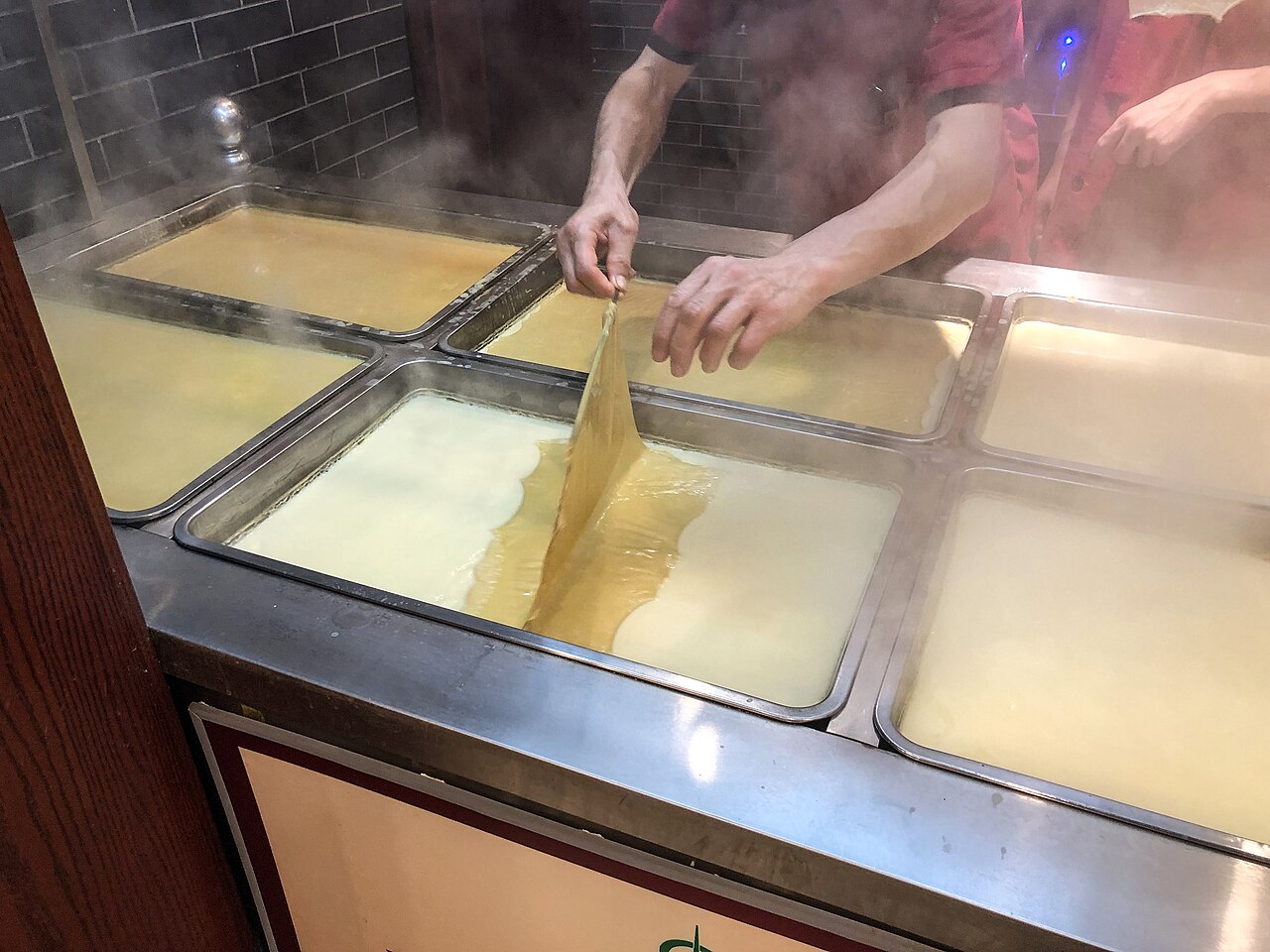
Yuba looks too quiet to be a luxury ingredient until you watch it being made. Nothing sparkles, nothing flames, and nothing arrives by air freight packed like jewelry. A pan of soy milk is held hot, a skin forms at the surface, and a cook lifts the sheet before it tears, dries, or thickens into something dull. The expensive part is not rarity in the usual status sense. It is attention.
That is why yuba belongs in fine dining when it is handled with restraint. It gives a kitchen a texture that tofu cannot quite provide: tender but tensile, creamy but able to fold, delicate but not empty. It tastes of soybeans without the weight of a block, and it can carry broth, citrus, sesame, mushroom, shellfish, vegetables, or a chilled dashi without becoming anonymous. The ingredient is modest. The control is not.
The cover photograph shows the whole proposition in one movement: a sheet rising from a bath of hot soy milk, steam around the hand, the formed skin still wet enough to shine.[6] This is not garnish manufacturing. It is surface work. The cook has to read the pan.
The Ingredient Is A Film, Not A Block
The most useful way to understand yuba is to stop calling it tofu's byproduct. Tofu is made by coagulating soy milk into curds, then pressing or setting them. Yuba is different. Chen and Ono's 2010 study in the Journal of Agricultural and Food Chemistry defines it as a protein-lipid film that forms on the surface of heated soy milk, and the authors identify protein particles, oil bodies, and soluble protein as the building materials of the network.[1] In plain dining-room terms, yuba is what happens when soy milk builds a skin.
That distinction matters at the table. A block of tofu gives the mouth custard, curd, or sponge depending on style. Yuba gives layers: a sheet, wrinkle, fold, ribbon, knot, or bite that can stretch slightly before yielding. Hodo's product page describes fresh yuba sheets as made by filming protein straight from organic soy milk, with only water and organic soybeans listed as ingredients.[2] The simplicity is part of the pressure. With so little to hide behind, bad soy milk, flat aroma, stale handling, or clumsy storage has nowhere to disappear.
The science also explains why yuba feels more architectural than it first looks. Chen and Ono found that protein particles were especially important to film formation and that oil bodies became incorporated into the yuba network.[1] That is the quiet trick. The sheet is not just dried protein. It is a thin organized surface, strong enough to lift and fold, soft enough to keep a creamy soy flavor. Fine dining should care about that because texture is often where vegetable-centered cooking either becomes persuasive or collapses into softness.
Yield Is The Price Signal
Yuba also carries a production argument. Bon Appetit's visit to Hodo's Oakland facility describes rows of rectangular vats, a new sheet forming about every 20 minutes, and a worker reading each tray by look and feel before lifting the sheet by hand.[4] That timing gives the ingredient its economics. The same report quotes founder Minh Tsai saying that in the time needed to make one pound of yuba, the facility could make 100 pounds of tofu.[4]
That ratio is why yuba feels expensive in a different way from caviar, truffle, or wagyu. It is not costly because the world contains only a few glamorous units. It is costly because the process spends heat, space, soy milk, and skilled attention on a thin sheet. Every batch asks the producer to keep choosing surface over volume.
For a restaurant, that should change the menu language. Yuba does not need to be announced like a trophy. It needs to be protected from being treated like a novelty noodle. If a kitchen buys fresh yuba and buries it under too much chili oil, too much acid, or too much sauce, it has paid for a watched surface and then made the watchfulness irrelevant. The better use lets the sheet keep its own pulse.
That pulse can be subtle: a folded square in warm clear broth, a ribbon around crab or mushroom, a cool sheet dressed with sesame, a crisped edge beside young vegetables, a soft layer carrying shellfish sweetness. Yuba should not merely replace pasta or meat. It should do the thing only yuba does: make soy milk feel like silk with a little chew.
Kyoto Made Quietness Legible
Yuba's fine-dining identity is not only technical. It is cultural. Savor Japan frames yuba as a Kyoto delicacy linked to Buddhist vegetarian temple cuisine, or shojin ryori, and says it became important in the Kyoto region during the Kamakura period before spreading more widely over the Edo period.[3] The same article notes that yuba remains part of shojin ryori and kaiseki ryori, which is the context that gives the ingredient its quiet authority.[3]
Kyoto matters because it teaches a useful lesson about understatement. The Japan National Tourism Organization's Kyoto food guide places yuba inside the city's tofu cuisine, alongside yudofu and other preparations that highlight delicacy, smoothness, and seasonal restraint.[5] This is not the same as treating yuba as luxury vegan protein. It is more precise than that. Kyoto gives yuba a format in which silence can be the point.
That format suits fine dining because yuba needs a room willing to notice small changes. Savor Japan's production description says soybeans are soaked, ground with water, cooked, strained into soy milk, then heated gently in rectangular pans so a solidified protein film can form where soy milk meets air.[3] It also says the flavor and aroma can change depending on when the sheet is pulled, with the first layer considered especially high quality.[3] Whether a restaurant serves Kyoto-style yuba or a contemporary local version, the important principle is the same: timing changes taste.
That is a more interesting luxury signal than abundance. A thick steak can impress by size. A seafood tower can impress by display. Yuba impresses only if the diner is paying enough attention to feel a difference between tender, leathery, warm, chilled, fresh, dried, folded, seared, or overworked. It asks for a slower palate.
Freshness Is A Service Constraint
Fresh yuba is not difficult because the ingredient has a complicated ingredient list. It is difficult because the list is so short. Hodo's version uses water and organic soybeans; the page positions the sheet as creamy, nutty, chewy, high-protein, and ready for cutting, wrapping, swirling into soup, or cooking like a noodle substitute.[2] Those uses are real, but in a fine-dining room the best question is narrower: what does the sheet make possible that a block, puree, noodle, wrapper, or custard would not?
One answer is temperature contrast. Fresh yuba can sit cool against warm broth or warm against a chilled sauce without losing its identity immediately. Another answer is folding. A sheet can hold a filling, but unlike a dumpling wrapper it brings soybean sweetness into the bite. A third answer is edge behavior. Seared yuba can crisp in places while remaining soft elsewhere, making one ingredient behave like both skin and interior.
The failure modes are just as useful. Too dry, and yuba becomes papery. Too wet, and it loses tension. Too much sauce, and the folds become limp carriers. Too much heat, and freshness gives way to generic chew. The ingredient rewards small service decisions: cut width, folding direction, broth temperature, dressing weight, whether to serve it flat, crumpled, rolled, or torn.
This is where sourcing and kitchen discipline meet. A restaurant buying yuba should know whether it is getting fresh sheets, dried sticks, rolled skins, first-layer yuba, mass-market tofu skin, or a producer-specific product made for chefs. None of these forms is automatically inferior. Dried yuba can be excellent when rehydrated into soups and braises. But the menu should not pretend they are interchangeable. Fresh yuba's force is immediacy; dried yuba's force is absorption and chew. Confusing the two makes the dish vague.
How To Use It Without Flattening It
The most persuasive yuba dishes keep the soybean flavor legible. In a tasting menu, that often means pairing it with ingredients that have clean pressure rather than loud dominance: clear mushroom broth, crab, scallop, mild white fish, spring peas, asparagus, sesame, shiso, citrus peel, aged soy, delicate chicken stock, or a very light shellfish sauce. The sheet should not have to fight for attention. It should give the plate a quiet center.
A yuba course can also do useful work in a long menu. After richer dishes, it can reset the mouth without feeling austere. Before a main course, it can create a bridge between vegetable and protein registers. In a vegetarian or plant-forward menu, it can provide substance without relying on imitation meat. The point is not that yuba "stands in" for something else. The point is that it gives the chef a non-meat structure that already has texture, protein, aroma, and cultural memory.
The ingredient's biggest danger is preciousness. A sheet of yuba placed on a plate with tweezers and no appetite behind it becomes fragile decoration. The opposite danger is overcorrection: frying, saucing, or seasoning it so aggressively that its fine texture disappears. The best version sits between those failures. It lets the diner feel that the sheet began as soy milk, became a surface, and was lifted at the right moment.
Yuba's luxury is therefore not loud. It is the luxury of a watched process held just long enough. Soybeans and water become milk; heat persuades the surface to gather; a hand lifts the skin; a kitchen decides how little to do next. In an era when fine dining often reaches for spectacle, yuba offers a calmer kind of seriousness. It says that a surface can be enough, if someone has paid attention to it.
Sources
- Yeming Chen and Tomotada Ono, "The mechanisms for Yuba formation and its stable lipid," Journal of Agricultural and Food Chemistry, 2010 - PubMed/DOI record and abstract on yuba as a protein-lipid film, film formation, and protein particles/oil bodies in the network.
- Hodo Foods, "Organic Yuba Sheets" - producer page describing fresh organic yuba sheets, ingredients, process language, texture, protein content, and culinary uses.
- Savor Japan, "What Is Yuba? The History and Method Behind Japanese Tofu Skin, and Where to Try It in Kyoto" - culinary overview of yuba's Kyoto, shojin ryori, kaiseki, ingredient, and production context.
- Julia Kramer, "Inside Hodo Soy Beanery, the Temple of Tofu and Yuba," Bon Appetit, October 28, 2014 - reporting on Hodo's production vats, hand lifting, timing, labor, and yield tradeoff versus tofu.
- Japan National Tourism Organization, "Kyoto's Local Flavours" - official tourism guide placing yuba within Kyoto tofu cuisine, kyo-kaiseki, seasonal food culture, and local culinary identity.
- Wikimedia Commons, "File:The making of a tofu skin (20190930192630).jpg" - real 2019 photograph by N509FZ of tofu skin being lifted from heated soy milk, used as the article image.