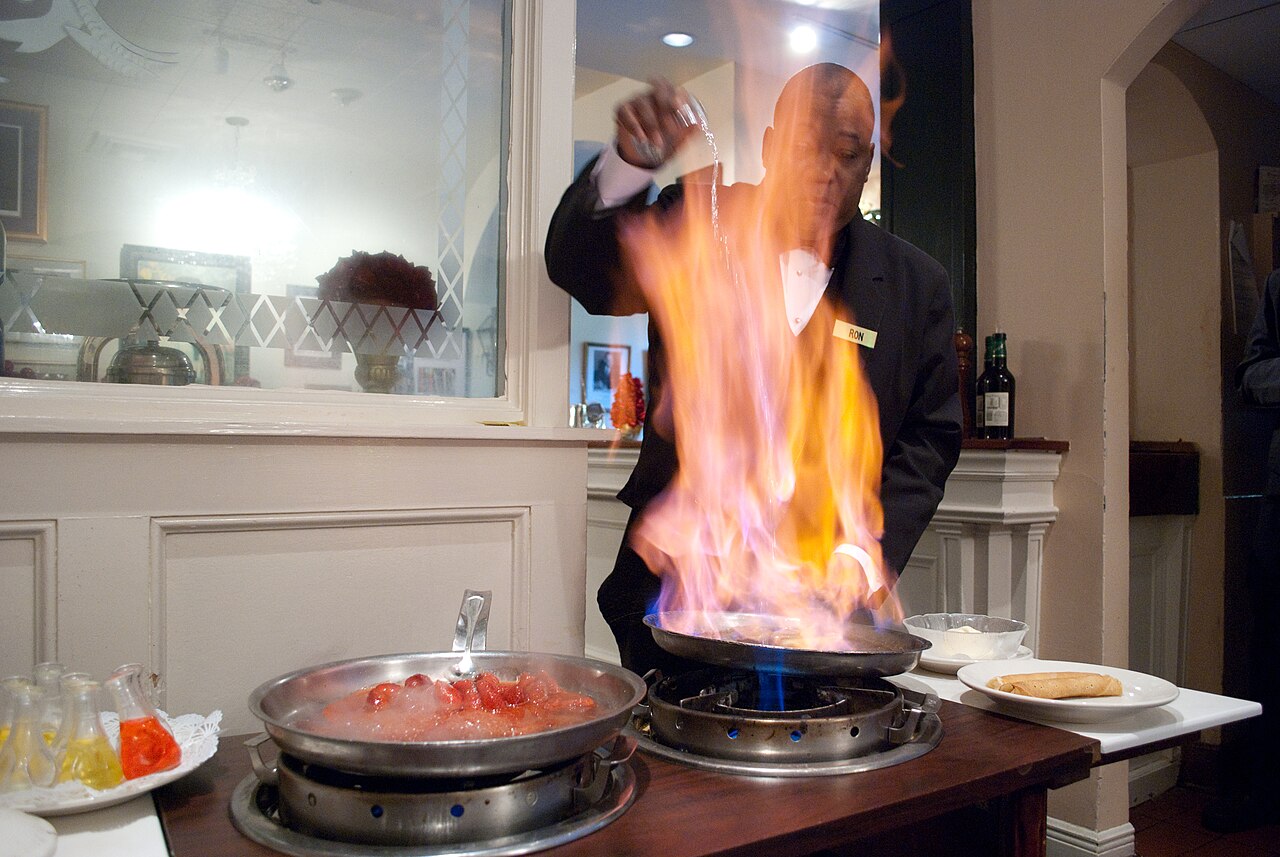
Bananas Foster begins with a useful imbalance: the ingredients are modest, but the entrance is grand. A banana is split in a pan with butter, brown sugar, cinnamon, banana liqueur, and rum; a server tilts the pan, the alcohol catches, and a dessert that could have stayed domestic becomes a small public event.[1] The luxury is not the fruit. It is the way the dining room makes everyone notice the moment when fruit becomes performance.
That is why the dish still belongs in fine dining. Not because flame automatically confers prestige, and not because every guest secretly wants an old restaurant trick. Bananas Foster survives because it joins three things that often drift apart: a place-specific supply story, a named kitchen lineage, and a tableside ritual that gives service real authorship. At Brennan's, the dessert is not simply served. It is completed in front of the guest.[1][2]
A Banana Dish Could Only Become This Dish In New Orleans
Brennan's official account gives the famous origin in compact form. In 1951, Owen Brennan challenged chef Paul Blange to create a dish featuring bananas, a fruit tied to New Orleans's role as a major import center from Central and South America. The result was named for Richard Foster, Brennan's friend and the chairman of the New Orleans Crime Commission.[1]
That origin story can sound almost too neat: a restaurateur wants publicity, a chef builds a dessert, a civic figure lends a name. But the neatness is part of the point. Bananas Foster was designed to be memorable enough for the room and legible enough for the city. It gave New Orleans a dessert that said, in one cart-side burst, that the French Quarter could turn commerce into pleasure.
The supply story underneath it was not ornamental. The Historic New Orleans Collection notes that bananas were unloaded at the Thalia Street wharf; some fruit was sold locally while the rest moved onto rail cars for shipment around the country. The same account places that traffic inside United Fruit's wider steamship, plantation, and political network across Latin America.[4] A fine-dining dessert does not have to carry every burden of that history on the plate, but ignoring it makes the dish smaller than it is. Bananas Foster tastes like butter, rum, and caramelized fruit. It also belongs to a port city that turned tropical logistics into local appetite.
That double register gives the dessert unusual depth. It is celebratory, but not placeless. The banana is not a random sweet fruit chosen because it browns well in sugar. It is the fruit New Orleans could plausibly claim, display, and theatricalize. The sauce is restaurant luxury; the banana is supply chain memory.
The Kitchen Lineage Matters
Paul Blange is sometimes flattened into the origin anecdote, as if the dish sprang fully formed from a publicity challenge. The Southern Foodways Alliance oral-history page for Blange's family gives him a more durable place in the Brennan's system. After the Brennan family bought the Vieux Carre in 1946, they retained Blange as the first chef of Brennan's Vieux Carre Restaurant; during his long tenure, he created or helped define dishes including eggs Hussarde, Trout Marguerite, Trout Blange, and, with Ella Brennan, Bananas Foster.[3]
That matters because Bananas Foster is not a pastry-chef miniature. It is a chef's dessert built for a restaurant that understood showmanship. The formula had to be rich but fast, stable but dramatic, simple enough to execute repeatedly, and aromatic enough to announce itself before the spoon arrived. It uses the logic of a savory saute: hot pan, fat, sugar, fruit, alcohol, timing. Then it resolves like a sundae, with the hot sauce and softened bananas poured over vanilla ice cream.[1]
The dish's genius is that each ingredient has a job the guest can understand. Butter gives gloss. Brown sugar gives depth. Cinnamon gives instant recognition. Banana liqueur underlines the fruit instead of hiding it. Rum supplies both aroma and ignition. Ice cream makes the heat visible because it starts to surrender as soon as the sauce lands.[1] Nothing is obscure, which is why the theater feels generous rather than cryptic.
The Dining Room Finishes The Recipe
Southern Foodways Alliance's Gravy feature is most useful because it treats Bananas Foster as work, not just spectacle. It describes Brennan's early years as coinciding with a fine-dining fashion for tableside dishes, then follows the servers who train to make the dessert safely and convincingly in front of guests.[2] That shifts the authorship. The kitchen can prep the mise en place, but the captain has to manage flame, pan, guest attention, and room temperature in the social sense.
Tableside service is often remembered as nostalgia, a relic of carts, carving, and formal dining-room manners. Bananas Foster shows the better version. The server is not merely displaying technique. The server is pacing a tiny story: melt the butter, dissolve the sugar, soften the bananas, add the rum, ignite, calm the pan, finish over ice cream.[1][2] The guest receives a dessert and a sequence.
That sequence is why the dish avoids feeling like a stunt when done well. The flame is not the entire event; it is the point of highest visibility in a longer transformation. Before it, the room smells butter and cinnamon. During it, the table gets heat and risk at a controlled distance. After it, the ice cream proves that the show had an edible consequence. The cold bowl is not an afterthought. It is the landing pad.
Why It Traveled
Brennan's says Bananas Foster is now the most-ordered item on its menu and that guests sometimes arrive after dinner elsewhere just for the dessert.[1] Gravy notes that the dish appears on menus worldwide while Brennan's continues serving the original day and night.[2] The portability makes sense. The recipe is compact, the ingredients are familiar, and the effect is instantly understandable even to a guest who knows nothing about New Orleans.
But the copies also reveal the danger. Remove the city, the service discipline, and the kitchen lineage, and Bananas Foster becomes just a flaming banana sauce. Pleasant, maybe, but thinner. What Brennan's keeps is the full circuit: port history, family-restaurant mythology, trained tableside execution, and a guest who can feel included without needing a lecture.
Modern fine dining should pay attention to that circuit. A theatrical gesture works best when it is not pasted onto a menu as entertainment. It should clarify something the restaurant already believes. If the restaurant believes in place, the gesture should carry place. If it believes in service, the gesture should give service a real role. If it believes in pleasure, the effect should be edible before it is clever.
Bananas Foster does all three. It turns New Orleans's banana trade into a dessert, turns a Brennan's kitchen idea into a dining-room ritual, and turns a few inexpensive ingredients into an occasion. The flame gets the photograph. The lineage is why the dish remains alive.
Sources
- Brennan's Restaurant, "Bananas Foster" - official origin account, ingredients, and method for the restaurant's signature dessert.
- Eve Troeh, "Flambeed! The Art & Theater of Bananas Foster," Southern Foodways Alliance Gravy, February 26, 2025 - reporting on Brennan's tableside service, training, safety, and the dish's dining-room theater.
- Southern Foodways Alliance, "Paul Blange's Family" - oral-history project page on Blange's Brennan's tenure and his role, with Ella Brennan, in creating Bananas Foster.
- The Historic New Orleans Collection, "Bananas, Quarantines, and the Octopus" - historical context on New Orleans banana unloading, United Fruit steamship routes, and the broader banana trade.
- Wikimedia Commons, "File:Banana's Foster - Brennan's.jpg" - Chris McCorkle's real 2009 photograph of a waiter making Bananas Foster at Brennan's in New Orleans, used as the article image.