Ten months after Yiaga opened, its dish lists already read like three seasons of the same restaurant rather than one set of signatures preserved in amber.
The opening menu in October 2025 moved from coconut and caviar to kangaroo with maitake, a wagyu bun that winked at the steak sandwich, and a dessert made with Victorian wakame. By the end of that year, Broadsheet was praising a brittle mille-feuille of dehydrated kale and cabbage, miso-cured squid with Thai basil and desert lime, and a sculptural sweet called the Banksia Pop. In July 2026, an independent diner found coconut tofu still holding its place, but around it were dry-aged coral trout with king prawn, sambar deer and apple, celeriac under Tilsit foam and black truffle, and a mandarin sorbet of startling intensity.[2][4][6]
The details change; the grammar does not. Australian produce is pushed through techniques and seasonings with passports of their own. High luxury keeps bumping into familiar forms—a bun, a tiny salad, a piece of fruit—and the dining room gives the kitchen enough time to make those collisions feel deliberate.
That is the useful verdict hidden inside Yiaga's almost uniformly admiring early coverage. The restaurant is most convincing not when an ingredient, chair or tile can be certified Australian, but when local material changes how the team cooks, serves and edits. Australia works here as a method of relationship, not as a motif printed across a very expensive evening.
This is a synthesis of published accounts, not a claim to have eaten at Yiaga. The evidence is enthusiastic and still young: launch reporting, design criticism, national and international best-new lists, plus a small number of detailed independent meal reports. Read together, those sources make a strong case for the restaurant's coherence. They also leave its durability—and how the menu behaves through less flattering seasons—open.[2][3][4][5][6][7]
The menu is moving faster than the monument
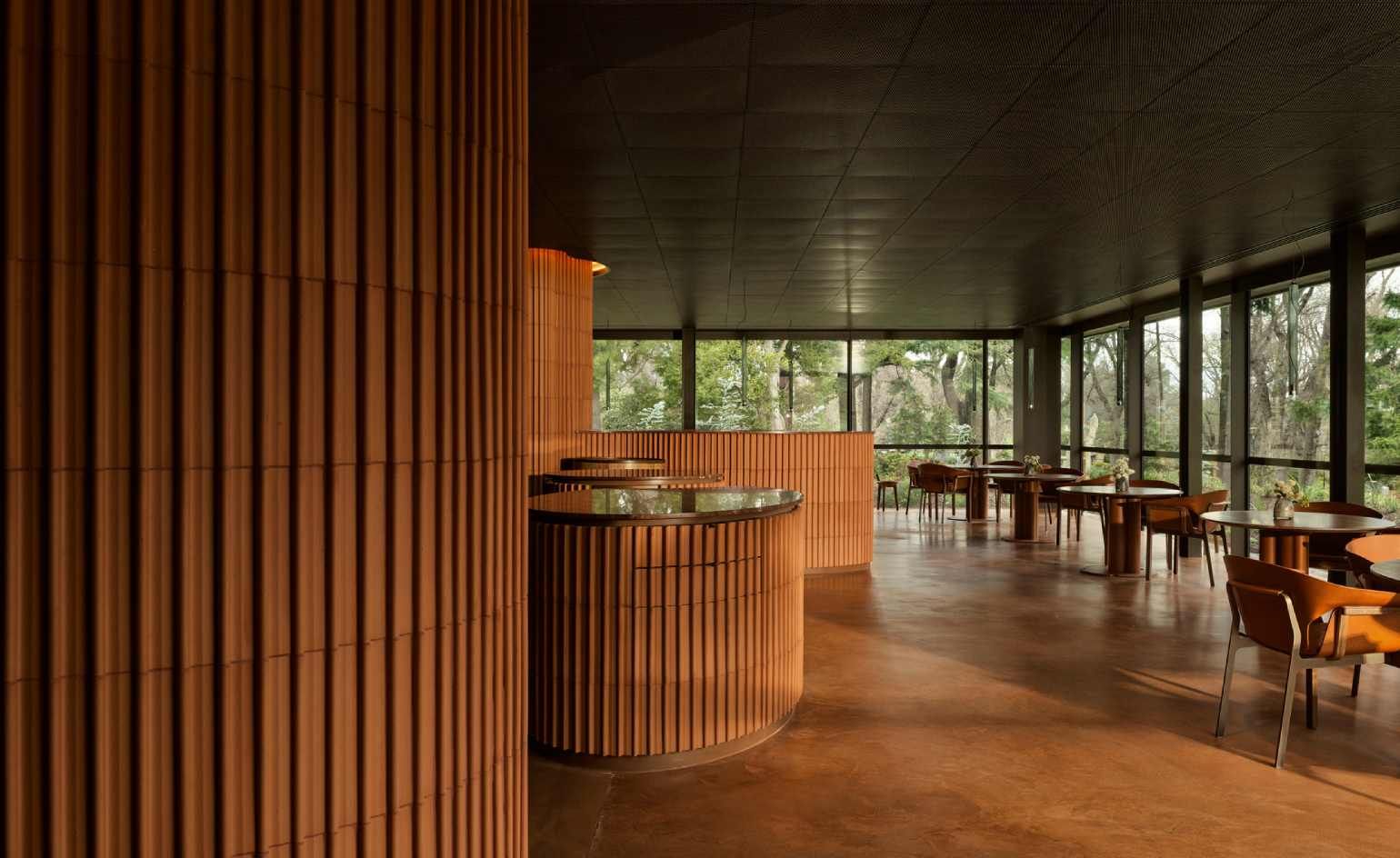
Yiaga arrived with the physical confidence of an institution. Chef and co-owner Hugh Allen spent years developing a former park pavilion with architect John Wardle before opening on October 16, 2025. The low room sits among the elms of Fitzroy Gardens, close to central Melbourne but reached through a sequence of paths, glass, curved walls and a cellar threshold. More than 13,000 individually formed terracotta tiles ripple like bark along the interior; Australian makers supplied blackwood furniture, handblown glass, ceramics and knives.[2][3]
That permanence could easily have trapped the food. When a restaurant invests so heavily in a national story, every course risks becoming an exhibit label: native herb, named producer, worthy object, repeat. Yiaga's early menus suggest the opposite instinct. Allen and head chef Michael McAulay keep recombining the pantry instead of guarding a museum of opening-night hits.[4][6]
The coconut dish shows how continuity can survive revision. Condé Nast Traveler describes coconut tofu with roasted macadamia oil, Oscietra caviar and makrut lime. BLK's Food Blog, recounting a July lunch, adds that the coconut replaces soy in the tofu while coconut water becomes the jelly above it.[5][6] The plate is not persuasive simply because macadamia is local or caviar is luxurious. Its idea is structural: one ingredient supplies curd, water and fat, then salt and citrus pull those textures into focus.
Other combinations resist a tidy national-cuisine box. Broadsheet's confit squid meets white miso, Thai basil and desert lime. BLK's later account puts Tasmanian apple against rich sambar deer and green ants over wagyu on a pancake-like bread.[4][6] None of this argues for purity. The restaurant's Australianness comes from deciding what the available landscape can do—not from pretending the landscape has never borrowed a technique.
The room is part of the cooking time
The photographs make Yiaga look hushed enough to hear a spoon touch ceramic. Ochre curves absorb the eye; the black ceiling recedes; tables face the open kitchen or the green perimeter. Wardle told Wallpaper that the seating was arranged so staff could discuss and deliver courses without cutting across conversations or sight lines. The same report describes a single sitting at dinner, 44 seats and a kitchen team of 12.[3]
Those are not neutral design flourishes. A single sitting removes the pressure to reclaim a table. Wide spacing gives servers cleaner approaches. A large brigade serving a small room can execute components that would be absurd in a faster restaurant. At launch, Melbourne Food & Wine Festival described 14 courses over roughly four hours.[2] The exact menu moves, but the operational bet stays fixed: sell one long piece of attention.
The best reviews understand that the room is machinery, not scenery. Wallpaper follows the guest from public garden to private feast, treating the approach as the first act of pacing. Condé Nast Traveler emphasizes craft both on and off the plate. The July independent review notices the open kitchen and generous table spacing, then spends most of its energy on flavor: crisp-skinned trout, barely cooked prawn, rich venison relieved by apple, a cold burst of herb ice cream. Architecture sets the tempo; food has to justify remaining inside it.[3][5][6]
That distinction matters because beautiful rooms generate soft-focus criticism. A spectacular entrance can make competence feel profound. Here, the later meal evidence is encouraging: BLK describes course after course landing with confidence, while Scoffer's account praises quiet, attentive service and Allen's unforced presence on the floor.[6][7] Still, two strongly positive independent reports are not the same as a mature critical record. We know much more about how Yiaga succeeds than how it recovers when a course, pairing or four-hour rhythm fails.
“Australian” is strongest as a chain of decisions
Yiaga's own description is broad by design. It says the menu and drinks celebrate Australia through farmers, fishers, growers, makers, artists and collaborators, and that the restaurant is made almost entirely from Australian materials.[1] This is promotional language, but the reviews show where it becomes concrete.
Wallpaper traces retired Blackmore wagyu breeding cows, foraged Victorian wakame, Gippsland dairy, Queensland coral trout and native aromatics such as river mint and Geraldton waxflower. The same report follows Australian artisans from the ridged tiles to blackwood furniture and handblown glassware. The July meal report names wines from Geelong, Bendigo, Margaret River and Heathcote rather than treating “local wine” as sufficient description.[3][6]
The chain matters more than the inventory. A retired breeding cow is interesting because age changes flavor and because the kitchen chooses a form that can carry it. Wakame in dessert is interesting only if salinity or texture earns the surprise. A hand-carved spoon matters when its bowl, weight or temperature changes the bite—not merely because a maker can be named.
This is the boundary that the favorable coverage rarely tests. Provenance can deepen a meal, but it can also become luxury's favorite alibi: the more makers listed, the harder it feels to question the result. Yiaga's strongest dishes, as described across the reviews, escape that trap through transformation. Coconut becomes tofu and jelly. Cabbage becomes mille-feuille. Apple interrupts venison. Mandarin is concentrated until a familiar fruit feels newly legible.[4][5][6] The source story begins the course; contrast, texture and pleasure still have to finish it.
The price buys total control—and removes casual excuses
Yiaga now lists its menu at AUD 320. The standard beverage pairing is AUD 195, the prestige wine pairing AUD 395, and the non-alcoholic pairing AUD 120. A regular pairing therefore takes the advertised food-and-drink spend to AUD 515 per person before any Sunday or public-holiday surcharge. The restaurant requires a credit card, charges the menu price per guest for cancellations inside 72 hours, and says same-day party-size reductions cannot be refunded or credited; for earlier reductions within that window, it will try to reseat the smaller party, subject to availability.[1]
Those terms make this a planned expedition, not a spontaneous dinner in the park. They also sharpen the review standard. At AUD 320 before drinks, “interesting” is not enough, and bespoke tableware cannot compensate for a dull middle hour. The guest is buying the coordination of garden, room, kitchen, cellar and floor.
Scoffer concludes that Yiaga earns the price; BLK calls the expense impossible to ignore even while judging the meal a tremendous experience.[6][7] Both positions can be true. Value at this level is not the sum of premium ingredients. It is whether a long menu continues to generate attention without exhausting it, and whether service turns restriction—the fixed format, limited services, strict cancellation window—into ease once the guest arrives.
The current evidence favors lunch for readers who want the garden to remain visibly in the meal, and the official schedule now offers lunch on Friday and Saturday alongside dinner Wednesday through Saturday.[1][3] But no source supports pretending this is a universal recommendation. A diner seeking choice, brevity or a relaxed attitude toward sunk cost should spend elsewhere. Yiaga's format is the feature and the warning.
A confident first verdict, with the future left open
Early acclaim can harden a young restaurant too quickly. Yiaga earned three hats within months of opening, appeared on Condé Nast Traveler's 2026 Hot List, and landed among Broadsheet's best new Australian restaurants of 2025.[4][5] Awards confirm that skilled observers found the opening coherent; they do not turn a ten-month-old dining room into a finished tradition.
Fortunately, finished tradition does not appear to be Yiaga's goal. The menus reported from October, year-end and July retain a few threads while changing enough to show a kitchen still searching. The room is permanent so the food does not have to be. That is a more exciting use of a costly building than enshrining one chef's greatest hits.
The recent-review verdict is therefore strongly positive but precise. Go for a long, controlled meal in which Australian craft is allowed to be plural: Indigenous ingredients and immigrant seasonings, old cattle and young chefs, park history and new ceramics, local wine and European bottles. Do not go merely to collect patriotic luxury objects.
Yiaga works when every named origin leads to a culinary consequence. The tile should alter the hush. The chair should make four hours possible. The producer should change the flavor. The ingredient should submit to a new form. When that chain holds, Australia is not the theme of dinner. It is the way dinner gets made.
Sources
- Yiaga, official information page — current menu and pairing prices, opening hours, reservation releases, surcharge, and cancellation terms.
- Melbourne Food & Wine Festival, “Hugh Allen's Yiaga is Australia's most ambitious new restaurant” (October 16, 2025) — opening-day report on the room, course count, price, drinks, and first menu.
- Wallpaper, Daven Wu, “Discover a hidden culinary gem in Melbourne” (January 3, 2026) — Anson Smart's restaurant photography and reporting on the pavilion, makers, seating, brigade, ingredients, and service rhythm.
- Broadsheet, “The 11 Best New Australian Restaurants of 2025” — editorial assessment of Yiaga's architecture and opening menu, including kale mille-feuille, confit squid, coconut and the Banksia Pop.
- Condé Nast Traveler, Joanna Kawecki, “Yiaga” (Hot List 2026) — review of the restaurant's Australian craft thesis, three-hat reception, wagyu, wakame and coconut-tofu course.
- BLK's Food Blog, “Yiaga is full of confidence—10 months in” (July 26, 2026) — detailed independent lunch account covering current dishes, wine, room, service and the expense boundary.
- Scoffer, Felix Marrow, “Yiaga Melbourne Review: Hugh Allen's Three Hat Fitzroy Gardens Restaurant” (May 26, 2026) — independently paid meal report on service, wine, value and the restaurant's early critical standing.