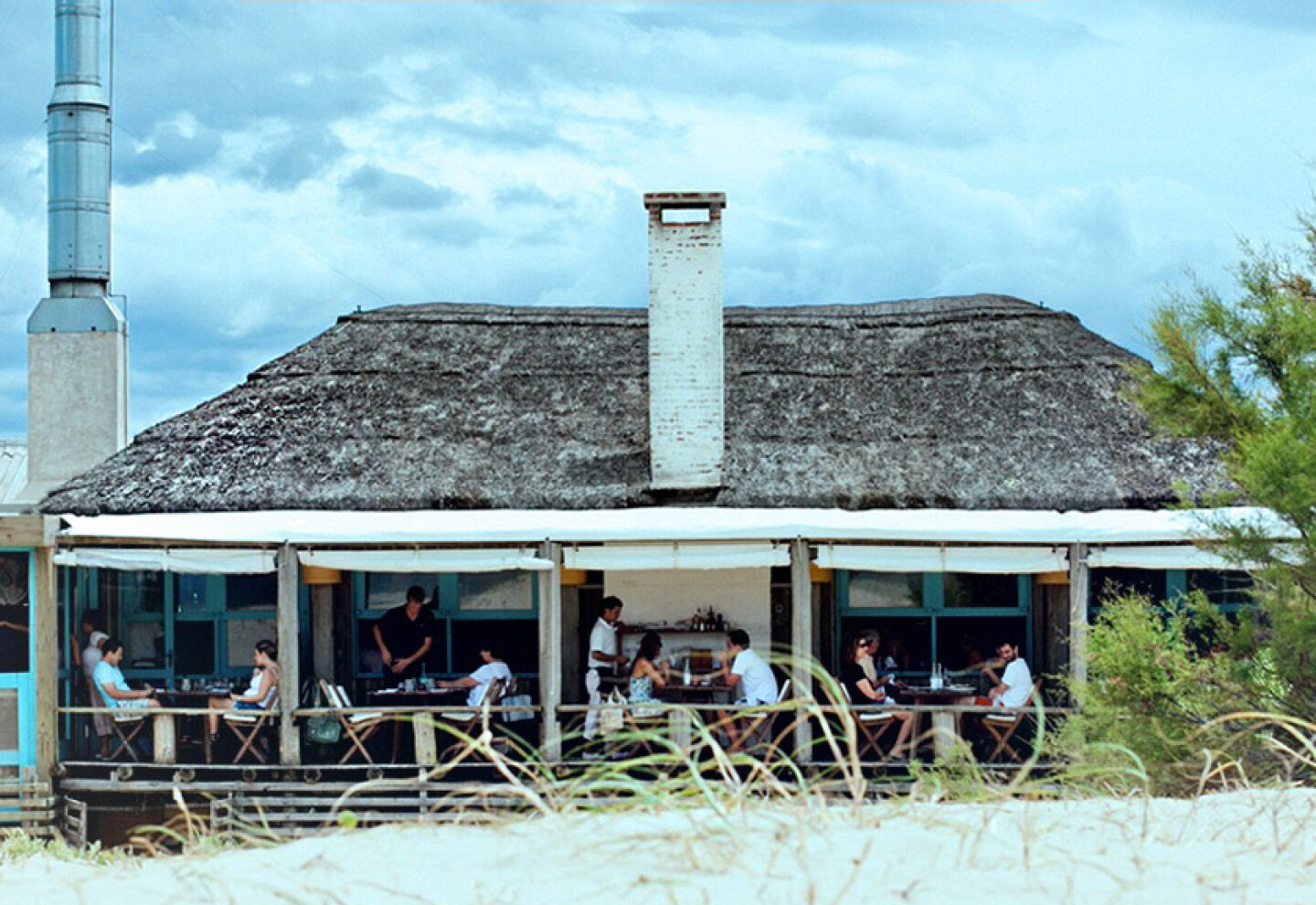
At lunch, the fire announces itself before the dining room does. Smoke drifts above the low roof at Playa Brava; wind moves through timber, canvas and beach grass; fish meets the grill within earshot of the Atlantic. La Huella is open to the day, and the whole visible apparatus—sand, flame, cooks, families, wet hair, cold glasses—pulls people toward it.
After dark, another fire works in the opposite direction. Marismo sits beyond the peninsula near Route 10, reached from a dirt road and organized around sand, trees, candles and a fogón. The ocean is no longer the bright stage. The room contracts to the light around the table. A bottle, a piece of lamb, a wood-fired crust and the faces opposite become the available landscape.[4][5]
These are not two versions of the same beach restaurant. They are the two poles of José Ignacio's dining grammar. La Huella makes rusticity perform at formidable scale; Marismo makes intimacy feel discovered. Both use open fire, local products and an apparently unbuttoned room. What separates them is the social work assigned to the flame: one gathers a crowd in public, while the other edits the world down.
This is a sourced scene portrait, not a claim to have eaten at either restaurant. The record combines current official and local reporting with older, unusually detailed profiles and a first-person interview with Marismo chef Federico Desseno. Menus, seasons and service can change. The more durable subject is how two rooms taught an ambitious dining destination to look relaxed.[1][2][3][4][5]
Before the restaurants, a warning light
José Ignacio's first great light was functional. The local government traces the lighthouse to a run of shipwrecks in the 1870s: a proposal was accepted in 1875, construction took two years, and the tower opened in a place it describes as inhospitable and unpopulated. Supplies for the keepers came from nearby estancias; beyond the tower were a well and rough shelters for animals.[6]
That origin matters because the modern dining scene still depends on the same exposed geography. The peninsula pushes into the Atlantic. Wind, sand and salt are not decorative references chosen by a designer; they are conditions every light structure, table setting and service plan has to negotiate. José Ignacio became luxurious without entirely ceasing to look temporary.
La Huella understood that tension early. The restaurant opened on Playa Brava in the first week of December 2001 after a long permitting process. Its founders had considered a more conventional development, but the project that survived was a low beach parador operated by Martín Pittaluga, Guzmán Artagaveytía and Gustavo Barbero. The original intention was not to import metropolitan grandeur. It was to build something its backers believed belonged to José Ignacio.[2]
The distinction is visible in the building. La Huella does not offer a sealed glass box from which diners admire nature at a safe distance. Its shaded decks and open windows admit breeze, smoke and the changing light. An old fishing settlement did not acquire a formal luxury room; the parador form acquired the systems of a major restaurant.[2][3][8]
La Huella: informality as a large machine
La Huella's great illusion is that nobody appears to be trying very hard. The menu's public identity remains direct—fish, seafood, vegetables, rice, bread, pizza, meat over fire—and the official site still introduces the place with little more than its Playa Brava address and contact details.[1] The room's visual language says beach lunch, not culinary headquarters.
The reported numbers tell another story. A 2012 Bon Appétit profile described a January brigade of 40 cooks serving as many as 1,000 covers in a day, alongside an in-house bread program and relationships with organic farms. A history updated by La Nación in 2025 says the first season managed roughly 60 covers a day; at peak season, the figure had grown to around 1,500, with 120 people working at the parador.[2][3] Those numbers come from different moments and sources, so they should not be treated as a current capacity sheet. Together, however, they reveal the size of the operating problem hidden beneath the straw roof.
Fire at that volume is not primitive cooking. It is fuel management, station design, purchasing, butchery, fish handling, bread production, reservation judgment and a floor team able to keep a deck convivial when several hundred people want the same sunset. A grilled corvina can look inevitable only after an organization has made weather, delivery, heat and timing disappear from the guest's field of vision.
Scale also changes the meaning of casualness. In a small room, a loose gesture can be personal. At La Huella, looseness has to be reproduced without becoming neglect. The sneakers, timber platters and shifting air work because a much stricter system sits behind them. That is the restaurant's central fine-dining move: not placing luxury objects on the beach, but making a huge service machine feel like an extension of a day by the water.[2][3]
The founders' insistence on opening beyond the summer deepened that role. La Nación reports that year-round operation was written into the original agreement, at least on weekends in the off-season, partly because a light structure abandoned for six months risked being overtaken by the dune.[2] The detail is almost too perfect. Continuity here is not marble permanence. It is the repeated act of keeping the sand from winning.
Marismo: the fire after the road turns dark
Marismo inherits the same materials and rejects the same scale. In a long interview, Desseno describes arriving from Argentina at 20, working at Los Negros with figures who would help shape the local restaurant network, and deciding to remain in José Ignacio. His account makes the scene sound less like a collection of isolated chef brands than a set of kitchens, jobs and friendships through which people moved.[4]
The early Marismo was fragile in the literal sense. Desseno remembers a tiny room, insufficient infrastructure, food running out, and wind and rain reaching the sides of the table. It began around 30 covers and later reached 70. Artists, musicians and established local figures helped word travel. The glamour arrived before the restaurant had fully mastered shelter.[4]
That roughness could have been polished away as José Ignacio grew. Instead, the room made exposure its form. Recent local dispatches still describe Marismo just beyond town, off a dirt road, with firewood cooking and feet in the sand; the wine cellar, family presence and darkness around the tables are treated as part of the experience rather than obstacles to it.[5]
Here, fire does not broadcast capacity. It establishes a perimeter. Candles and the fogón give the eye only enough information: scorched surface, rising steam, the rim of a glass, trees beyond. Food suited to this room must survive proximity to smoke and atmosphere. It needs flavor with edges—wood, salt, rendered fat, browned dough—but also enough restraint that the setting does not turn dinner into a campfire theme.
The risk is obvious. A beautiful night can season mediocre cooking, and sand beneath a chair can make inconvenience feel authentic. Desseno's own history is more useful than the usual romance because it shows that the atmosphere was not conceived as an exportable luxury aesthetic. It grew out of limited infrastructure, local labor and a cook choosing to stay. The room became desirable without erasing the conditions that made it.[4]
Two fires, two kinds of attention
Put the restaurants together and José Ignacio's house style becomes clearer.
La Huella is centrifugal. Its fire sends aroma and spectacle outward; its decks absorb the beach crowd; its best trick is turning volume into ease. Marismo is centripetal. Its fire draws people into a small illuminated circle; the dark removes visual competition; its best trick is making seclusion feel hospitable rather than staged.
One depends on legibility. You should understand where you are immediately: Playa Brava, open grill, sea beyond. The other depends on transition. The road, turn, sand and low light make arrival part of dinner. At La Huella, the restaurant amplifies the public life of the beach. At Marismo, the restaurant suspends it.[3][4][5]
The common language is not a fixed list of Uruguayan dishes. It is material: wood rather than chrome, wind rather than climate control, sand allowed to remain sand. Fire turns that material language into flavor. This is why the scene has proved so imitable and so difficult to copy. A developer can purchase rough timber and hang linen; it cannot purchase decades of staff movement, supplier habits, weather knowledge and the social permission to look unfinished.
Summer is the invisible third kitchen
The relaxed picture also hides a severe seasonal clock. During the 2025–2026 summer, Maldonado's transport authority barred several bus routes from entering central José Ignacio between 11:00 and 21:00 through February 28, directing them to terminate by the ANTEL office. The stated reason was the pressure of visitor and vehicle traffic.[7] That is not restaurant trivia. It changes how workers arrive, how guests move, when deliveries meet congestion and what a supposedly spontaneous lunch requires from the town around it.
Seasonality creates two José Ignacios. At peak, the small settlement has to process metropolitan demand without looking metropolitan. Outside peak, a room must decide whether to reduce, close or keep enough continuity that skills and relationships survive. La Huella's all-year ambition and Marismo's smaller, seasonal identity are different answers to that same problem.[2][4][7]
This is where the scene's real luxury sits. Not in sand by itself, and not in celebrity proximity. It lies in converting exposure into confidence: knowing how the wind changes the pass, how many fires the room needs, which fish can carry smoke, how a cold night alters pacing, and how to welcome a crowd without building a dining room that could be anywhere.
José Ignacio's two emblematic fires make opposite promises. La Huella says the whole beach can become a table. Marismo says one table can become the whole night. The first promise needs scale disciplined until it feels effortless; the second needs intimacy protected from becoming theater. Between them, a tiny Atlantic settlement found a fine-dining language that never had to put on a jacket.
Sources
- Parador La Huella, official site — current Playa Brava location and restaurant contact.
- Jorge Martínez Carricart, La Nación, “Dos amigos, un cuadro y una playa desierta: la particular historia de La Huella, el parador más exitoso de Uruguay” (updated November 18, 2025) — founding, opening, scale, staffing, year-round operation and local restaurant lineage.
- Christine Muhlke, Bon Appétit, “La Huella, Uruguay” (2012) — reported service scale, brigade, bread program, farm relationships, room and fire-grill atmosphere.
- Location.uy, “Charlas Location: Federico Desseno” — first-person account of the chef's arrival, Marismo's improvised early services, growth and José Ignacio's restaurant network.
- Donna Lennard, Yolo Journal, “Dispatch from José Ignacio & Garzón, Uruguay” (2026) — recent scene report on La Huella, Marismo and the coast's fire-centered dining culture.
- Intendencia de Maldonado, “José Ignacio celebró los 147 años de la inauguración de su faro” (July 2, 2024) — lighthouse, shipwreck and early-settlement history.
- Intendencia de Maldonado, “Área de Tránsito extiende la prohibición del ingreso de ómnibus al centro urbano de José Ignacio” (January 30, 2026) — summer bus restrictions and visitor-pressure context.
- El País Uruguay, “Parador La Huella entre los nueve mejores del mundo” (January 7, 2017) — source page for the Parador La Huella photograph and contemporary description of its open beach terraces.