
Wylie Dufresne's 2011 Harvard Science and Cooking lecture is easy to misfile as a period piece from the high modernist moment: a chef at the board, a room full of students, and transglutaminase presented under its tabloid nickname, "meat glue."[1][2] Watch it that way and the talk becomes a museum label for a closed restaurant. Watch it more carefully and it becomes something more useful: a lecture about when fine dining earns the right to make food look unfamiliar.
That distinction matters because wd~50, Dufresne's Lower East Side restaurant, was never only a gadget room. The restaurant became famous for modernist techniques, and Eater's closure coverage places its final 2014 service in the physical reality of 50 Clinton Street: a restaurant name tied to an address, then pushed toward its end by redevelopment.[6] But Dufresne's best dishes worked because the strangeness kept circling back to memory. The diner might not recognize the format at first glance, but the plate still had to land as pleasure, wit, texture, and hospitality.
The video below is worth watching with that problem in mind. Transglutaminase is not the point by itself. The point is how an enzyme can let a kitchen ask sharper questions about structure: what holds, what bends, what feels like a noodle, what reads as an egg, and what kind of surprise still respects the guest.
The opening stretch is useful because Dufresne does not introduce the enzyme as magic. He treats it as a tool with a narrow job: bonding proteins. Harvard's 2011 lecture page places the talk in a course sequence on "Proteins & Enzymes: Transglutaminase," which is exactly the right frame.[2] The enzyme is not a personality. It is a condition of possibility. It can help turn a protein mixture into something sliceable, shapeable, or noodle-like, but it cannot make the dish good.
That is the first fine-dining lesson. A technique only becomes cuisine when it has a guest-facing reason to exist. McGill's Office for Science and Society gives the plain scientific version: transglutaminase forms cross-links between proteins and is used in food processing to bind meat, fish, and other protein structures.[5] The culinary risk is obvious. A chef can use that property to create clarity, or use it to create novelty that has nowhere to go after the first bite.
Around the lecture's early demonstrations, the right thing to watch is Dufresne's tone. He is playful, but the play is procedural. He keeps moving from the chemical action to the eating effect. That is where the talk separates itself from the lazy caricature of "molecular gastronomy" as laboratory showmanship. The chef's real question is not "Can this be glued?" It is "What familiar form can be rebuilt so the diner feels both recognition and displacement?"
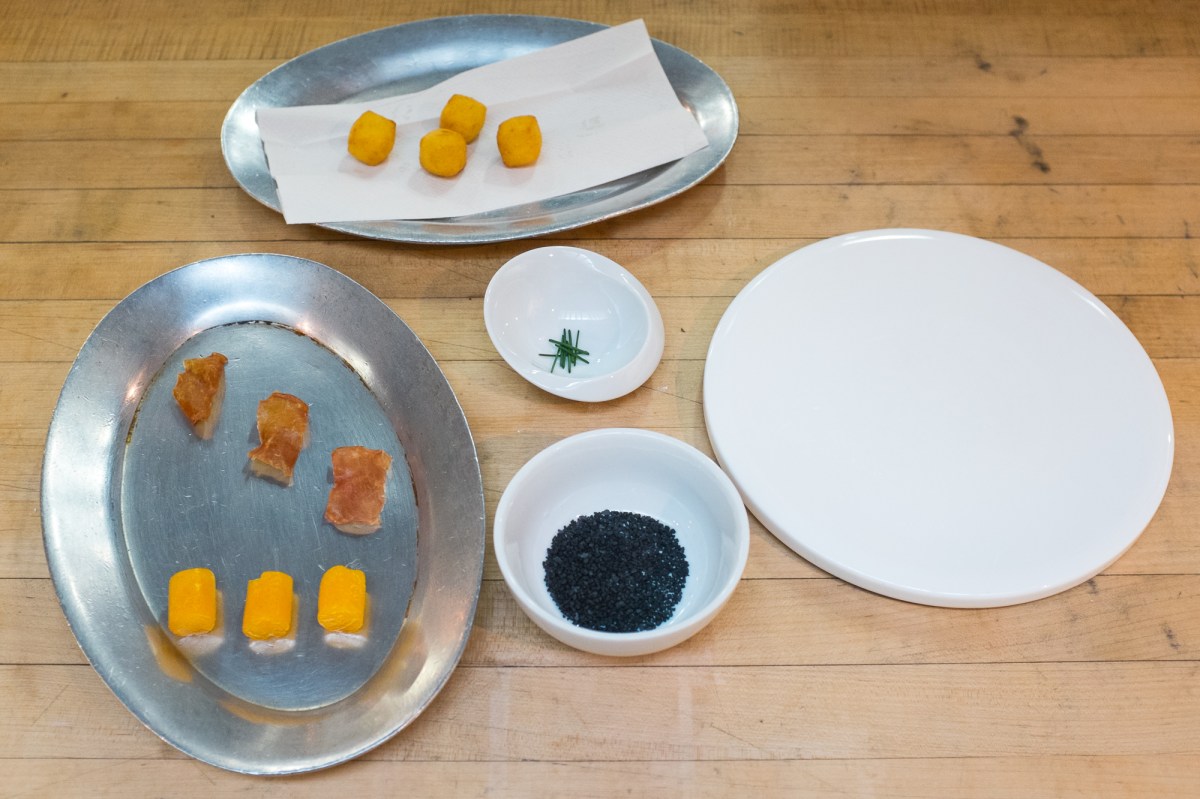
wd~50's Eggs Benedict makes that logic especially clear even though it is not a transglutaminase showcase. Eater's deep dive into the dish describes how the restaurant broke the brunch classic into yolk, bacon, fried hollandaise, English muffin crumbs, black salt, and chive points, then rebuilt it as a plate that looked unlike diner Eggs Benedict while still calling up the same memory.[4] The fried hollandaise alone took months of testing: gelatin for portioning, starch and gums for heat tolerance, breading for the fryer, and a cube shape that was both efficient and visually direct.[4]
That process explains why Dufresne's Harvard talk still has value after wd~50 closed. The modernist ingredient is never interesting in isolation. It becomes interesting when it solves a dining-room problem. Shrimp noodles are not better because shrimp has been forced into a noodle shape. They are better only if the noodle shape changes how shrimp texture, aroma, sauce, and bite behave. Fried hollandaise is not better because a sauce entered a fryer. It is better only if the cube protects the memory of hollandaise while making temperature and crunch part of the joke.
Eater's 2013 report on a later Dufresne Harvard appearance catches this tension in a sharper public setting. The writeup notes that the lecture turned transglutaminase into a discussion of culinary "dirty little secrets," but it also quotes Dufresne resisting rigid correctness in cooking.[3] That resistance is important. The modernist chef can seem like a rule-maker because the work is so technical. Dufresne's better claim is nearly the opposite: technique expands the field of possible forms, but taste and context still decide whether the form deserves to exist.
The strongest section of the embedded lecture, then, is not any single trick. It is the repeated insistence that structure can be designed. A conventional kitchen inherits many structures from tradition: an egg yolk is round, hollandaise is a sauce, shrimp is a piece of seafood, noodles are made from starch or wheat. Dufresne asks which of those structures are necessary and which are merely habitual. Fine dining becomes compelling when it changes the second category without damaging the first. The diner should feel the eggness, the seafoodness, the sauce memory, or the breakfast joke more clearly after the transformation, not less.
There is also a historical reason to revisit the talk now. wd~50 closed in 2014 after Dufresne announced that the building housing the restaurant would be torn down for new development.[6] Enough distance has passed that the old argument over whether the cuisine was too clever feels less useful. The better question is what survived. The answer is not meat glue as a gimmick. It is a method of testing whether a dish's form can be argued with.
That is why the lecture belongs in a fine-dining feed rather than a food-science sidebar. Dufresne shows that technical cooking becomes hospitable only when it gives the diner a stronger experience of something they already care about: a breakfast memory, a texture joke, a cleaner cut, a more surprising sauce, a familiar flavor made unstable for a reason. The enzyme may bond proteins, but the dish has to bond technique to appetite. Without that second bond, modernism is just equipment.
Sources
- Harvard Science, "Proteins & Enzymes: Transglutaminase" - YouTube video source for the embedded Wylie Dufresne lecture.
- Harvard Science and Cooking, "Science and Cooking Public Lectures 2011" - institutional lecture listing that places Dufresne's talk in the course sequence on proteins, enzymes, and transglutaminase.
- Paula Forbes, "Wylie Dufresne at Harvard: Meat Glue and the 'Dirty Little Secrets of Chefs'," Eater, 2013 - report on Dufresne's Harvard discussion of transglutaminase and culinary rules.
- Hillary Dixler Canavan, "Wylie Dufresne Looks Back at wd~50's Iconic Eggs Benedict," Eater, 2015 - process account and Nick Solares photographic source for the article image.
- Joe Schwarcz, "What is 'meat glue'?" McGill Office for Science and Society - scientific explanation of transglutaminase and protein bonding in food.
- Khushbu Shah, "The Shutter," Eater, 2014 - closure context for wd~50, including Dufresne's explanation that the building housing the restaurant was being redeveloped.