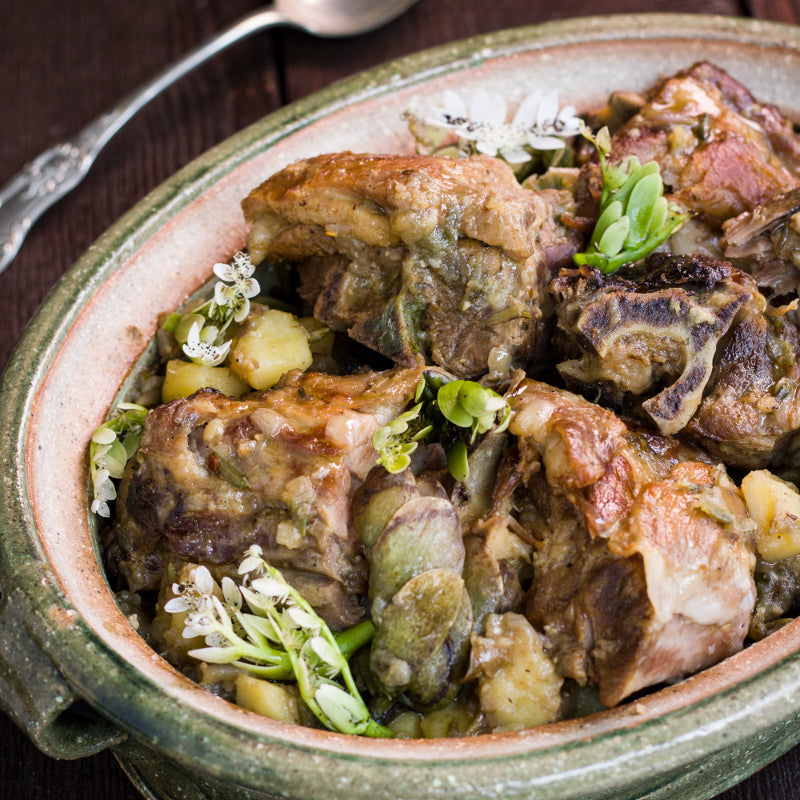
In waterblommetjiebredie, the flower goes into the pot with the potatoes. It shares the cooking liquid with browned lamb, soft onions, and the juices collecting around the bones. By the time the stew reaches the table, the botanical curiosity has become part of dinner. The Afrikaans name gives a useful introduction: waterblommetjie means “little water flower,” and the compound names a stew of meat and those flowers.[1]
The ingredient deserves that place in the name. Writing in Woolworths TASTE, Ilse van der Merwe compares its texture to small artichoke leaves and its flavor to green beans with a lemony floral hint.[3] That is an inviting combination for lamb: something green and gently structured inside a rich, yielding mouthful. The cook's challenge is to let the flower remain worth finding.
The most revealing way into this dish is through its sequence. Several Cape recipes agree on the basic company—lamb or mutton, onions, potatoes, waterblommetjies—but give the vegetable different amounts of time in the pot.[3][4][5] Their differences make a useful tasting question: how much should dissolve into the gravy, and how much should still meet the spoon?
The pond sets the season
The plant is Aponogeton distachyos, an aquatic perennial whose oval leaves float on the water. CapeNature describes a forked flowering structure carrying small white flowers with brown anthers. It grows in ponds and seasonal wetlands, where dormant tubers begin growing again when autumn water returns.[2] The flowers have a life before the casserole, and that life depends on the water coming back.
CapeNature gives the flowering and harvest window as roughly June to mid-October. Fresh produce is the principal form sold, although canned waterblommetjies also travel abroad.[2] That distinction matters when a restaurant puts the dish on a menu. A cook working with fresh flowers is handling a seasonal vegetable; a preserved supply offers another set of possibilities. The menu can simply say which it uses.
Long familiarity has left a paper trail. The Dictionary of South African English records the dish in Hildagonda Gerber's Cape Cookery in 1950, followed by references to gathering, shopping, and restaurant cooking. It also preserves less reverent judgments, including a complaint that the vegetable tastes bland.[1] This is useful company for a celebrated regional dish. Affection can explain why people return to it; seasoning and cooking still have to make the next bowl good.
Two arrivals in the pot
First comes the unglamorous work of cleaning. Van der Merwe calls for a soak in salted cold water, followed by draining and rinsing, to remove sand. Her meat is browned in batches, then simmered with onion, water, and a little nutmeg. The potatoes and waterblommetjies arrive after about an hour and cook for roughly another hour, until the meat and potatoes are tender.[3]
That delay gives the lamb a head start while leaving substantial cooking time for the vegetable. Imagine the task from the diner's side: the meat should give way readily, yet the green ingredient needs enough presence to reward a separate bite. Those are related pleasures, and the kitchen has to arrange for them to coincide.
Ina Paarman's version makes the interval more pronounced. The lamb cooks slowly until tender, about an hour and a half; the flowers and diced potatoes then get approximately twenty minutes. Her recipe uses stock, wine vinegar, garlic, and seasoning, with lemon juice added at the end.[4] The shorter vegetable stage is one reason to treat these published timings as complete methods, rather than interchangeable instructions.
A Getaway recipe offers a third approach: divide the waterblommetjies. Half enter with the potatoes, and the rest follow thirty minutes later, alongside lemon juice.[5] The author describes the recipe as a personal combination of several versions. Read as a cooking idea, that split suggests a way to pursue both integration and texture: one addition spends longer in the sauce, while the later one has less time to soften.
For a restaurant kitchen, I would taste the vegetable itself before choosing among these approaches. A neat portion of lamb tells only part of the story. The flower's tenderness, the condition of the potatoes, and the amount of gravy carried by a spoonful determine whether the bowl feels complete.
Give the rich spoonful a sour edge
Sourness belongs inside the dish's vocabulary. CapeNature identifies local sorrel, or suring, as a traditional addition for acidity.[2] Paarman uses both vinegar during cooking and fresh lemon juice at the finish.[4] These choices offer a cook different moments at which to adjust the stew's balance.
My preference would be to assess that balance with the rice alongside it. Rice appears in all three culinary sources considered here.[3][4][5] It belongs in the tasting spoon: a sauce that seems forceful alone may read differently once it coats a mouthful of grain, potato, flower, and lamb. Adjusting the pot without tasting the way dinner will be eaten misses that last relationship.
There is room for careful presentation—a warm shallow bowl, a recognizable flower cluster, enough gravy to reach the rice. The dish already brings an unusual ingredient and a patient sequence of cooking to the table. Give the diner a spoon that can gather them together.
Sources
- Dictionary of South African English, “waterblommetjie” — meaning, botanical identification, and historical quotations documenting the dish's domestic and restaurant life.
- Ruida Stanvliet, “Aponogeton distachyos: The Waterblommetjie,” CapeNature (May 19, 2023) — growth cycle, flower structure, harvest season, preserved availability, and sorrel in the traditional stew.
- Ilse van der Merwe, “Waterblommetjiebredie,” Woolworths TASTE (February 24, 2026), extracted from Timeless South African — sensory description, cleaning, and staged lamb-and-vegetable cooking.
- Ina Paarman's Kitchen, “Waterblommetjie Bredie” — lamb-first preparation, shorter vegetable cooking, vinegar and final lemon juice; source of the article's photograph.
- Getaway, “Waterblommetjie bredie recipe” (June 15, 2010) — an explicitly adapted recipe that adds the waterblommetjies in two stages.