Tokaji Aszu is too often treated like a polite museum object. It appears at the end of dinner, near a custard, a fruit tart, or a cheese trolley, and the room speaks about it with the voice reserved for famous old things: noble, historic, sweet, rare. None of that is wrong. It is just too small a job for a wine with this much structure.
The better fine-dining use is not "dessert wine" in the lazy sense. It is a precision pour of sweetness with an acid spine. A small glass can make salt taste cleaner, fat feel less flat, spice feel more deliberate, and blue cheese feel less like a dare. The trick is to stop pairing Tokaji Aszu only by sugar level and start pairing it by tension: concentration against lift, honeyed depth against citrus bite, amber age against a plate that still has savory momentum.
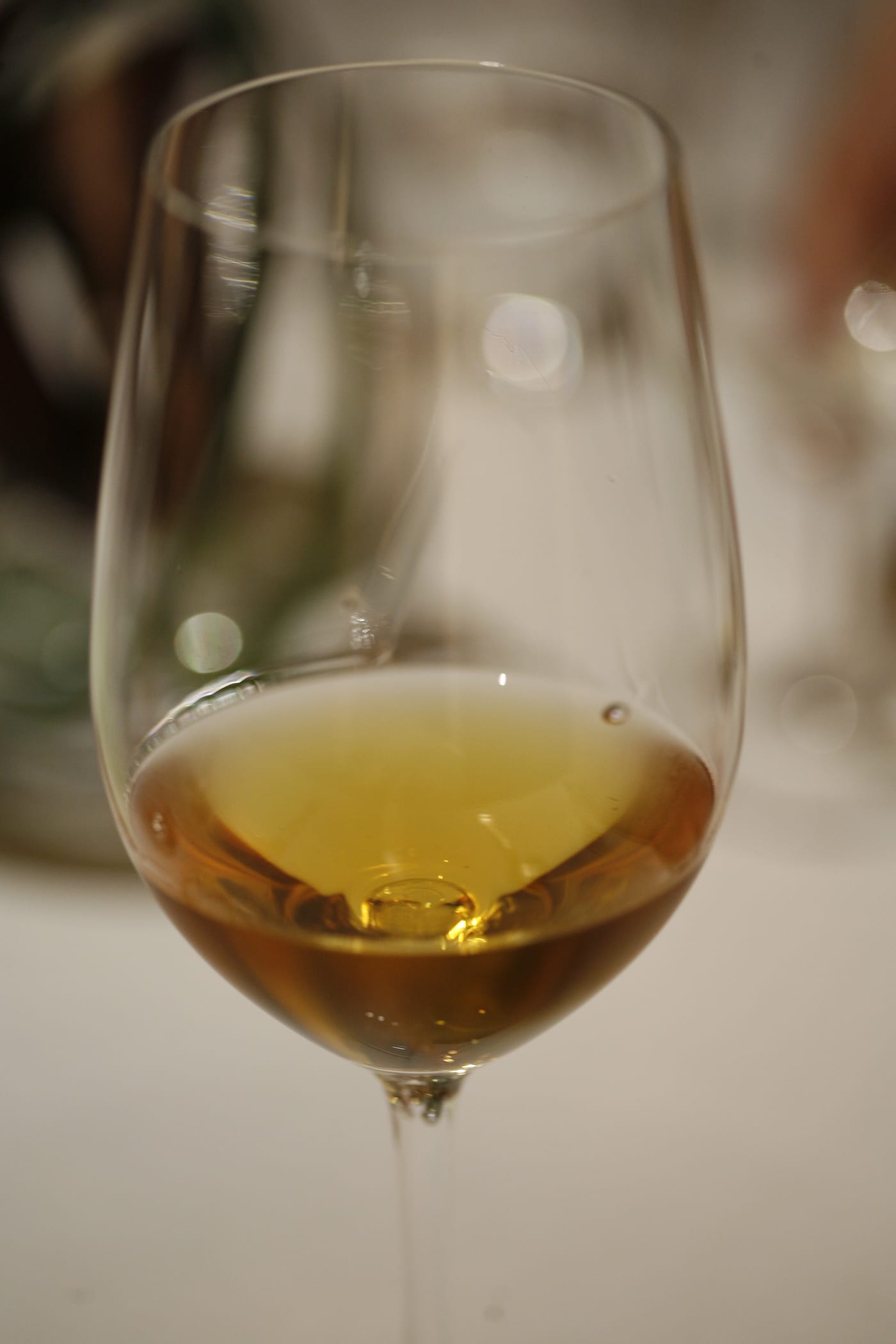
The cover image shows the useful scale of the idea. The glass is not full. The wine is amber and low in the bowl, almost a seasoning rather than a beverage by volume.[5] That is the right way to think about it in a long menu. Tokaji Aszu should not flood the guest. It should tilt one course.
The Place Builds The Tension
Tokaj's drama begins before the bottle. The Hungarian World Heritage site describes the region at the foothills of the Zemplen Mountains, near the Bodrog and Tisza river systems, where volcanic slopes and floodplain wetlands help create the microclimate that supports Botrytis cinerea, the noble rot needed for Aszu grapes.[1] The same site notes that aszu wine production has been documented there for centuries and that the region was demarcated by royal decree in 1737.[1]
That geography matters at the table because noble sweet wine is not simply a way to make grapes sweeter. Botrytis changes grapes by concentrating sugar, acidity, flavor, and texture. In weak service, that concentration becomes a dessert cue: pour it with the final sweet course and let history do the talking. In better service, it becomes a tool for contrast.
Tokaji Aszu's fine-dining value comes from the wine's refusal to behave like syrup when it is balanced well. The plate can be rich, but the wine should not feel like a sauce poured into the glass. The plate can be salty, but the wine should not merely cancel salt with sweetness. The point is a controlled opposition: the course pulls one way, the glass pulls another, and the diner gets motion instead of heaviness.
Sugar Is Only The Beginning
The numbers can be startling. WSET's Tokaji guide describes Tokaji Aszu as made from hand-picked botrytized berries macerated into a base wine, then explains that 5 puttonyos means at least 120 grams per liter of residual sugar and 6 puttonyos means 150 grams per liter or more.[2] Modern regulations require all Tokaji Aszu wines to reach at least 120 grams per liter.[2] Those figures are useful, but they can mislead a pairing decision if the sommelier reads them as dessert instructions.
Sugar tells you concentration. It does not tell you shape. The shape comes from grape, acid, botrytis, barrel, age, and serving context. WSET identifies Furmint as Tokaj's widely planted grape and notes its high acidity and aging potential; Harslevelu and Sargamuskotaly add richness, floral detail, and aromatic lift in blends.[2] In the glass, that means sweetness can arrive with snap instead of slowness.
This is why Tokaji Aszu can be more agile than a guest expects. It has enough sugar to stand beside forceful flavors, but enough acidity to keep the mouth awake. When poured too warm, too large, or too late, it becomes a prestige sweet wine. When poured cool, small, and early enough in the menu, it becomes a hinge between savory and sweet.
The Best Pairings Are Savory First
The obvious pairings still work because they are mechanically sound. Blue cheese gives salt, fat, bitterness, and mineral bite. Tokaji gives sugar, acid, dried-fruit depth, and lift. The Guardian's 2024 wine column frames Tokaji's modern appeal around its sweetness held in check by acidity and points to blue cheese as a natural partner for a 5 puttonyos bottling.[4] That is not a cliche by accident. It is a pressure system that works.
But blue cheese should not be the ceiling. A fine-dining menu can use Tokaji with foie gras, duck liver parfait, glazed duck, pork with fruit and spice, aged hard cheese, mushroom-rich poultry, or a course with saffron, apricot, quince, chestnut, ginger, or gentle chile heat. The wine needs a plate with salt, savor, and density. It does not need another spoonful of sugar.
The most useful question is not "what dessert matches this?" It is "where would sweetness act like seasoning?" A small pour of Aszu can do for a torchon what a fruit gel tries to do on the plate, except the diner controls the alternation. With blue cheese, it can make sharpness feel deliberate rather than punishing. With spice, it can cool the attack without erasing the dish. With roasted or glazed meats, it can echo caramelization while acid keeps the bite from becoming sticky.
The mistake is pairing it with desserts that already carry the same vocabulary: honey, caramel, dried apricot, candied orange, rich custard, and heavy pastry all at once. That can be delicious for two bites and exhausting by the third. Tokaji Aszu is often better when the plate leaves space for it. Salt and umami are space. Fat is space if the acidity has somewhere to cut. Pure sweetness is usually not.
Age Makes It More Useful, Not Just More Reverent
Older Tokaji Aszu can make sommeliers sentimental, but age should still serve the course. Bor.hu's report on 1990s Aszu tastings describes wines that remained fresh after decades, with acidity acting as a foundation even where residual sugar could run around 150 to 200 grams per liter.[3] The same report notes a modern gastronomy trend of serving Tokaji Aszu not only at the end of the meal, but with main courses.[3]
That shift is important. As Aszu ages, fruit can move from bright apricot and citrus peel toward honey, mushroom, spice, tea, tobacco, cocoa, or dried fruit. Those notes are not automatically "dessert" notes. In the right hands, they are bridge notes. Mushroom and tea can meet poultry. Ginger and dried fruit can meet duck. Cocoa and spice can meet venison or aged cheese. The sweetness remains, but the wine's savory shadows become easier to use.
For service, this argues for restraint. A 50- to 75-milliliter pour is often enough in a tasting menu. Serve it cool rather than refrigerator-cold, so the aromatics open without turning the sugar sluggish. Put it before the guest is tired. If the menu already has several sweet-leaning courses, use Aszu as the one sweet accent and keep the plate more savory. If the dish is already rich, keep the pour smaller and let acidity do the work.
What The Dining Room Has To Get Right
The bottle alone cannot make the pairing elegant. The dining room has to frame it correctly. If the server introduces Tokaji Aszu as "a dessert wine," the guest will brace for sugar. If the server introduces it as "a small sweet wine with serious acidity for the salt and fat in this course," the guest knows how to drink it.
The glassware should help. A tiny thimble pour in a clumsy glass makes the wine feel ceremonial and distant. A modest pour in a proper white-wine stem lets the guest smell the botrytis, citrus peel, honey, saffron, and age. The temperature should suggest refreshment, not syrup. The pacing should make room for alternation: bite, sip, bite, not one isolated taste after the plate is gone.
The kitchen also has to resist over-explaining the same idea twice. If the wine is carrying apricot and honey, the plate does not need apricot puree, honey tuile, and candied zest. If the wine is balancing blue cheese, the plate does not need a sugary chutney that crowds the glass. If the dish has chile or ginger, the wine can soften heat, but the kitchen should leave the spice alive enough to justify the pairing.
Tokaji Aszu is famous because of history, noble rot, royal reputation, and long life. Fine dining should care about all of that, but not stop there. The more interesting reason to pour it is practical: it lets sweetness act with manners. It can enter a savory course without turning dinner into dessert. It can make richness move. It can make salt ring. It can turn blue cheese, liver, spice, and roasted depth into something brighter than any of those parts alone.
That is the pairing lesson. Tokaji Aszu is not precious because it is sweet. It is precious because, at its best, sweetness does not sit still.
Sources
- Hungarian World Heritage Site, "Tokaj Wine Region Historic Cultural Landscape" - official site notes on geography, rivers, Botrytis microclimate, aszu tradition, and the 1737 demarcated wine region.
- Wine & Spirit Education Trust, "Tokaji decoded: the science behind Hungary's iconic sweet wines" - production overview, grape varieties, puttonyos thresholds, residual sugar levels, and Tokaji styles.
- Magyar Bor / Bor.hu, "What are the Tokaji Aszus from the nineties like?" - tasting report on aged Aszu, acidity, residual sugar ranges, bottle scarcity, and modern main-course pairing interest.
- David Williams, "Let's talk about Tokaji, the Hungarian wine that inspired Beethoven and Goethe," The Guardian, 2024 - modern wine-column context on Tokaji's acidity, post-communist recovery, and blue-cheese pairing logic.
- Wikimedia Commons, "File:A glass of Tokaji.jpg" - real 2008 photograph by Charles Haynes used as the article image.