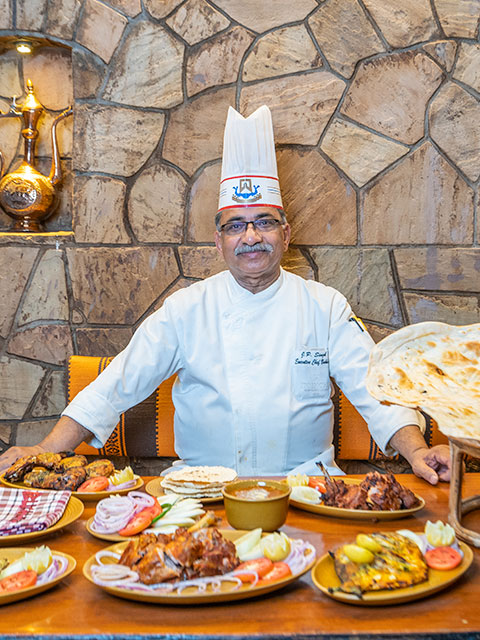
Bukhara is one of those restaurants where the most expensive mistake is not a supplement. It is the anxiety of variety. The room has spent more than four decades teaching diners the same lesson: sit low, let the stone walls and copper pots do their work, tie on the apron, tear bread, use your hands, and stop treating the menu like a checklist.[1][2]
That can feel counterintuitive in New Delhi, where serious hotel dining often tempts guests toward maximal sampling. Bukhara, inside ITC Maurya, is famous precisely because it refuses that mood. ITC's own anniversary page frames the restaurant as a 45-year culinary heritage address built around the robust flavors of the North West Frontier, naming Dal Bukhara, Sikandari Raan, chargrilled vegetables, and Naan Bukhara as core dishes.[1] 50 Best Discovery describes the same operating grammar more bluntly: the menu has barely changed, an open kitchen lets guests watch meat and vegetables move through the tandoor, and cutlery is not part of the default ritual.[2]
So the best order is not the one that covers every category. It is the one that lets Bukhara behave like Bukhara. Start with the dal. Add bread that can carry it. Choose one major tandoori centerpiece. Add vegetables or prawns only if the table size can absorb them. Skip the impulse to build a polite fine-dining progression. This is not a sequence of tiny plates. It is a table built around heat, smoke, fat, lentils, bread, and touch.
Start With The Dal, Then Build The Meal Around It
Dal Bukhara is not a side dish in the emotional sense, even if it sits beside meat and bread. It is the anchor. ITC names it among the restaurant's defining dishes, while 50 Best Discovery calls it legendary and identifies its base as black lentils with tomatoes, ginger, and garlic.[1][2] A Commons photograph of dal bukhara is useful because it shows why the dish works visually before you even taste it: dark, glossy, thick, and not remotely designed for dainty spooning.[5]
Order it early in your mind, not as an afterthought when the table realizes it needs something wet. The dal changes the logic of everything else. It makes naan important. It gives smoky meats a soft landing. It turns chargrilled vegetables from a token vegetarian order into something that can drag through richness. It also slows the table down, which is half the point. Bukhara's best rhythm is not "taste, judge, move on." It is tear, scoop, pass, return.
This is where first-timers often go wrong. They look for the dish that will justify the restaurant's fame in one theatrical bite. Bukhara's fame is more stubborn than that. The dal is a persistence dish. Its pleasure comes from staying on the table and becoming more necessary as the meal gets smokier.
Choose One Centerpiece, Not A Parade
The tandoor is the house engine. 50 Best Discovery points to murg tandoori, Sikandari Raan, and tandoori jumbo prawns as signatures, while Zomato's current listing surfaces Sikanderi Raan, Tandoori Phool, Chicken Khurchan, Onion Kulcha, and Jumbo Prawns among the dishes diners associate with the restaurant.[2][4] The temptation is obvious: order one of everything and call it a survey.
Resist that unless you are with a large table. Bukhara's food is not delicate in portion, flavor, or table behavior. A serious lamb order wants space. A whole chicken wants appetite. Jumbo prawns want attention before they cool. If you order too many centerpieces, the meal becomes a traffic jam of prestige proteins, with dal and bread demoted to cleanup duty.
For two people, think like this: Dal Bukhara, one bread order that can actually be torn and shared, and one main tandoori subject. Sikandari Raan is the dramatic move if lamb is what you came for. Tandoori Phool or chargrilled vegetables make more sense when you want the smoke and spice without turning the table entirely meat-heavy.[1][4] Jumbo prawns are the cleaner luxury choice, but they can feel less central to the Bukhara myth than lamb, chicken, dal, and naan.[2][4]
For four people, the order can widen: dal, Naan Bukhara or another substantial bread, one lamb or chicken centerpiece, one vegetable grill, and perhaps prawns if the table is ready for the bill and the appetite load. The goal is contrast, not coverage.
Let The Bread Stay Whole
Vir Sanghvi's anniversary reflection is valuable because it treats Bukhara's small rules as part of the restaurant, not as quaint decoration. He notes that the menu has remained mostly unchanged since 1978, that rice is not part of the house grammar, that pickle is not placed on the table, that cutlery comes only if requested, and that naans and parathas are served whole rather than cut into convenient pieces.[3]
That whole-bread rule is not a gimmick. It changes the meal from service into participation. A sliced naan behaves like a basket of starch. A whole naan behaves like a shared object. It asks the table to tear, negotiate, reach, and pace itself. This is why Bukhara is easiest when you stop expecting the restaurant to make every bite convenient. Convenience would flatten the point.
If you are ordering for diners who are nervous about eating with hands, do not shame them and do not turn the meal into a performance of authenticity. Ask for cutlery if someone needs it. But the strongest version of the room is tactile. ITC's official ambience description mentions aprons and the invitation to engage with all the senses, while 50 Best's profile says the no-cutlery practice fits the frontier theme.[1][2] The apron is not a souvenir costume. It is a signal that dinner may get messy, and that the mess is designed.
What To Skip
Skip the completionist order. Bukhara is not improved by turning the table into a tasting spreadsheet. If everyone gets protective over "their" dish, the restaurant stops working. The better move is to order fewer things that can be shared with less accounting.
Skip rice thinking unless you need it for personal comfort. Sanghvi's point about rice not being served since the restaurant's early years is a reminder that Bukhara's starch logic is bread-first.[3] Dal plus naan is not a missing-course problem. It is the center of the architecture.
Skip overcorrecting toward luxury. Zomato lists the average cost at about Rs8,000 for two before alcohol and taxes, and 50 Best Discovery lists average spend and a tasting menu benchmark, so this is not a casual snack stop even if the room feels earthier than many fine-dining hotels.[2][4] The way to protect value is not to avoid the famous dishes. It is to avoid stacking famous dishes until none of them has room to land.
Skip the idea that "unchanged" means stale. The better reading is discipline. In a restaurant culture that often treats reinvention as proof of life, Bukhara's strange power is that it makes continuity feel physical: the same low tables, the same tandoor logic, the same dal gravity, the same whole bread, the same hand-first invitation.[1][3]
A Clean First Order
For a first visit, the cleanest order is almost boring on paper: Dal Bukhara, Naan Bukhara or another bread built for sharing, Sikandari Raan if the table eats lamb, and a vegetable grill if you want freshness and smoke without adding another heavy protein. If lamb is not the table's mood, make the chicken or prawns the main event instead, but keep the shape: one anchor dal, one bread strategy, one grill subject, one supporting contrast.[1][2][4]
That order works because it obeys the room. Bukhara is not trying to show you how many directions North Indian hotel dining can go. It is trying to make a small number of things feel inevitable. The dal should keep calling you back. The bread should make you use your hands. The grill should bring enough char and spice that the table wakes up. The room should feel rustic, slightly theatrical, and stubbornly itself.[1][2]
The final test is whether the meal still feels good after the famous names have stopped being famous. If Dal Bukhara becomes the thing everyone reaches for without discussion, if the bread disappears by tearing rather than by polite serving, if one tandoori centerpiece feels more generous than three half-attended orders, then the table has understood the restaurant.
Bukhara rewards the diner who can edit. The prestige is real, but the best night is not about proving you touched every legend on the menu. It is about letting the few right dishes make the table warmer, slower, smokier, and more communal than it was when you sat down.
Sources
- ITC Hotels, "Celebrating 45 Years of Bukhara: An Iconic Culinary Heritage" - official page covering the restaurant's heritage framing, North West Frontier cuisine, iconic dishes, origin story, ambience, aprons, and sensory dining ritual.
- 50 Best Discovery, "Bukhara Restaurant - New Delhi" - venue profile covering the barely changed menu, open kitchen, no-cutlery ritual, signature dishes, location, and published price benchmarks.
- Vir Sanghvi, "What makes Bukhara so special?" - anniversary reflection on Bukhara's unchanged menu logic, house rules, rice absence, cutlery practice, and whole-bread service.
- Zomato, "Bukhara - ITC Maurya, New Delhi" - current restaurant listing with popular dishes, cuisine tags, average cost, service details, reservation recommendation, and diner-facing practical context.
- Wikimedia Commons, "File:Dal Bukhara.JPG" - real photograph and metadata for dal bukhara, used as visual reference for the dish's texture and table role.
- ITC Hotels official image file, "cuisine.jpg" - Bukhara chef-and-table photograph used as the article image.