At first glance, bacalao al pil-pil seems to have a missing ingredient. A piece of cod sits in a pale, glossy sauce that looks as though somebody has reached for cream. Spain’s official recipe lists only salt cod, olive oil, garlic and chilli. The fish helps supply the sauce’s structure; the cook supplies the movement.[1][2]
That makes this Basque preparation unusually revealing. Follow it from the soaking bowl to the plate and the familiar division between cooking a fish and making something to pour over it begins to dissolve. The liquid released during cooking becomes part of the dish’s attraction. A little garlic and a ring of chilli are enough to finish the picture.
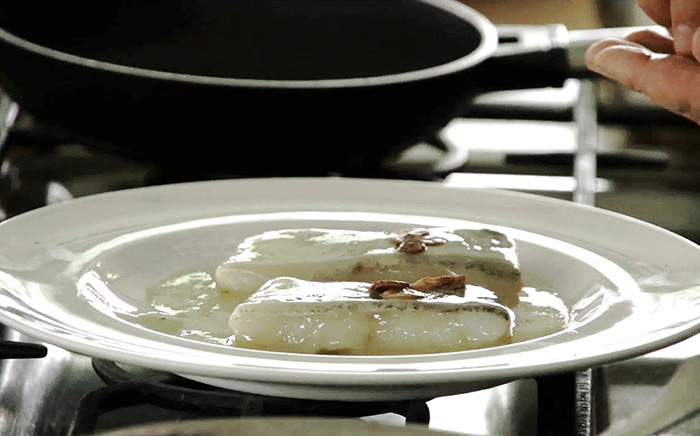
Before the pan moves
Salt cod requires preparation before the apparent simplicity of the recipe can take over. The two published methods give different soaking schedules: Spain’s tourism site specifies 36 hours with several water changes; Basque chef Javier De La Hormaza’s Basco recipe specifies 48 hours, changing the water three times daily. Those are instructions for their respective recipes, not an interchangeable promise for every thickness of fish.[1][2]
Both methods also require attention to scales, bones and drying. This is the quiet work hidden by a plate with so few visible components. There is nowhere for a stray bone to disappear and no elaborate garnish to distract from the fish. For a diner, simplicity is what arrives; for the cook, it is the result of several decisions already made.
The skin matters, too. In Shanna Killeen’s account of the 2016 Smithsonian Folklife Festival, chefs demonstrating the dish sought out skin-on salt cod for its natural gelatin.[4] The sauce starts with the choice of fish, well before any dexterity with a pan.
What turns oil into sauce
Pil-pil is an emulsion. Movement disperses oil into the watery cooking juices, with the fish’s gelatin helping the mixture hold together. This is why the liquid released by the cod deserves to be collected rather than discarded. The sauce depends on bringing those components together.[3][4]
De La Hormaza first perfumes the oil with garlic, then cooks the fish gently. Once the cod releases gelatin, he takes the dish off the heat, lets it cool slightly and begins the circular movement. His method moves between gentle warming and time away from the flame.[2] That rhythm gives the preparation its particular drama: watch the liquid, adjust the heat, move the pan, watch again.
The recipes do not even agree on a universal skin position. De La Hormaza starts skin-side up; Spain’s tourism recipe places the cod skin-side down in a second dish for the sauce-forming stage.[1][2] These are different sequences. Pulling one instruction out of either and declaring it the secret would obscure the more useful lesson: understand what the cook is trying to achieve at that moment.
A sieve changes the choreography
Joseba Arguiñano’s version, published by Hogarmania in February 2026, separates the jobs more explicitly. He removes the fish, reserves its whitish juices and allows the cooking oil to cool. A small quantity of oil and juices goes back into the pan. He moves a sieve through them in circles, then introduces the remaining oil in a thin stream. The cod returns once the sauce has formed, for gentle reheating without boiling.[3]
The practical advantage is easy to see: the cook can concentrate on the sauce while the delicate portions wait outside the pan. The transformation remains visible, but the fish need not travel through every circular movement.
This tool also appears in the Smithsonian demonstration. Ozamiz Goiriena explained that he learned the mesh-colander method at culinary school and joked that his grandmother would disapprove. She had achieved the same creamy result by rotating the pot.[4] The exchange is a small, affectionate illustration of how professional training can change a gesture while preserving its purpose.
The last few movements
Arguiñano warns that excessive heat can split the sauce. His suggested repair uses a little more reserved fish liquid, or a few drops of warm water, followed by gradual mixing. Reheating also stays gentle.[3] The finishing stage therefore needs attention even after the sauce has thickened.
For me, that is the pleasure of reading this dish through its technique. The garlic has already scented the oil; the cod has contributed both flesh and juices; the sauce makes those contributions visible in one glossy coating. The kitchen’s work is concentrated in how they meet. The plate can then be almost disarmingly spare: fish, sauce, garlic, chilli—and room for a piece of bread.
Sources
- Spain’s official tourism website, “Cod ‘al pil-pil’” — ingredients, desalting and the two-dish method.
- Javier De La Hormaza, “Bacalao Al Pil Pil Recipe,” Basco — preparation and pan movement.
- Joseba Arguiñano, “Bacalao al pil-pil,” Hogarmania, 5 February 2026 — sieve method, temperature management and sauce repair.
- Shanna Killeen, “Basque Recipe: Bakailaoa Pil-pilean,” Smithsonian Folklife Festival, 12 August 2016 — chef demonstration, skin-on cod, family and culinary-school methods, and archival photograph.