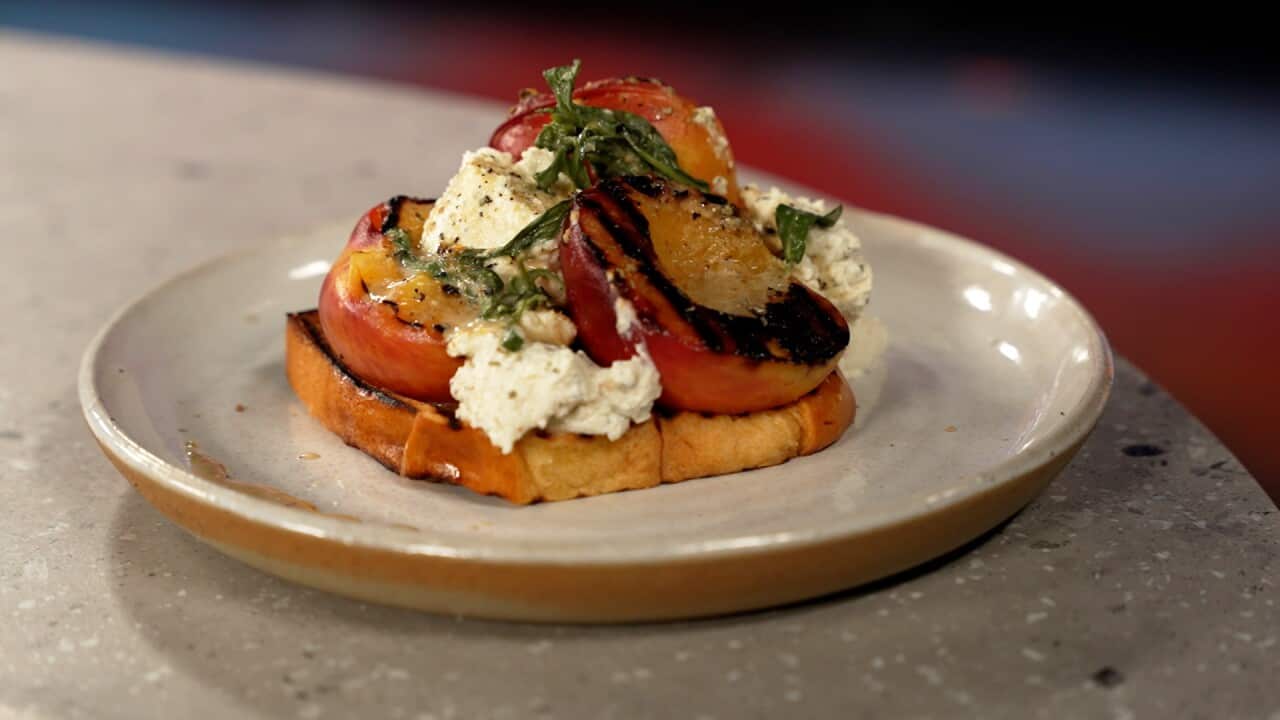
The peaches have dark edges from the pan; the ricotta is blended smooth; underneath sits a slice of charred brioche. In Nornie Bero's recipe for SBS, pepperberry enters twice, as a pinch in the dressing and another in the cheese.[1] It is a small part with considerable room to move: fruit, dairy, vinegar, toasted bread.
That plate is a useful invitation to look beyond the pepper mill. For a restaurant kitchen, Tasmanian pepperberry arrives with decisions already made about ripeness, picking and drying. Understanding those decisions makes it easier to choose a form that belongs in a dish—and to explain what its provenance actually means.
A berry with growing tips to protect
Tasmanian mountain pepper is Tasmannia lanceolata, native to Tasmania and mountainous parts of southeastern Australia. Bronzewing Farm describes separate male and female plants: the females carry the berries, while leaves from either sex can be used as seasoning. The farm also reports substantial variation in pungency between individual wild plants.[2]
For a chef, that last detail deserves as much attention as the botanical name. A new delivery calls for a small tasting trial in the intended preparation. A familiar weight on the scales cannot, by itself, promise a familiar result.
Bronzewing's harvest runs from April to June. Its account explains why picking remains handwork: berries can cling stubbornly, and new growth sits within their surrounding cluster. The picker has to recover this season's fruit while protecting the buds that follow.[3]
The farm estimates that roughly 4,000 fresh berries make a kilogram, yielding about 250 grams when dried.[3] These are its working figures, not a universal specification. They make the contents of a small packet easier to picture: repeated movements of the hand, followed by a substantial loss of water.
Bronzewing also describes alternating heavy and light crops. Cultivation gives it a way to plan around that rhythm; the farm does not claim the rhythm disappears.[3] A menu written around pepperberry therefore benefits from a conversation about supply before the ingredient becomes a nightly promise.
What a wild harvest can tell you
Wild Pepper Isle describes a different arrangement. It gathers berries from about a dozen Tasmanian properties under agreements with landholders. Those sites include former mining, forestry and farming land where pepper has flourished after earlier disturbance and a period of recovery.[4]
That account complicates the picture a diner might form from the word “wild.” The berries can come from landscapes with a long history of work and change. Their value need not depend on imagining a forest untouched by people.
The producer says it waits for berries to release easily, avoids cutting branches to reach fruit, leaves berries for birds, and washes boots and vehicles between sites to reduce disease risks.[4] These are the company's stated practices, rather than an independent certification. They nevertheless give a buyer concrete matters to discuss: harvesting permission, picking methods and care between visits.
A restaurant can pass on that specificity. Naming the producer and describing its harvest is more informative than adding another expansive adjective to the menu. The story becomes especially interesting when it includes what the picker leaves behind.
Drying is part of the recipe
After harvest, the ingredient begins to divide into different kitchen possibilities. Bronzewing describes freeze-dried berries that crush readily and retain much of the fresh fruit's size and colour. Its warm-air process produces harder, shrivelled berries suited to a mill, with some loss of volatile aromas and red pigments.[5]
These are the farm's descriptions of its own products. They offer a useful reason to ask for samples in more than one form. The choice affects how a kitchen handles the ingredient as well as how it appears on a plate.
A berry intended for a grinder and one intended to crush into cream have different jobs. Bronzewing notes that its freeze-dried berries can release colour into foods including rice, potatoes and ice cream.[5] For a pastry chef, colour is consequently part of the trial alongside flavour. The powder can change the appearance of a pale preparation even when very little is used.
The purchase is not finished when the botanical identity and origin are settled. The drying method belongs on the order too.
Give the pinch somewhere to go
Bero's peaches show how deliberately pepperberry can be placed. The dressing brings vinegar, mustard and tarragon; the ricotta brings lemon and wattleseed. Pepperberry joins both components before they meet the warm fruit and brioche.[1] Reading the recipe, the appeal lies in that distribution: the seasoning has company throughout the plate.
Her published pickle takes another route. Whole pepperberries enter a spiced liquid with red wine vinegar, which is poured over karkalla, cucumber, samphire and chilli. Bero serves the finished pickle with cheddar and olive bread.[6] Here the berry belongs to the preparation surrounding the food, rather than a last scatter from a grinder.
For a dining room developing a cheese accompaniment or a fruit course, these recipes offer useful starting points. They show how to give the ingredient a defined role before building an elaborate explanation around it. Taste the chosen product in that role, then decide how much the dish needs.
Back at the peach plate, the pinch remains small. Behind it are berries picked around tender growth, a harvest that changes from season to season, and a drying choice that shapes the cook's options. Good sourcing makes those details available. Good cooking gives the diner a reason to care.
Sources
- Nornie Bero, “Charred peaches with wattleseed ricotta,” SBS Food, 26 June 2025 — published recipe and the article's photograph, credited to Living Black.
- Bronzewing Farm, “Tasmannia lanceolata — bits about the plants” — the grower's description of distribution, separate male and female plants, culinary leaves and variation in heat.
- Bronzewing Farm, “Mountain Pepper Production: Berry Harvesting” — the farm's picking season, protection of new growth, approximate fresh-to-dried yield and alternating crops.
- Wild Pepper Isle, “The Pepperberry Library” — the producer's account of landholder agreements, harvest landscapes and its stated environmental practices.
- Bronzewing Farm, “Mountain Pepper drying techniques” — the producer's comparison of its freeze-dried and warm-air-dried berries and their culinary uses.
- Nornie Bero, “Pickled pepperberries and succulents,” SBS Food, 16 November 2023 — whole pepperberries in a spiced pickling liquid, served with cheese and bread.