In Taipei, one of the fastest ways to misunderstand fine dining is to read it as menu price alone.
The more revealing layer is operational design. Serious rooms sell food, but they also sell timing, labor deployment, room geometry, booking discipline, and how much narrative pressure the evening can hold without breaking rhythm. In 2026, one of the clearest places to see that is across MUME, logy, and Taïrroir: three high-credibility dinners in the same city, each engineered through a different mix of reservation rules, pacing, seat count, and formal intensity.[1][2][3][4][5][6]
Taipei is especially useful here because the city does not force every ambitious restaurant into the same luxury script. One room is built to feel finite and contemporary. Another is built around compression and scarcity. Another is built to hold full formal occasion. The menu matters, but the operating model does just as much work.
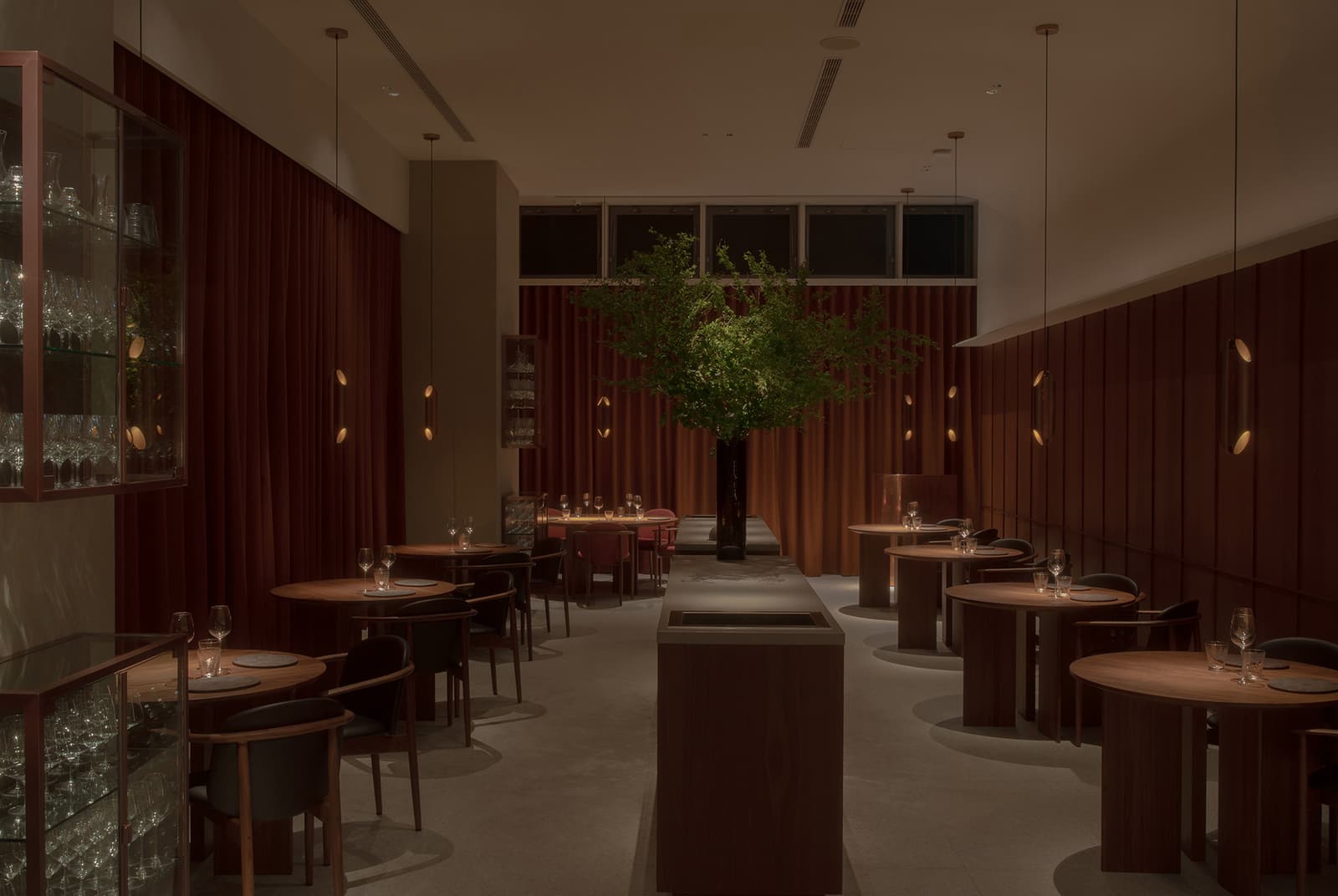
Image context: the cover image shows logy’s walnut-heavy dining room after its move to the current location. It matters here because this article is about service architecture as much as cuisine: room materials, seat density, and visual warmth all help determine how tightly a restaurant can choreograph the night.
1) MUME: a serious city dinner calibrated to stay finite
MUME’s current baseline is unusually clear. The restaurant’s reservation page lists a seasonal tasting menu at NTD$3,980 + 10%, with an expected dining time of about 2.5 hours.[5] Michelin describes the room as relaxed and friendly, with seasonal Taiwanese ingredients pushed through Nordic influence and modern technique.[6]
That combination matters because it tells you where the value sits. MUME is not trying to win by over-signaling prestige. It is selling a serious, composed dinner that still behaves like a city dinner rather than a once-a-quarter ceremony. The economics feel tighter. You pay for a complete point of view, but not for maximum theater.
This is why MUME works so well for diners who want a real fine-dining night without turning the whole evening into project management. The menu price stays below the city’s top ceremonial tier, the dining window is finite, and the room’s mood reads more like contemporary confidence than hushed temple luxury. In value terms, MUME buys you clarity per dollar.
The trade-off is that the restaurant is also explicit about boundaries. The site says there is no a la carte option, no strict vegan or no-seafood menu, and a full cancellation charge applies within 48 hours.[5] That is a clean signal: the lower headline price does not mean higher flexibility. The value is in the dinner itself, not in optionality around it.
2) logy: the product is compression, seat scarcity, and sequence density
logy’s menu is currently listed at 4,750 TWD per person, plus service, with pairings priced separately: 2,300 TWD for a five-glass alcohol pairing, 4,750 TWD for a seven-glass wine pairing, and 1,800 TWD for a non-alcoholic pairing.[3] Michelin adds the qualitative part that pricing alone cannot show: the restaurant moved to its current location in 2025, the room is generously furnished in walnut wood, and the omakase-style menu runs to more than 10 courses.[4] 50 Best Discovery supplies the sharper scarcity cue: there are only 13 seats.[2]
That is where logy becomes interesting from a value perspective. The step up from MUME is not huge in raw menu price, but the experience shape changes materially. Fewer seats mean labor lands differently. More courses mean pacing becomes more authored. The room feels less like “a restaurant with a tasting menu” and more like a controlled sequence engine.
This is also where Taipei’s value ladder starts exposing a useful truth: higher spend does not always buy more abundance; often it buys more edit. At logy, you are paying for a dining room that has removed slack. The warmth of the walnut room matters because it softens what could otherwise feel too compressed, but the real purchase is density — more transitions, more attention, less noise.
If you add the five-glass alcohol pairing, you are still far below Taïrroir territory; if you add the seven-glass wine pairing, the total starts climbing into full-occasion spending. That makes logy the city’s most sensitive threshold restaurant in this trio. It can be read as a strong-value splurge or as the start of prestige spending depending on how you drink.
Its reservation policy underlines that seriousness. Reservations are card-guaranteed, and late cancellation, no-show, or arrival after the last sitting time leads to a full-payment charge of 4,750 TWD per person.[3] In other words, logy’s value proposition depends on commitment and precision. The restaurant is not selling roominess; it is selling a tightly authored night.
3) Taïrroir: ceremony built through time, buffer, and formal control
Taïrroir operates on a different price plane. Its dinner page lists the seasonal menu from NT$8,880 + 10%, with an alcohol pairing at NT$3,580 + 10% for five glasses.[1] On the reservation page, the restaurant recommends allowing at least three hours for dinner, and the cancellation fee inside three days is NT$5,000 per person for dinner.[7] Michelin’s description helps explain why the price lands where it does: chef Kai’s menu is framed as a love letter to Taiwan, shaped by local producers, seasonal references, and unmistakably Taiwanese desserts built through Western technique.[8]
This is not just “more expensive Taipei fine dining.” It is a different spending category. The extra money buys a broader buffer of luxury: more time, more ceremony, more sense that the evening has been cleared out to hold one central performance.
The important thing, though, is that the value is not only symbolic. Taïrroir is expensive because it is trying to deliver a fuller prestige stack at once: local-reference cuisine legible to international fine-dining diners, longer-form pacing, heavier occasion signaling, and a room that expects you to surrender a larger block of night. That is costly to stage, and the restaurant prices accordingly.
Where diners get confused is assuming that Taïrroir automatically gives the “best deal” only if every plate feels vastly more luxurious than at cheaper rooms. That misses the operating logic. Much of what you are paying for is not ingredient shock; it is ceremonial capacity. The restaurant can hold a bigger emotional frame without rushing the meal or collapsing the room’s polish.
4) What Taipei’s serious rooms are actually optimizing
If you strip away star-chasing and ask what each tier actually buys, the picture is cleaner:
- MUME buys the most convincing serious-dinner entry point: focused cooking, a full tasting-menu worldview, and a shorter time burden.
- logy buys the highest jump in authored sequence per extra dollar: tighter seat count, more course density, and more tactile service attention.
- Taïrroir buys the most complete prestige envelope: longer pacing, higher ceremony, and a more explicit sense of major-occasion dining.
That also means “value” depends on what kind of waste you are trying to avoid.
If you hate overpaying for ceremonial padding you do not actually enjoy, Taïrroir can feel expensive fast. If you dislike compressed chef’s-counter intensity, logy can feel like paying extra to be worked harder. If you want your one Taipei splurge to feel visibly singular, MUME can feel a touch too rational.
The city’s best value, then, is not one universal answer. It is the restaurant whose spending logic matches your preferred night shape.
5) A booking rule before you spend anything
A simple rule helps connect the reservation you make to the kind of night you actually want.
- Book MUME when you want one excellent, modern Taipei dinner and still want the night to have a second act somewhere else.
- Book logy when you want the highest concentration of attention and sequence design without jumping straight to the city’s top ceremonial pricing.
- Book Taïrroir when the dinner itself is the event and you want the bill to buy not just food, but a full occasion architecture.
In other words: Taipei’s serious-dinner ladder is not a straight line from cheap to expensive. It is a shift from sharpness, to compression, to ceremony.
That is why the money question matters. In this city, the best-value tasting menu is rarely the cheapest respected one and rarely the most famous one. It is the one whose price is buying exactly the part of luxury you will actually notice.
The pairing arithmetic changes the bracket
For diners actually deciding tonight, the drink math is what makes the trio separate more sharply. To keep the comparison honest, it helps to line them up on the same basis rather than mixing service-included and pre-service totals.
- MUME remains the easiest serious-night buy-in. The menu starts at NTD$3,980 before service, or about NTD$4,378 once the standard 10% is added, which is why it still reads as a composed city dinner rather than a full ceremonial spend.[5]
- logy changes category depending on how you drink. Menu plus the five-glass alcohol pairing reaches NTD$7,050 before service and about NTD$7,755 if the full check carries the same 10%; menu plus the seven-glass wine pairing reaches NTD$9,500 before service and about NTD$10,450 on the same basis.[3]
- Taïrroir starts in a different bracket and stays there. Menu plus the five-glass pairing reaches NT$12,460 before service and about NT$13,706 if you carry the listed 10% across the dinner check, which is why the restaurant only makes sense when you want the room, pacing, and formal occasion to be the event itself.[1]
That arithmetic sharpens the practical choice. Once the trio is normalized to the same before-service or after-service basis, MUME reads as the rational serious dinner, logy as the threshold splurge, and Taïrroir as full-occasion spending. The distance between logy-with-serious-wine and Taïrroir narrows faster than many diners expect, which is exactly why pairings should be part of the booking decision rather than an afterthought.
Three booking mistakes worth avoiding
- Mistaking menu price for total commitment: service, pairings, and cancellation exposure change the real spend much more than the headline menu number suggests.[1][3][5][7]
- Assuming longer means better value: extra time can mean more ceremony, but it can also mean you are buying a room format you may not personally enjoy.
- Booking by fame instead of night shape: the trio makes more sense once you decide whether you want sharpness, compression, or ceremony first, then spend accordingly.
One-glance fit filter
- Choose MUME if you want the most rational serious dinner in the group: a strong point of view, a lower time burden, and less ceremonial drag.
Skip it if you want high flexibility on diet or cancellation, because the restaurant is explicit that the rules stay firm.[5] - Choose logy if you want the sharpest authored sequence per extra dollar and do not mind committing to a denser, more managed room.
Skip it if you want looseness, because the 13-seat format and full-charge policy make casualness expensive.[2][3] - Choose Taïrroir if the dinner itself is the occasion and you want your spending to buy time, buffer, and prestige staging.
Skip it if you mainly care about ingredient shock per plate; a meaningful share of the bill is really paying for ceremony.[1][7][8]
Sources
- Taïrroir — dinner page (seasonal menu and pairing pricing)
- 50 Best Discovery — logy profile (13 seats, positioning, menu character)
- logy — reservation page (menu price, pairings, booking and cancellation policy)
- MICHELIN Guide — logy listing (2025 move, walnut room, course density)
- MUME — reservation page (menu price, dining time, cancellation policy)
- MICHELIN Guide — MUME listing (room mood, ingredient/technique profile)
- Taïrroir — reservation page (dining time and cancellation policy)
- MICHELIN Guide — Taïrroir listing (Taiwan/terroir framing and cuisine character)