The Pacojet's signature ingredient is an unpromising one: a cylinder frozen hard enough to resist a spoon. Lock its beaker beneath the machine, start the motor, and a blade descends into that solid block. What comes back can be a satin-smooth sorbet, a mousse, or a vegetable purée, processed without first thawing the base.[1][2]
There is no flame, no tableside cloud, and usually no guest watching. The drama happens in the mouth. A flavor assembled yesterday acquires its final texture only after tonight's order arrives. That is the Pacojet's real claim on fine dining: it makes freezing ahead and finishing à la minute feel like the same action.
Calling it an ice-cream maker misses the clever part. The Pacojet does not freeze a liquid while paddles churn it. It takes food that is already deeply frozen and micro-purées downward through the block. The freezer becomes a library of possible textures; the machine reads only the portion service needs.
The blade moves through a frozen clock
The current operating manual defines pacotizing as processing deep-frozen food into ultra-fine preparations without thawing. Its standard cycle uses overpressure, which can expand the volume and change the finished consistency. The base must first spend at least 24 hours at -20°C / -4°F, long enough for the entire beaker to reach that temperature.[1]
Those numbers explain why the result can feel so fine. A peer-reviewed Chemical Reviews survey describes the Pacojet blade turning at roughly 2,000 rpm while descending through the solid block, shaving a layer of about one micrometre per revolution. Keeping the base completely frozen lets the blade break ice crystals small enough that the tongue barely detects them; headspace above the block also permits aeration while the mixture remains cold.[2]
The machine therefore attacks texture from the opposite direction to a batch freezer. Conventional ice cream tries to limit crystal growth as a liquid freezes. The Pacojet begins after freezing and mechanically reduces crystals inside the solid mass. One method manages the birth of ice; the other edits ice after it exists.
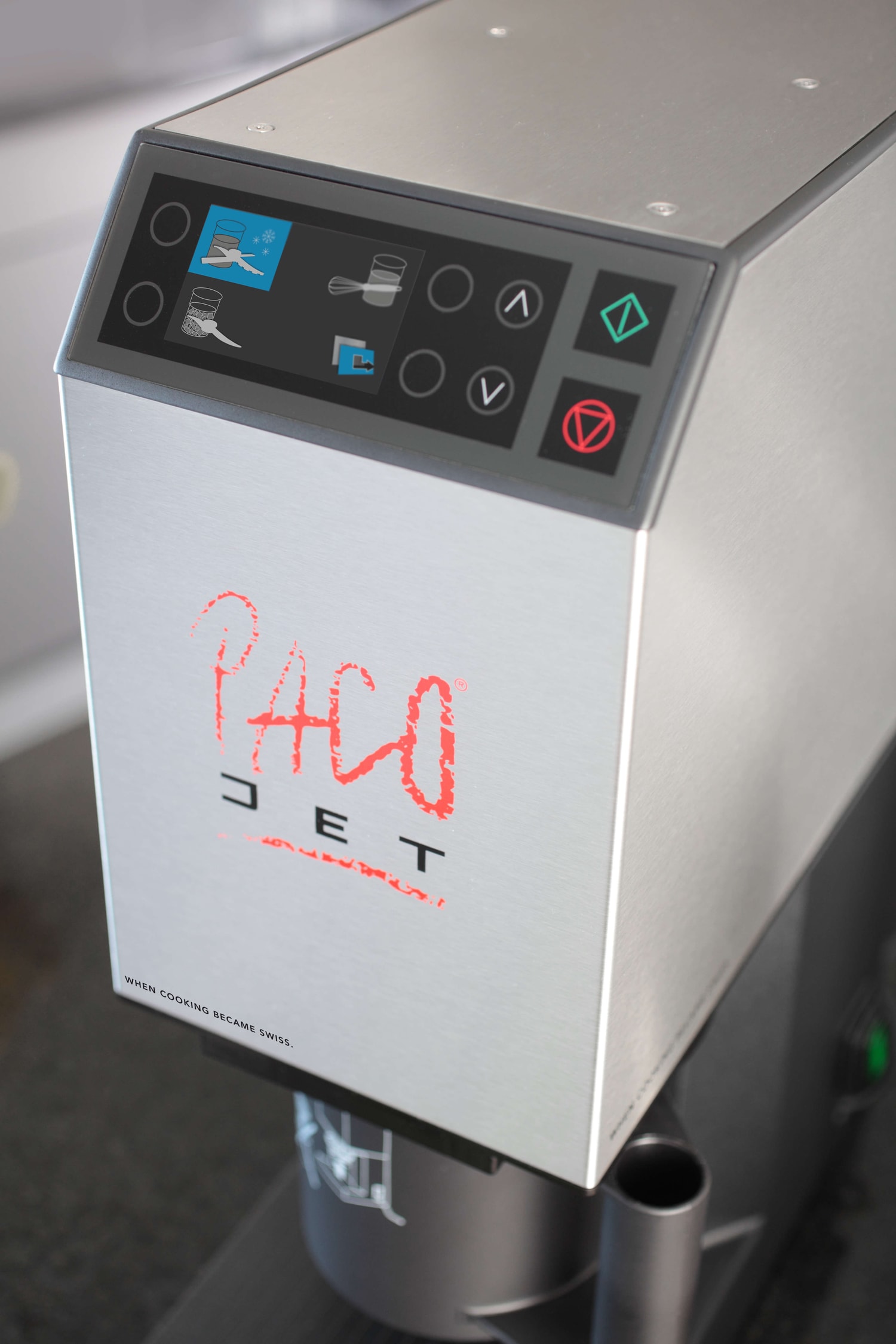
The cover photograph shows a Pacojet 2, the generation introduced in 2012 with selectable overpressure and decimal-portion processing.[6][7] It looks less like laboratory theater than a compact drill press wearing a coffee machine's body. That visual plainness suits the technique. The blade's vertical journey, not a glamorous exterior, is the invention.
Yesterday's work becomes tonight's spontaneity
“Made to order” normally suggests ingredients meeting heat only after the ticket prints. Pacojet cooking rearranges that sequence. The flavor base has to be cooked, infused, seasoned, blended, cooled, placed in a dedicated beaker, labeled, leveled, and frozen well before service. Only the last conversion—from hard block to spoonable texture—waits for the guest.
This changes what a small ambitious kitchen can keep ready. Instead of holding several finished tubs at their ideal serving texture, it can hold frozen bases: tart apple, toasted hay, roast beet, cultured cream, browned poultry trim, herbs, shellfish, or chocolate. The examples are not a promise that every ingredient benefits. They show the useful shift in thinking. A frozen beaker is not yet a dish; it is stored potential.
Martín Lippo's professional pastry account makes the operational advantage explicit: the machine itself has no refrigeration unit, so mixtures must be pre-frozen around -20°C to -22°C, but the blade can process a programmed portion rather than the whole beaker. The unprocessed remainder can return to the freezer.[4] A tasting menu can therefore offer one cold accent for a handful of orders without turning an entire batch soft under the pass lights.
That flexibility is not spontaneity for free. It is spontaneity purchased with planning. A cook who discovers at 5 p.m. that the basil base was never frozen cannot improvise away the missing 24 hours. A beaker mislabeled “green apple” when it contains celeriac is not a tiny clerical error. The Pacojet makes the freezer part of the station, and freezer discipline becomes cooking discipline.
Smoothness still begins in the recipe
The machine's reputation can tempt a kitchen into believing that power will repair formulation. It will not. Ice cream remains a structure of frozen water, dissolved sugars, fat, milk solids, and air. Michael Laiskonis's frozen-dessert course at the Institute of Culinary Education compared vanilla formulas containing 6% to 14% fat, conventional freezing against Pacojet processing, and the rate at which the results melted. His point was not that one machine made recipe design obsolete. It was that formula, process, texture, and melting behavior have to be judged together.[3]
Sugar is especially revealing. It sweetens, but it also depresses the freezing point. Water content determines how much ice exists. Fat and solids change lubrication, body, and release. A blade can make crystals smaller; it cannot make an over-sweet base taste brisk, give a watery purée natural depth, or stop a badly balanced scoop from collapsing on a warm plate.[2][3]
Pressure is another choice rather than an automatic upgrade. Lippo distinguishes normal-pressure processing, which produces relatively little overrun, from overpressure processing, which incorporates substantially more air and yields a lighter body.[4] That means the kitchen has to decide what the dish needs. A dense chocolate preparation may want compactness. A fruit sorbet may benefit from lift. A savory purée intended to carry sauce might become less useful if aeration turns it foamy.
The best Pacojet work is therefore not “smoothest possible” by default. It is the right smoothness for the next bite. Grainlessness can make a pea purée taste intensely green, but it can also erase the rustic pulse that makes a bean dish satisfying. A sorbet can dissolve like cold perfume, yet a frozen garnish sometimes needs crystals that crackle. Fine dining earns the machine by knowing when refinement clarifies an ingredient and when it merely polishes away character.
Savory food reveals the machine's reach
Restaurant pastry made the Pacojet famous because frozen desserts expose crystal size immediately. Its wider importance appears when a kitchen stops treating it as a sorbet appliance. In 2001, The Washington Post watched Gérard Pangaud process one serving of tomato-basil sorbet seconds before the dish left the kitchen, then return the uncut block to the freezer. Robert Wiedmaier described using the machine to eliminate hours of forcing a fish farce through a tamis.[5] The technique is not tied to sweetness; it is tied to a desired particle size and serving condition.
The same report found chefs using it for soups, sauces, mousses, chile pastes, infused oils, and shellfish or fish farces; Lippo's later account adds savory frozen powders that can melt over a hot course as the plate travels across the table.[4][5] That opens a particularly fine-dining kind of movement. Roast carrot can become a purée fine enough to behave almost like sauce. A cold herb preparation can supply temperature as well as aroma. Farce can be made with close attention to heat. One vertical process moves among those jobs because particle size and serving condition, not sweetness, set the brief.
But this is also where restraint matters most. The machine's uniform finish can become a house accent as predictable as microgreens once were. If every course receives a quenelle—herb, fish, cheese, fruit—the diner stops tasting precision and starts seeing a template. The Pacojet should solve a textural problem, not leave its signature on every plate.
The portion is more radical than the purée
The glamorous story is that the blade makes food impossibly silky. The more consequential story is that it can do so by the portion. Texture no longer has to be finalized for every guest at the same moment. A kitchen can perform the labor-intensive flavor work in advance, preserve the base in a hard-frozen state, then commit only what the dining room has actually ordered.[1][4]
That changes waste, consistency, and pacing at once. It also creates new failure points. The manual requires a flat frozen surface, forbids overfilling, and says cavities should be filled with liquid. Any unused surface must be smoothed before refreezing. It warns that food can warm during pacotizing and should be handled promptly afterward.[1] The beautiful spoonful depends on unbeautiful habits: dated labels, level freezer shelves, clean fittings, correct beakers, and a cook who knows exactly when to process.
This is why the Pacojet belongs to the same tradition as the combi oven or immersion circulator more than to the tradition of dining-room spectacle. It shifts precision into a repeatable backstage system. Luxury appears as a sorbet that tastes newly made on the last table of the night, or a purée whose texture is the same for the first menu and the twelfth, even though the final portion did not exist until it was needed.
Pacojet dates its first global launch to 1992.[6] Three decades later, the machine's central paradox still feels contemporary. It asks a kitchen to wait a full day so that service can move in minutes. It freezes flavor so texture can feel immediate. And it proves that “à la minute” need not mean starting from zero; sometimes it means doing yesterday's work so carefully that the final spoonful seems to have no past at all.
Sources
- Pacojet International, Pacojet 4 Operating Manual: General Information — official definition of pacotizing, the -20°C/24-hour freeze requirement, overpressure specification, fill rules, refreezing instructions, and food-handling boundary.
- Peter Barham et al., “Molecular Gastronomy: A New Emerging Scientific Discipline,” Chemical Reviews 110, no. 4 (2010) — peer-reviewed explanation of the Pacojet's blade speed, downward shaving action, frozen-state requirement, ice-crystal reduction, and aeration.
- Michael Laiskonis, “Sweet Science: Frozen Desserts With Chef Michael Laiskonis,” Institute of Culinary Education (July 17, 2013) — freeze-point depression, recipe formulation, fat-range trials, conventional-versus-Pacojet comparison, and melt testing.
- so good.. magazine, “Pacojet: The alternative for making creamy ice cream instantly, according to Martín Lippo” (2026) — professional account of pre-freezing, portion processing, aeration choices, savory applications, and the machine's operational boundaries.
- Walter Nicholls, “Ice in the Fast Lane,” The Washington Post (August 22, 2001) — independent kitchen reporting on portion-finished sorbet, refreezing the unused block, savory applications, and reduced farce labor.
- Pacojet International, “History” — official product chronology from the 1992 global launch through the 2012 Pacojet 2 and later generations.
- Wikimedia Commons, “File:PacoJet 2.jpg” — Obschepit's 2013 documentary photograph of a Pacojet 2, used as the article image.