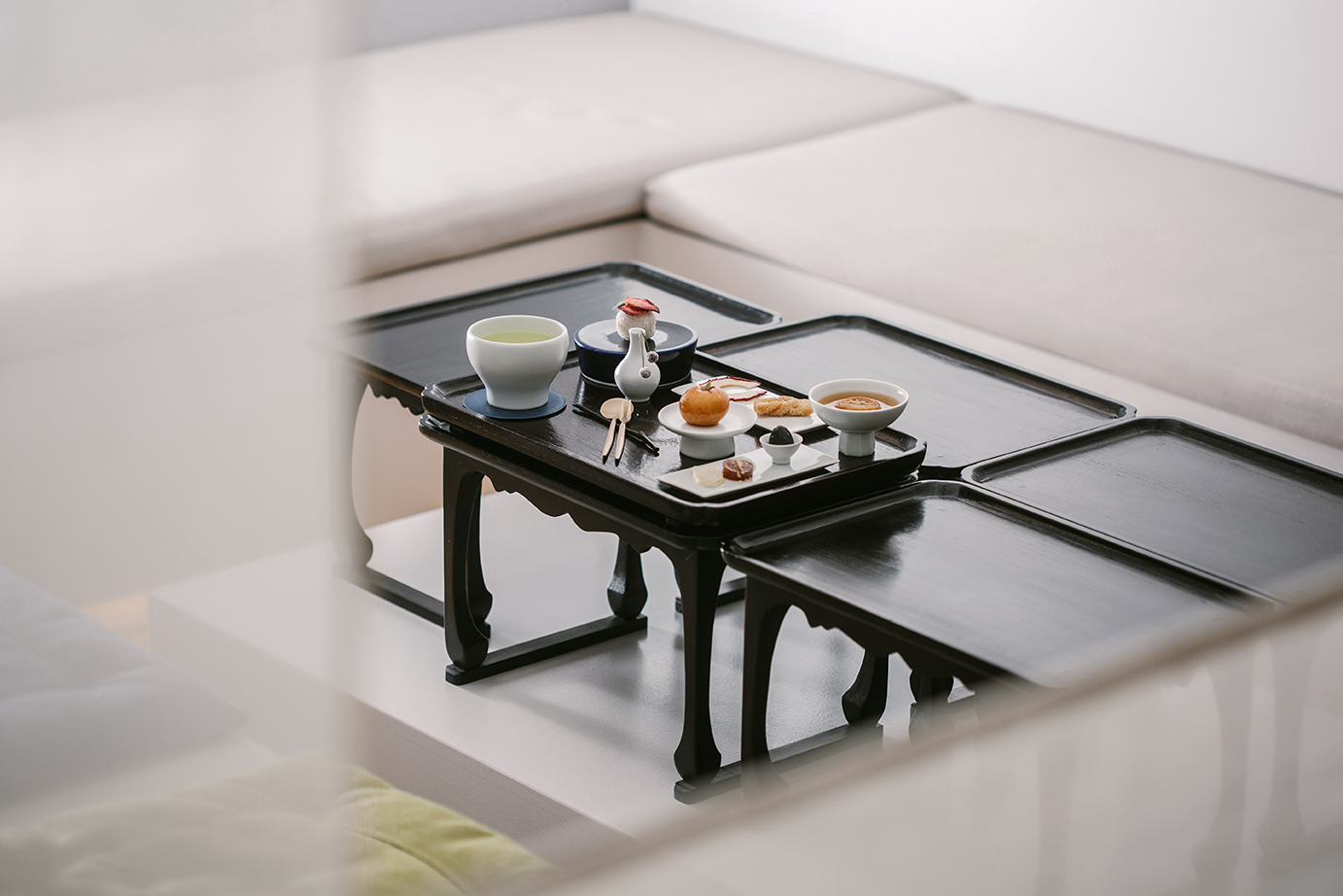
At Kimssibooin in Seoul, a serving of sweets has its own furniture. Visit Seoul’s 2021 account describes rice cakes, preserved confections and tea arranged on a soban, a small portable dining table. Among the sweets is juak: glutinous rice dough mixed with rice wine, fried and coated with grain syrup. Tea might draw on yuja, jujube or ginger. The arrangement considers color as well as flavor.[1]
The little table gathers all that variety into a setting for one person. A diner can look from the tea to the sweets and see the whole invitation. It is an appealing service idea: hospitality expressed through the space given to a guest’s food.
The soban’s shape also remembers a more practical journey. Before becoming a miniature stage for dessert, it had to carry dinner across a house.
A setting that could be lifted
Ewha Womans University Museum describes the soban as a tray-like table used to transport food from a kitchen to a room across a courtyard. Its account links the form’s popularity during the Joseon dynasty to meals separated by age and social rank. A household might need several small tables because its members did not necessarily gather around one shared surface.[2]
That history changes how the object reads. The guest’s setting could be assembled elsewhere and brought into the room complete. The table was part of the route between cooking and eating.
The museum notes that everyday examples were generally about shoulder width, although dimensions varied with their purpose. Lightness and resistance to warping mattered in the choice of wood.[2] Imagine carrying bowls of food and the surface beneath them: every unnecessary bit of weight would travel with the meal.
Personal service came with social divisions, too. The same portable setting that honored an individual could support a household’s separation of people. Its intimacy should not erase that history.
The hands beneath the meal
In a 2025 Koreana profile, Naju craftsman Kim Chun-sik explains his preference for ginkgo over heavier zelkova. Tables carried largely by women needed to be light. His construction also gives attention to stability: bars connect the feet, while braces strengthen the structure. Repeated lacquering, drying and sanding protect the wood from moisture and give it a quiet sheen.[3]
These details belong to the dining experience. A cup deserves a level resting place. A server needs a manageable load. The attractive curve of a leg has to coexist with the ordinary business of setting food down.
Another maker offers a useful counterpoint. Interviewed by The Korea Times in 2015, Park Jong-deok stressed balanced legs, an even top and an understanding of how wood changes with weather. He preferred leaving his tables without added coatings, allowing the wood’s appearance to remain visible.[4]
A soban therefore does not specify one finish or one care routine. For a dining room commissioning such pieces, the practical conversation should include how the chosen surface tolerates spills and cleaning. That is an operational implication of the makers’ different approaches; a beautiful example in a photograph cannot answer it.
A small stage for sweets
Kimssibooin’s documented presentation puts the idea back to work with food. The tea and confections share a portable surface, with their colors composed together. The 2021 account is evidence of that presentation, rather than a promise about today’s menu.[1]
Read as service design, the appeal lies in the relationship between the dishes. A succession of small plates asks a diner to follow a sequence. A complete little setting offers several things to consider at once. The cup, the sweets and the spaces between them become one composition.
The soban has also traveled beyond the Seoul café. In November 2019, the city’s “Sweet Seoul” promotion took Korean desserts to Galeries Lafayette in Paris and then to Jungsik in New York. The municipal account records five dessert chefs presenting their creations on soban.[5] The furniture helped carry a dining custom into rooms far from its domestic setting.
That example suggests how much a service object can communicate before anyone explains a recipe. A small table establishes a place for the food and a scale of attention around it. Its usefulness remains visible even to a guest encountering it for the first time.
Receiving a table
Kim’s account in Koreana gives the gesture a particularly domestic meaning. He describes the difference between a family member returning late to eat alone at a large table and receiving a personal soban. For him, the individual setting conveys respect.[3]
A restaurant borrowing that gesture still has decisions to make. Can the guest reach each dish comfortably? Is the arrangement stable when a cup is lifted? Does a hot component need to arrive later? Preparing several items as a single setting makes their readiness a shared concern. The object invites these service questions; it does not solve them automatically.
There is pleasure in the finished arrangement all the same: a dark wooden surface, a cup, several carefully placed sweets, enough room to choose the next bite. The setting feels personal because someone has considered its parts together. The final act of carrying it to the guest makes that attention tangible.
Sources
- Seoul Tourism Organization, “A Different Sweetness, K-Desserts,” Visit Seoul, 21 April 2021, edited 15 June 2021 — Kimssibooin’s soban presentation, sweets, teas and the article’s photograph.
- Ewha Womans University Museum, “Wood · Craft,” 2016 exhibition on Google Arts & Culture — soban as portable dining furniture, household separation, dimensions and wood selection.
- Lee Gi-sook, “An Elegant Table for One,” Koreana, Spring 2025 — Kim Chun-sik’s Naju tables, construction, lacquerwork and understanding of individual hospitality.
- Chung Ah-young, “Soban: more than small tables,” The Korea Times, 10 May 2015 — Park Jong-deok on balance, wood movement and his preference for uncoated tables.
- Seoul Metropolitan Government, “Seoul Metropolitan Gov’t presents Korean desserts in Paris and New York,” 25 November 2019 — written broadcast account of the Sweet Seoul presentations and their use of soban.