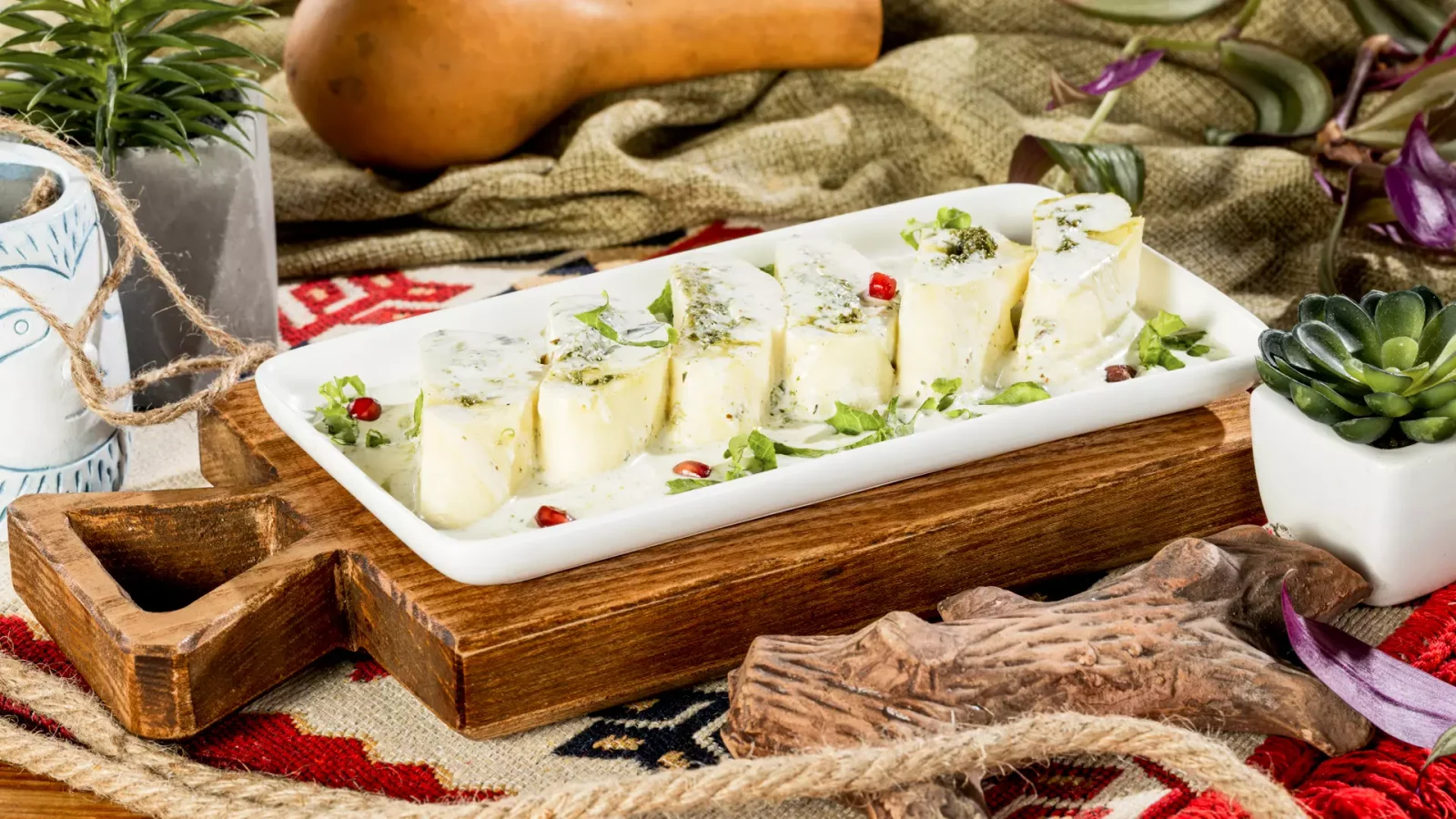
A slice of gebzhalia can look like a tiny roulade: pale layers circling a green seam, with more pale sauce around them. The wrapper is cheese. So is part of the sauce in many versions. Mint travels through the middle, giving the eye a route into a dish that might otherwise seem almost monochrome.[1][2]
This specialty of Samegrelo, in western Georgia, makes a surprisingly expansive meal out of a narrow family of ingredients. Its interest lies in what happens between them: a sheet holds its shape, a sauce flows, and herbs interrupt both. Reading Georgian cooks’ methods reveals a dish whose refinement depends on handling and proportion rather than a long shopping list.
The cheese has to become a wrapper
Food writer Irma Iantbelidze’s recipe begins with fresh cheese, naming Imeruli and sulguni among the options. Slices soften in heated milk or water, then become a mass that can be flattened on a board. Mint, green pepper and salt go over the sheet before it is rolled and cut.[2]
The cleverness is easy to miss once those slices reach a plate. The cook has persuaded something usually cut into portions to behave like a material for making portions. The edge of each spiral records that transformation. It is a small piece of kitchen work that remains legible at the table.
Georgia’s tourism administration adds two telling cautions: flatten the cheese before it cools, and avoid excessive kneading, which makes the finished result dense.[1] Those instructions describe a brief opportunity. The cheese must be workable enough to spread and fold, but working it harder is not automatically an improvement.
That distinction gives the diner something useful to notice. A neatly drawn spiral is only the visible achievement. Its tenderness matters just as much. The dish asks a wrapper to contain its filling without making the mouth work too hard to reach it.
The sauce takes a different route
In Iantbelidze’s version, cottage cheese or ricotta is mixed with sour cream and loosened with liquid from the saucepan. It is poured over the sliced rolls in a deep plate.[2] The cooking liquid therefore has a second job: it helps turn another form of cheese into something spoonable.
This arrangement puts two dairy textures into the same mouthful. One can be lifted; the other follows it. The mint filling gives that mouthful a fragrant center, while the sauce reaches the cut surfaces from outside. On paper, the ingredients repeat. On the plate, their jobs differ.
A useful comparison appears in Georgian Recipes’ 2015 cottage-cheese version. There, the cook divides crushed mint between the cheese surface and a sauce of cottage cheese and milk.[3] The herb consequently appears in two places. It need not wait inside a roll to announce itself.
These methods suggest a way of looking at the sauce before reaching for the fork. How much of the cheese remains visible? Does the herb sit mostly on the surface or travel through the surrounding dairy? Those are choices that change the encounter with a bite, even when the menu supplies only the dish’s name.
A spiral is one possible shape
The 2015 recipe also offers a useful surprise: its softened cheese is flattened into a round on the plate, spread with mint and cut into portions before the sauce is added. The instructions call for serving it cold.[3] There is no rolled spiral to display.
The difference is substantial enough to change the first impression, yet the essential relationships remain easy to recognize. Prepared cheese, crushed herbs and a surrounding dairy mixture still meet. In this version the mint is exposed across the surface; in the rolled version, cutting opens the filling to view.
This is why a single handsome restaurant photograph cannot establish the only correct outline. A roll makes its construction visible in cross-section. A flat round distributes that construction across the plate. Both can invite the same attentive eating: take some cheese, bring the sauce with it, and notice where the mint enters.
Cheese at the beginning of dinner
A dated restaurant menu provides another perspective. Funicular’s April 2025 menu places a cheese board among its starters, listing gebjalia alongside sulguni, mint with nadughi, sour cream sauce and Guda cheese chips.[4] The spelling varies, and the placement is revealing: this is an opening assortment of dairy preparations.
The menu gives evidence of that particular presentation, without telling us exactly how the restaurant formed or seasoned its gebjalia. What it does show is room for several textures on one board. Against that company, the dish’s softened cheese and sauce become part of a broader conversation about what cheese can do.
Back in its regional setting, Georgia Travel identifies ghomi, a cornmeal porridge, as a traditional accompaniment.[1][5] That pairing also leaves room for the sauce to matter. The pleasure suggested by these preparations is generous and tactile: cheese that yields, herbs carried through dairy, and enough sauce to make the next mouthful a little different from the last.