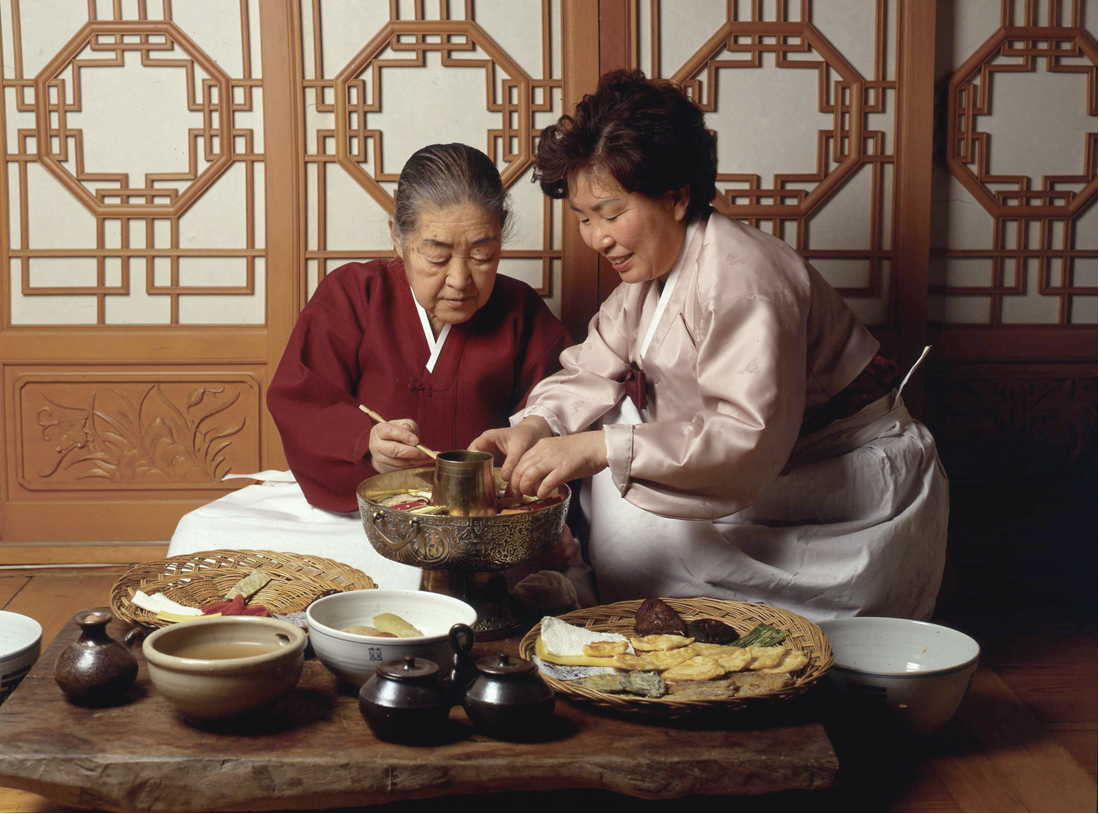
A sinseollo offers plenty to look at before the first spoonful: pale fish, yellow egg, green water parsley, little meatballs, all arranged around the vessel's central opening. Beef broth joins the separate preparations into a hot, elaborate whole.[1] The shape makes dinner feel gathered around its own hearth.
Often introduced as Korean royal hot pot, sinseollo has a history that extends beyond the palace. Its name once belonged specifically to the vessel. Following that vessel into restaurants, gift exchanges and teaching kitchens reveals how a prestigious dish acquires a wider life.[2][4][5]
Before the dish took the name
In her 2022 study, historian Jeong Ji Hui distinguishes two earlier terms: yeolgujatang for the food and sinseollo for the pot. Her published abstract places the shift toward calling the food sinseollo after the appearance of Dongguksesigi, a record of seasonal customs, in 1849; the usage entered standard language in the late 1930s.[2]
The vessel had also served more than one purpose, including warming alcohol or tea. Jeong compares its central flue and perforated foot with Chinese ring-shaped hot pots, finding the same basic form. She also records competing accounts of its origins.[2] A familiar silhouette can travel while names and recipes take different paths. The evidence calls for more care than a tidy invention story allows.
That distinction makes the modern menu name unusually expressive. Ordering sinseollo invokes an object as well as something to eat. The pot has become so closely associated with its contents that it can announce the meal before the ingredients are named.
A place among many dishes
At court, sinseollo belonged to a larger arrangement of food and occasion. The Korea Tourism Organization describes it among the accompaniments to myeonsang, a table centered on noodles, rice-cake soup or dumplings, offered on holidays and royal birthdays. Sliced meat, raw fish and pan-fried delicacies could share that setting.[3]
The surrounding room mattered, too. The same account describes banquet food reaching musicians, dancers and soldiers, with tables differentiated by rank; remaining food went to royal relatives and servants.[3] To call this royal cuisine identifies a system of hosting, labor and hierarchy as well as an elaborate recipe.
For a diner, that wider frame changes the picture. The handsome pot need not carry an entire meal's worth of spectacle by itself. It can sit among other preparations, offering warmth and broth between quite different bites.
The pot goes visiting
Kim Serine's 2021 study of metal sinseollo follows its changing audience. In the early twentieth century, the vessel retained associations with royal and elite tables and with wedding gifts. Korean restaurants helped more people encounter the food and its distinctive tableware. Foreign visitors, particularly Japanese visitors, also valued the pot as a Korean souvenir.[4]
Kim places that appeal within a longer history of Japanese interest, rather than treating it as something that suddenly appeared during colonial rule.[4] The distinction matters: an object's changing market has its own chronology, which a simple palace-to-restaurant story can flatten.
Here the cooking vessel becomes a particularly revealing traveler. A guest can remember a dinner through its taste, but can also take home something shaped like the dinner's centerpiece. In that reading, the pot's recognizability helps the dish circulate. It carries an expectation of hospitality even when it is empty.
What the finished arrangement conceals
The accessible recipe published by KBS makes the kitchen labor visible. Fish is coated and pan-fried; beef and tofu become small meatballs. Egg preparations and vegetables are cut into orderly pieces. These components are assembled over radish and beef before broth is added and the pot simmers.[1]
This is a useful recipe to read backward from the finished dish. A spoonful brings together foods that reached the pot through different preparations. The neat surface is the last stage of considerable handling. Its elegance depends on the cook's ability to make that work look settled and coherent.
KBS documents one version, not a recipe proven unchanged across centuries.[1] That leaves room to appreciate the particular cook's decisions: the distribution of colors, the proportions of fish and meat, and the balance between a clear view of the ingredients and a generous spoonful of broth.
A tradition passed across a kitchen table
The photograph offers a more intimate account of continuity. Hwang Hye-seong and Han Bok-ryeo prepare sinseollo together. Korea.net's 2020 profile traces the teaching lineage from court cook Han Hui-sun to Hwang, whose studies with her began in 1944, and onward to Han Bok-ryeo.[5]
In the accompanying interview, Han describes the work of comparing historical records with cooking practice. Written names, quantities and instructions survive, but interpreting older methods takes sustained collective effort.[5] Preservation happens through reading and through hands learning what to do.
That is the most inviting way to approach the pot at dinner. Look at the careful arrangement, then consider the many people required to make it possible: those who shaped the vessel, those who recorded a preparation, and those who taught someone else to cook it. The first spoonful disturbs the pattern. The work has achieved its purpose when someone begins to eat.
Sources
- KBS World, “Sinseollo,” August 10, 2018 — ingredients, separate preparations and final assembly.
- Jeong Ji Hui, “Reconsideration of the Appellation and Origin of Sinseollo and Modernization,” Journal of Korean Modern & Contemporary Art History 43 (2022), pp. 231–265 — published abstract on naming, vessel uses and comparative origins.
- Korea Tourism Organization, “Royal Cuisine” — historical account of court banquet tables and food distribution.
- Kim Serine, “Japanese Colonial Era Metallic Sinseollo Production and Consumption Culture,” Korean Studies Quarterly 44, no. 1 (2021), pp. 285–326 — published abstract on restaurants, gifts and souvenir culture.
- Kim Samuel, “Preserving Royal Cuisine,” Korea.net / Monthly KOREA, April 10, 2020 — interview with Han Bok-ryeo, teaching lineage and Institute of Korean Royal Cuisine photograph.