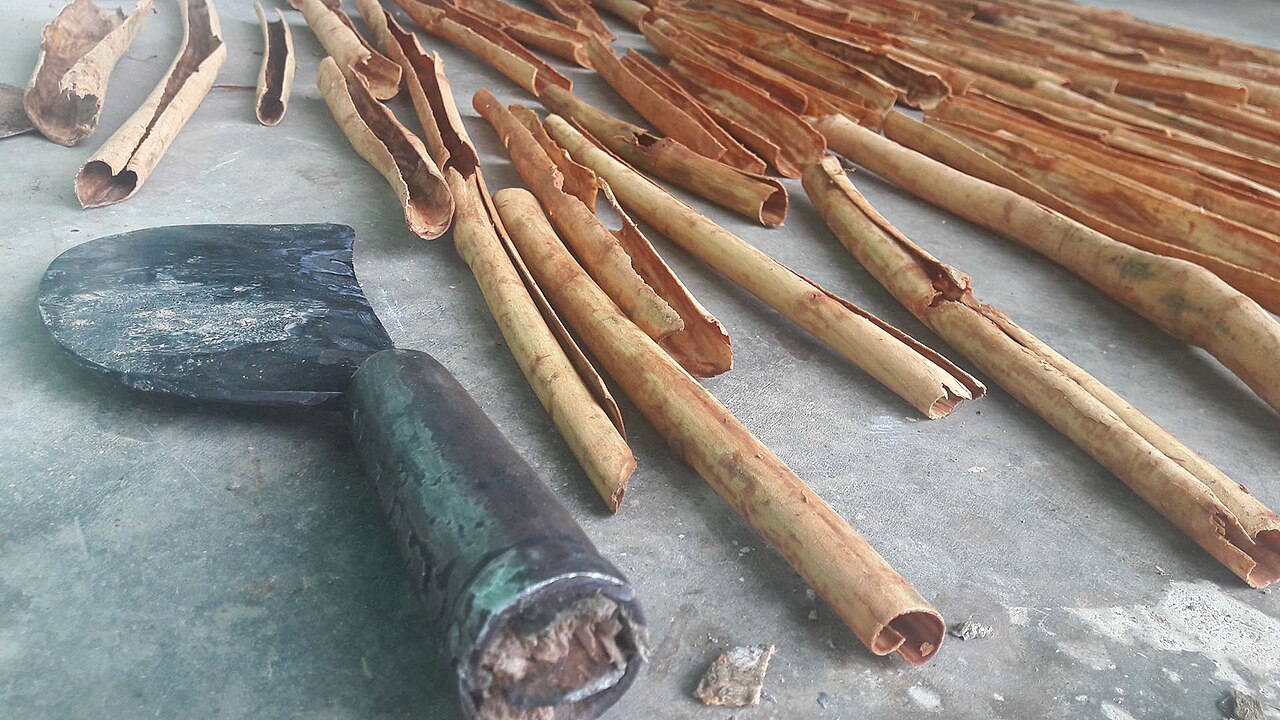
At Singapore's Saint Pierre, cinnamon merits a choice of origin. In a May 2025 account of its seasonings, the restaurant says chef Emmanuel Stroobant sources it from Sri Lanka because he prefers Ceylon cinnamon's nuanced flavor to cassia.[1] That is a modest claim with an interesting journey behind it. Before a cook can decide what the spice contributes to dinner, someone has to turn a living stem into a remarkably delicate object.
Look into the end of a Ceylon cinnamon quill and the layers become the story. Thin pieces of inner bark are fitted together, with smaller pieces filling the space inside. The long roll is assembled by a peeler.[2][3] Its neatness records decisions made with a scraper, a brass rod and a knife, well before it encounters a pastry chef's scales.
For a restaurant buyer, those decisions deserve attention. Origin, workmanship and performance in a dish are connected, but each needs its own evidence.
The harvest has to suit the hand
Cinnamon presents a timing problem before it presents a grading problem. Sri Lanka's Department of Cinnamon Development advises harvesting when the new leaves have turned green, a stage when bark is easier to remove. Timing varies between growing zones. Leaving stems longer can increase the proportion of wood without adding much bark, while making the finer grades harder to produce.[3]
The implication is that waiting for a bigger stem does not automatically give a grower a more valuable harvest. The bark has to be suitable for the work that follows.
The Export Development Board's account describes the peeler scraping away the rough exterior, then rubbing the exposed surface with a brass rod to loosen the inner bark. Careful cuts allow that bark to come away in sheets. The sheets overlap along the roll and nest within it; drying completes the transformation into the familiar pale quill.[2]
There is pleasure in understanding that construction. What looks like a little stick in a kitchen jar has passed through several judgments about thickness, damage and fit. A broken sheet need not be useless: smaller pieces have a place inside the assembled quill. The finished surface hides some of the craft that made it possible.[3]
Reading the letters on the packet
The buying language becomes less romantic: Alba, C5 Extra Special, C5 Special, C5. These names belong to a grading system. The EDB's guide for processors gives maximum quill diameters of 6 millimeters for Alba and 10 millimeters for C5 Special. It also assesses appearance, including color and the extent of surface markings called foxing, and the number of quills per kilogram.[4]
A slender, evenly made quill is an achievement. But the table does not tell a pastry chef how strongly a particular batch will register in a custard. That is an inference from what the grading criteria measure: physical presentation cannot, by itself, settle the flavor of a finished dish.
The distinction changes the purchasing conversation. If whole quills will be presented to guests, their appearance may be part of what the restaurant is buying. If the bark will be ground or strained from an infusion, the relevant comparison includes how the samples taste in that preparation. Paying for careful workmanship can be entirely reasonable; choosing a grade still leaves the cook with work to do.
Nor should a restaurant quietly turn its preference into somebody else's sourcing claim. Saint Pierre's account identifies Sri Lanka and the type of cinnamon. It does not name a quill grade.[1]
A place name with paperwork
Ceylon Cinnamon received European Union Protected Geographical Indication status in February 2022. The EDB explains that products carrying the PGI mark must meet the scheme's requirements and contain cinnamon grown, processed and manufactured in Sri Lanka.[5]
That mark answers a different question from Alba or C5. It connects a product with a defined origin and production specification. The grade describes the quill within a commercial system. Neither label tells a chef how much cinnamon a chocolate dessert needs.
The paperwork makes the origin claim more useful. The processors' guide calls for records of received material, identification of lots and measures to prevent mixing with nonconforming products.[4] For a buyer, asking the supplier to connect the delivered lot to its certification is a practical extension of those controls. A Sri Lankan address on a packet alone is not evidence that the contents carry PGI certification.
The last test happens in the dish
Chef and cooking teacher Heidi Fink offers a useful example of how flavor resists a simple ranking. While developing chocolate ice cream with Ceylon cinnamon, she found that a later batch lacked the effect she remembered, despite containing more spice. Changing from Dutch-processed cocoa to natural cocoa restored the combination she wanted.[6]
This is her reported kitchen experience, not a controlled comparison of cinnamon grades. Its value here is the reminder that the surrounding ingredients matter. An excellent spice can seem less expressive when the rest of the preparation changes.
A restaurant can take that lesson into a small tasting: compare supplier samples at the same weight, in the same base, using the same method, then taste the finished preparation. Keep the lot details beside the tasting notes so the next order can be judged against something more precise than a remembered fragrance.
The reward for all that attention should be easy to enjoy. Cinnamon can bring warmth to chocolate without making the whole dessert taste of the spice cupboard. Behind that balance sits a chain of careful work, beginning with a peeler coaxing a thin sheet of bark away from the wood.
Sources
- Saint Pierre, “6 Condiments & Seasonings to Savour,” 22 May 2025 — the restaurant's account of Emmanuel Stroobant's cinnamon sourcing and preference.
- Sri Lanka Export Development Board, “Processing of Ceylon Cinnamon: Age-Old Traditions Rooted in a Colourful History,” 5 June 2015 — peeling tools, layered quill construction and drying.
- Sri Lanka Department of Cinnamon Development, “Post Harvest Technology” — harvest timing, stem maturity and the production of finer grades.
- Sri Lanka Export Development Board, CCGI Guidebook for Processors and Traders, Volume 2 — printed pages 2–3 and 6–8: lot records, segregation and grading criteria.
- Sri Lanka Export Development Board, “Ceylon Cinnamon Geographical Indication” — recognition, origin requirements and use of the PGI mark.
- Heidi Fink, “Chocolate Ice Cream with Ceylon Cinnamon,” 31 July 2013 — the chef's account of recipe development and the effect of changing cocoa.
- Photograph licensed under CC BY-SA 4.0: Backbone DM, “Ceylon Cinnamon,” Wikimedia Commons — made in Balangoda on 18 August 2018; reproduced at reduced resolution.