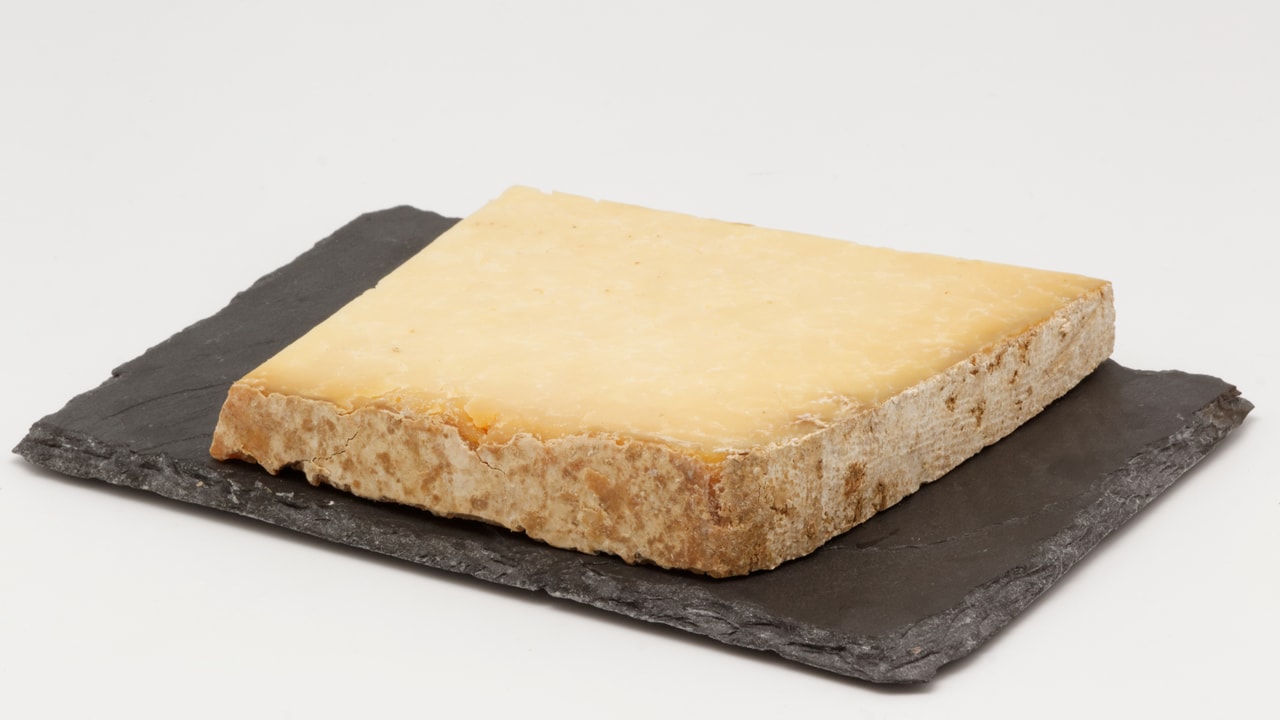
A wedge of Salers looks manageable on a cheese trolley: pale paste, a thick, weathered rind, enough room on the plate for another selection. Its parent wheel is a different proposition. The producers' association describes cylinders weighing 30–50 kilograms, made on farms from raw, whole cow's milk.[1] The portion at dinner is a small cut through a considerable amount of work.
Some of that work happens in an object the diner never sees. Before there is a wheel, there is a gerle: a wooden vat that receives the milk and contributes microorganisms to it.[5] Following Salers back to that vessel makes the familiar restaurant language of origin unusually concrete. The pasture supplies the milk; the workshop helps determine what happens next.
A season built into the name
Salers has a production calendar. The appellation's specification, approved in July 2021 and published by the producers' association, places manufacture between 15 April and 15 November, with the cows at pasture. It also requires the cheese to be made on the farm from that farm's milk.[2]
The feeding rule deserves careful reading. Grazed grass forms the entire basic ration, but permitted supplements can account for up to a quarter of dry-matter intake.[2] Turning that into a menu claim of “nothing but grass” would make the promise larger than the specification.
For the dining room, the useful distinction is between the season of production and the date of service. Salers needs at least three months of aging.[5] A wheel offered in winter can therefore belong perfectly well to this pasture-based system. Its presence on a December trolley does not imply December cheesemaking.
Ask when a cheese was made as well as how long it has matured. The answers describe two different stages of its life.
The cow is a separate question
The name Salers belongs to both a cheese and a cattle breed, which invites a persuasive but unreliable shortcut. A Ministry of Agriculture report from February 2022 describes the Ferme du Jarry making Salers with milk from an Abondance herd. The farm sits at 1,120 meters in the Cantal mountains and supplied, among other customers, local restaurants.[3]
The additional designation Tradition Salers makes the narrower breed claim: its makers undertake to use milk only from herds composed entirely of Salers cattle.[2]
That distinction gives a waiter something better than a picturesque generalization. The farm and the breed can each be named when known. Neither needs to be guessed from a photograph of a red cow or from the cheese's name alone.
The wood participates
The gerle is made from chestnut or acacia, according to the producers' account of manufacture.[5] Its role goes beyond holding liquid while the cheesemaker reaches for the rennet.
In 2012, Robert Didienne and colleagues reported on gerles from ten farms studied over two years. Their microbial communities differed, alongside inoculation and washing practices. A test showed a farm gerle transferring microorganisms into pasteurized milk in less than a minute.[4]
The pasteurized milk belonged to the experiment; Salers uses raw milk.[1][4] The test reveals an active vessel, bringing resident organisms into contact with incoming milk.
Biofilms developed in experimental gerles in under a week.[4] That makes an ancient vat's age a poor explanation on its own. The craft involves maintaining a working microbial community through use and care.
A wheel takes several kinds of hands
The producers' description follows curd through repeated pressing, cutting into blocks and turning. It then rests to acidify, is broken up and salted, and rests again. A second pressing, in the mold, lasts 48 hours. During maturation, the wheels are turned and wiped twice a week.[5]
There is a pleasing change of scale here: milk fills a vessel, curd becomes blocks, blocks become fragments, and fragments are gathered into a wheel. The finished solidity conceals all those interruptions.
Nor does “farmstead” necessarily mean that one family performs every stage. In the ministry's Jarry report, production from pasture through pressing takes place on the farm, while a separate affineur within the appellation area handles maturation.[3] Naming the affineur alongside the farmer can make the account more complete. The cellar is another place where the cheese receives sustained attention.
Leave room for the particular wedge
The Salers association's sensory guide offers a broad vocabulary: butter and fermented cream, grass and hay, walnut and hazelnut, with other possible impressions including pepper and toasted onion. It explicitly says that there is no standard Salers whose aromas recur identically at every tasting.[6]
That makes the vocabulary an invitation to pay attention. A restaurant need not promise all those sensations in one portion. Taste the wheel being served, then choose the words that fit it.
The same restraint improves the sourcing story. A farm name, a production date and an affineur give the diner something specific to follow. A verified breed designation adds another detail. The wooden vat explains why the workshop belongs in the account alongside the meadow.
After that, the trolley can move on. The pleasure is still in the cheese: a small piece whose individuality has become easier to notice.
Sources
- Comité Interprofessionnel des Fromages, “AOP Salers” — farmstead production, raw whole milk, rind and wheel dimensions.
- INAO, Cahier des charges de l'appellation d'origine « Salers », approved 7 July 2021 — pages 4 and 6–7: Tradition Salers, farm milk, production season, grazing and permitted supplements.
- French Ministry of Agriculture, “Les Salers AOP et Cantal AOP de la ferme du Jarry,” 28 February 2022 — Abondance cattle, farm production, restaurant customers and separate maturation.
- Robert Didienne et al., “Characteristics of microbial biofilm on wooden vats ('gerles') in PDO Salers cheese,” International Journal of Food Microbiology 156(2), 2012, pp. 91–101 — INRA's bibliographic record, hosted by FAO AGRIS.
- Comité Interprofessionnel des Fromages, “La Fabrication” — gerle materials, curd handling, pressing and maturation.
- Comité Interprofessionnel des Fromages, “Arôme” — sensory vocabulary and variation among Salers cheeses.
- Photograph licensed under CC BY-SA 3.0: Coyau, “Salers (fromage) 01,” Wikimedia Commons, photographed 20 February 2015 — the article's photograph, reproduced at reduced resolution.