In July 1980, Kathleen Bick invited her business partner, Larry Becker, to dinner at L'Orangerie in West Hollywood. It was her celebration and her treat. The restaurant seated them beneath high ceilings and flowers, then placed a green menu in Becker's hands and a white one in Bick's. His showed the prices. Hers did not.[1][2]
The gesture was meant to remove money from the guest's evening. Instead, it removed the host from her own dinner.
That is what makes the old ladies' menu more than an eccentric relic of white-tablecloth service. It was a small information system. By deciding who could see the prices, the dining room also decided who was paying, who could judge value, who was allowed to order freely, and who was expected to remain pleasantly unaware. The food on the two menus could be identical; the authority was not.
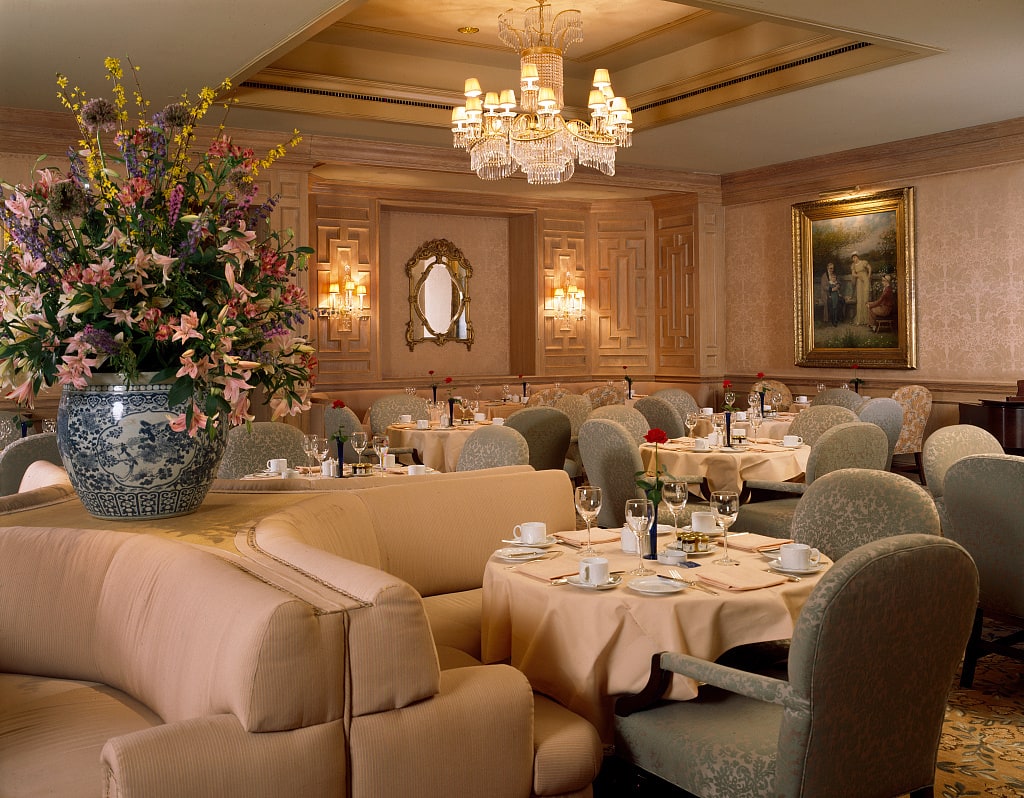
The cover photograph, made in a formal American restaurant during the same decade, preserves the world around that gesture: pale napery, crystal, flowers, upholstered quiet, and a room arranged to make every decision look effortless.[8]
Two colors carried an entire social script
The contemporary Time report is valuable because it catches the dispute before hindsight tidied it into legend. Bick and Becker left without ordering. With attorney Gloria Allred, they sued under California's Unruh Civil Rights Act, seeking at least $250 in statutory damages and an injunction against the dual-menu practice. L'Orangerie's owners, Virginie and Gerard Ferry, defended the price-less menu as a courtesy to a guest. They said a woman booking in her own name would receive prices.[1]
That defense contains the better version of the idea: distinguish host from guest, not man from woman. Yet the menus handed out that night showed why the distinction could not be trusted to intuition. Bick had arranged the dinner and intended to pay, but the first service move treated Becker's gender as better evidence than her agency. Before the first drink or course, the room had assigned the parts.
The mistake was not merely that Bick lacked a number beside the veal. A price lets a diner read the scale of a restaurant. It shows which dishes carry premiums, whether caviar is a small flourish or a major commitment, and how one choice sits beside another. Without that information, a guest can order expansively and worry about imposing, or order cautiously and miss the pleasure the host hoped to provide. Tracey MacLeod later described doing exactly that calculation at a London club: unable to see prices, she tried to guess which ingredients would be affordable and avoided obvious luxuries.[6]
A menu designed to make money disappear can therefore make money more present. The diner begins pricing the meal in imagination.
The restaurant menu promised individual choice
The irony runs back to the birth of the restaurant itself. UNLV Special Collections describes the luxurious early Paris restaurant as a departure from the inn's common table and fixed meal: patrons gained their own tables, broader hours, and a menu from which they could choose individual dishes.[5] The printed restaurant menu was not just decoration. It helped turn appetite into a private decision inside a public room.
Prices belong to that architecture of choice. They are not the only information a diner needs—ingredients, portion, preparation, and dietary boundaries matter too—but they complete the offer. A priced menu says: these are the possibilities, these are their terms, and the selection is yours.
The price-less ladies' menu kept the possibilities while editing the terms. It offered aesthetic freedom but withheld commercial knowledge. In a private dinner where the host has explicitly requested that arrangement, the omission can feel generous. Applied automatically, it changes the character of restaurant choice. One diner receives an offer; the other receives an invitation to trust both host and house.
That trust is not trivial. Fine dining depends on it. Guests accept unfamiliar ingredients, surrender hours to a tasting sequence, and let servers pace the table. But good hospitality does not confuse trust with passivity. It gives the guest enough knowledge to consent to the experience, then makes the mechanics recede.
Courtesy became a form of classification
The ladies' menu sat inside a much larger history of deciding how women could occupy public space. Elizabeth Sepper and Deborah Dinner's legal history of public accommodations shows that, into the 1970s, women faced exclusion or secondary status in restaurants, bars, professional organizations, sports, and financial institutions. The era's equality campaigns were not only about getting through the door. They also challenged rules that made a woman's attachment to a man determine how she could act once inside.[3]
Seen in that frame, the menu was unusually efficient. It did not refuse service, lower the quality of the meal, or mark a forbidden table. It encoded dependence in a polished object and called the result elegance. The same logic could continue through the evening: offer the wine to the man, address explanations to him, and place the bill beside him. Each gesture was small enough to defend as tradition. Together they made one person the economic center of the table.
The modern text of California's Unruh Act states that people are entitled, regardless of sex and other protected characteristics, to the full and equal accommodations, advantages, privileges, and services of every kind of business establishment.[4] That language clarifies why “but both menus list the same food” is not a complete answer. Restaurant service includes the handling of information and choice, not only the delivery of a plate.
There was no courtroom ending
The L'Orangerie story is often flattened into a victorious court case that banned the ladies' menu. The record described by Atlas Obscura is less cinematic and more instructive. The restaurant announced that it would keep price-less menus but stop assuming the guest was the woman; the suit was dropped. There was no final judgment declaring the practice unlawful.[2]
That distinction matters. A court did not design a new service ritual. Public pressure made the old assumption expensive, and the restaurant moved toward a host-and-guest rule that its owners said they had intended all along. The object survived. The classification changed.
Nor did gendered service disappear on schedule. In 2010, MacLeod reported that Le Gavroche still used a price-less menu for a woman when a man had booked. She also recalled a female host at La Tante Claire receiving the menu without prices while her husband was offered the wine and the bill, despite her having made the reservation.[6] Three decades after Bick's dinner, the problem was still not the existence of two printed versions. It was the room's confidence that it could identify the payer by looking.
The guest menu survived by becoming optional
There is a legitimate pleasure inside the old ritual. A host may want to celebrate a parent, thank a colleague, or propose marriage without asking the guest to measure every desire against a number. A private club may want members to entertain without turning hospitality into a live budget discussion. The price-less menu can make generosity feel spacious.
By 2013, a Town & Country survey showed restaurants trying several ways to preserve that effect. Epicure in Paris reportedly gave the priced menu to the person who booked and blind menus to the other guests. La Pergola in Rome offered menus without prices on request. Elsewhere, the old automatic distribution still produced exactly the failure one would predict: a woman who was the chief executive and host received no prices while male employees at her table did.[7]
Those examples reveal three different systems:
- A ladies' menu assigns roles from gender.
- A booking rule assigns roles from reservation data.
- An opt-in guest menu lets the host assign roles deliberately.
Only the third removes the guess. The booking rule is better than gender, but reservations can be made by assistants, concierges, partners, or whoever had the account open. The clean service move is a discreet question before arrival: Would you like prices on every menu, or one host menu and guest menus? The answer can sit in the reservation notes beside allergies and occasion details.
Even then, discretion needs boundaries. Supplements, market-price dishes, beverage pairings, and verbal additions should not become invisible obligations. Any guest who asks for prices should receive them immediately and without theater. A price-less menu should be an offered atmosphere, never a barrier to information.
Elegance begins after the assumption ends
The old ladies' menu failed because it tried to produce ease through certainty: the man hosts, the woman is treated, and neither needs to discuss it. Real tables were always more complicated. Women hosted business dinners. Couples shared money. Friends alternated paying. Guests cared about the burden they placed on hosts. The smooth script became awkward the moment a person refused the assigned role.
Fine dining still has to solve the original problem. Money can be coarse at a celebratory table; hospitality should soften its edges. But the answer is not to hide information from the person whom tradition expects to be dependent. It is to ask the host what kind of discretion the occasion requires, keep access to prices easy, and then carry out the choice so calmly that nobody has to negotiate it under the chandelier.
L'Orangerie's two menus looked like a minor difference in ink. They were actually two versions of the evening. One made the guest financially legible. The other made her rely on a role the room had selected for her. The best contemporary service keeps the grace, discards the guess, and lets the people at the table decide who is hosting before the menu tries to decide for them.
Sources
- Time, “Living: Priceless Menu” (August 18, 1980) — contemporaneous report on Kathleen Bick and Larry Becker's dinner, the two menu colors, the Unruh Act claim, requested remedy, and L'Orangerie's courtesy defense.
- Natasha Frost, “The Court Case That Killed the ‘Ladies Menu,’” Atlas Obscura (February 2, 2018) — reconstruction of the L'Orangerie dispute, the restaurant's policy change, the dropped suit, and the distinction between price-less menus and nineteenth-century ladies' dining rooms.
- Elizabeth Sepper and Deborah Dinner, “Sex in Public,” Yale Law Journal 129 (2019) — legal history of sex discrimination in public accommodations and the shift from access alone toward freedom from gendered regulation in public life.
- California Legislative Information, Civil Code § 51 — current official text of the Unruh Civil Rights Act and its guarantee of full and equal services in business establishments regardless of sex and other protected characteristics.
- UNLV Libraries Special Collections, “The History of the Restaurant” — institutional account of individual tables, flexible dining hours, and menu-based choice as defining features of early restaurant service.
- Tracey MacLeod and John Walsh, “Battle of the sexes: Do men or women make the better dining companion?”, The Independent (November 13, 2010) — firsthand account of ordering from a price-less menu and later gendered host assumptions at Le Gavroche and La Tante Claire.
- Melanie Broder, “Filling in the Blanks,” Town & Country (May 13, 2013) — survey of blind-menu practices based on booking identity, explicit request, club membership, and gender, including their operational failures.
- Library of Congress, “Restaurant table settings” — Carol M. Highsmith's archival color photograph of a formal American restaurant dining room in the 1980s, used as the article image.