At Restaurante Manu, three nouns sit above the invitation to book: mar • horta • campo—sea, garden, countryside. They sound almost too clean, three little territories lined up like courses. The meal described around them is messier and more interesting. Weather interrupts menus. Honey changes character from one native bee to another. A piece of young coconut borrows the spring of squid. Farmers, fishers, cooks, gardeners, and five tables all press upon what reaches the plate.[1][3][4]
That makes Manu Buffara's restaurant in Curitiba, in southern Brazil, a useful test of what local can mean after the word has been polished smooth by fine-dining menus. Her answer is not a radius alone, although the restaurant says that 80 percent of its products come from within 300 kilometres. It is a set of relationships: who grew the food, what the season is doing, whether the team has the energy to notice, and what a chef owes the city after dinner service ends.[1][2]
This is a reported Q&A synthesized from Buffara's published interviews, the restaurant's own account, and independent reporting from Curitiba—not a new interview. The answers below preserve the substance of those sources while testing the tensions inside them: luxury made from ordinary ingredients, a smaller dining room with a larger civic horizon, and social work that matters without becoming garnish for a tasting menu.
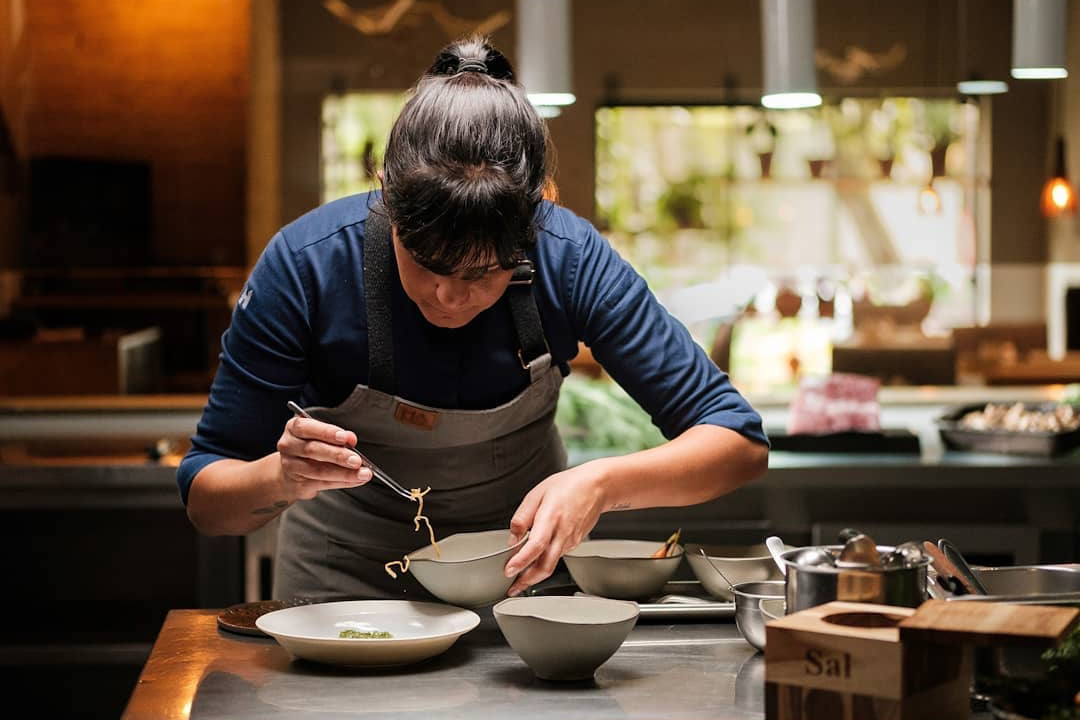
Image context: the cover is a real photograph from Restaurante Manu's official site. Buffara is bent over the pass rather than posed with a finished plate; that concentration is the article's subject in miniature.[1]
Why build this cuisine in Curitiba?
Because the city is not merely Manu's address. It is the point where several landscapes become close enough to study.
Buffara has described travelling through Paraná before opening the restaurant, learning the state's producers, agriculture, nature, and weather. Forecasting was not background information: it helped her think about what could be served across a year. In her account, the research group began with roughly ten women looking for ingredients as basic as sugar, milk, and flour—not exotic trophies, but better versions of the pantry's grammar.[3]
Her family history gives that research a shoreline. Buffara told National Geographic that her father's Spanish and Italian relatives first arrived in the port city of Paranaguá, where she learned seafood cookery at her grandparents' table; her Lebanese maternal family supplied another register of grains and spices. Farm life supplied the habit of asking how food grows before asking how it plates.[4]
So mar • horta • campo is less a slogan than a route. The sea brings fish and shellfish; the garden introduces leaves, roots, flowers, honey, and fermentation; the countryside brings farms and the knowledge of changing weather. Curitiba enters the kitchen whenever those relationships constrain a dish. The city is not sprinkled on top at the end.
If the ingredients are ordinary, where is the luxury?
In attention, transformation, and timing—not in replacing place with prestige.
Buffara's sharpest early statement of intent was that she wanted fine dining “not with caviar or foie gras,” but with food available at an ordinary grocer.[3] That does not make the restaurant anti-technique. It changes what technique is for. Instead of proving that an expensive ingredient is expensive, the kitchen has to reveal an unsuspected property in something familiar.
Take squid and young coconut. Buffara links the dish to drinking coconut water at the beach and scraping the tender flesh from the opened shell. In the published recipe, coconut water, tapioca, fish stock, squid ink, chilli, tomato, native honey, diced coconut, and squid meet in layers. The visual joke—seafood beside something that can resemble seafood—is secondary to the bite: two pale, yielding textures begin close together, then separate as salinity, sweetness, and ink arrive.[4]
Native-bee honey works by the same logic. Buffara says the Curitiba area holds roughly 20 to 25 types; some taste more acidic, others more floral. A honey vinaigrette with scallop is therefore not generic sweetness. The bee determines the seasoning.[4] A 2022 menu moved further toward vegetables with leek, peanut, and vegetable sauce; fermented palm heart with amberjack and dill oil; and a carrot course with levain and fermented cassava flour closing the savoury sequence.[2]
The pleasure has to survive the explanation. A diner should not need a lecture on responsible sourcing to feel why tart honey wakes up a scallop, why coconut belongs beside squid, or why carrot can land with the finality usually assigned to meat. The ethics become convincing only when they sharpen appetite.
Are the urban gardens part of the pantry—or part of the politics?
Both, but not in the conveniently seamless way restaurant storytelling often suggests.
Curitiba's Horta do Chef programme explicitly connected urban growers with restaurants. A 2019 Folha de S.Paulo report followed Buffara to the gardens and described her weekly use of herbs, shoots, vegetables, and tubers from the municipal network. Its largest participating garden then covered 13,000 square metres and involved 100 families; residents kept food for themselves while surplus could be sold, donated, or exchanged.[5] That is a real supply relationship, not a mood board.
The wider work has a different purpose. Buffara's interviews describe vacant sites becoming productive green spaces, alongside honey gardens, school talks, meals for people experiencing homelessness, and later the Instituto Manu Buffara.[2][3][4] A Rede Globo report on Mulheres do Bem documents chefs preparing meals in restaurants or at home, using their own resources and supplier donations, before distribution through Curitiba's Restaurante Popular do Capanema. The project grew from Buffara's earlier involvement with the city's Mesa Solidária programme.[6]
It would be too neat to call every one of those beds an extension of Manu's mise en place. The sources show overlapping systems, not one private restaurant garden stretched across a city. Some produce can move toward restaurants; some feeds the people who grow it; some spaces teach cultivation or food literacy. The distinction protects the civic work from becoming a luxury-dining prop. A community garden does not need to supply a tasting-menu course to justify its existence.
Can a smaller restaurant still be more ambitious?
Buffara's strongest operational answer is yes—if ambition means intensity of care rather than maximum covers.
At the end of 2019, she cut Manu from ten tables to five and reduced service from five days each week to four. She also introduced team activities including English lessons and annual days away. Her explanation in 2022 began with a blunt premise: “Restaurants are built on people, not workers.” The goal was physical, mental, and financial health, not a softer aesthetic pasted onto the same workload.[2]
The official restaurant page still describes five tables and an average of 20 diners a night. It also says the tasting menu is about 60 percent plant-based and may change suddenly with fresh supply.[1] Those figures make the room's calm easier to understand. Five tables do not automatically create humane work, but they create a different ceiling: fewer simultaneous promises, more room to notice a sauce, a guest, or a tired colleague.
The menu appears to have undergone a parallel edit. Buffara described moving toward fewer decorative flowers, fewer ingredients on each plate, and more flavour.[2] Capacity and composition were reduced for the same reason—not minimalism as branding, but concentration. In that sense, the five-table restaurant is not a retreat from ambition. It is a refusal to measure ambition only by expansion.
What should another restaurant borrow from Manu?
Not the coconut, the honey, or the visual language of leaves. Those belong to a particular cook and place. The transferable part is the separation of three jobs that fine dining likes to blur.
First, the restaurant must make dinner delicious. Second, sourcing must be specific enough to change the food rather than merely decorate its description. Third, civic work must answer to a public need, not to the menu's desire for a virtuous story. Manu's published record is persuasive because the three jobs touch without becoming identical: regional honey seasons a scallop; a city programme can connect growers with buyers; a separate group can prepare meals for people who will never sit at one of Manu's five tables.[4][5][6]
There is also an evidence boundary. Awards profiles and chef interviews tell us what Buffara intends; they do not independently measure every social outcome. Reporting establishes that the garden and meal collaborations exist, but it does not prove that one small restaurant can solve urban food insecurity. It cannot, and it does not have to. Phaidon's edition of Buffara's book—60 recipes arranged with stories and photographs of land, sea, ingredients, and communities—makes a narrower claim: the cuisine can keep the people and places behind it visible.[7]
That is enough to change the feeling of luxury. Five tables cannot feed Curitiba. They can decide whether Curitiba is present in the room as more than a name. At Manu, the most compelling answer arrives as a chain of attention: weather to producer, producer to cook, cook to guest—and then, beyond the dining room, citizen to citizen. The sea, garden, and countryside do not line up neatly after all. They lean into one another, exactly as a living city should.
Sources
- Restaurante Manu, official English site — current restaurant concept, five-table scale, sourcing radius, plant-forward menu, address, and source of the cover photograph.
- Laura Price, “Manu's metamorphosis: how Latin America's Best Female Chef is prioritising work-life balance and a new ‘mature’ cuisine.” The World's 50 Best Restaurants, September 20, 2022 — staffing changes, civic projects, and menu evolution.
- CQP, “Manu Buffara, Chef & Environmental Activist,” November 17, 2020 — interview on Paraná research, ordinary ingredients, leadership, urban gardens, and community responsibility.
- Qin Xie, “Brazilian chef Manoella Buffara on her pioneering career and culinary heritage.” National Geographic Traveller, August 29, 2023 — family influences, native-bee honey, squid and coconut, and Instituto Manu Buffara programmes.
- Luiza Fecarotta, “Chef do Paraná leva sua delicada cozinha autoral para Nova York.” Folha de S.Paulo, May 6, 2019 — reported visit to Curitiba's community gardens, Horta do Chef supply, growers, ingredients, and Buffara's regional method.
- Rede Globo/RPC, “Chef paranaense, Manu Buffara, cria projeto solidário que entrega marmitas para moradores de rua de Curitiba,” May 29, 2020, updated June 10, 2022 — Mulheres do Bem preparation, funding, distribution, and connection to Mesa Solidária.
- Phaidon, Manu: Recipes and Stories from My Brazil — publisher record for the book's 60 recipes and its documentation of Buffara's land, sea, ingredients, and communities.