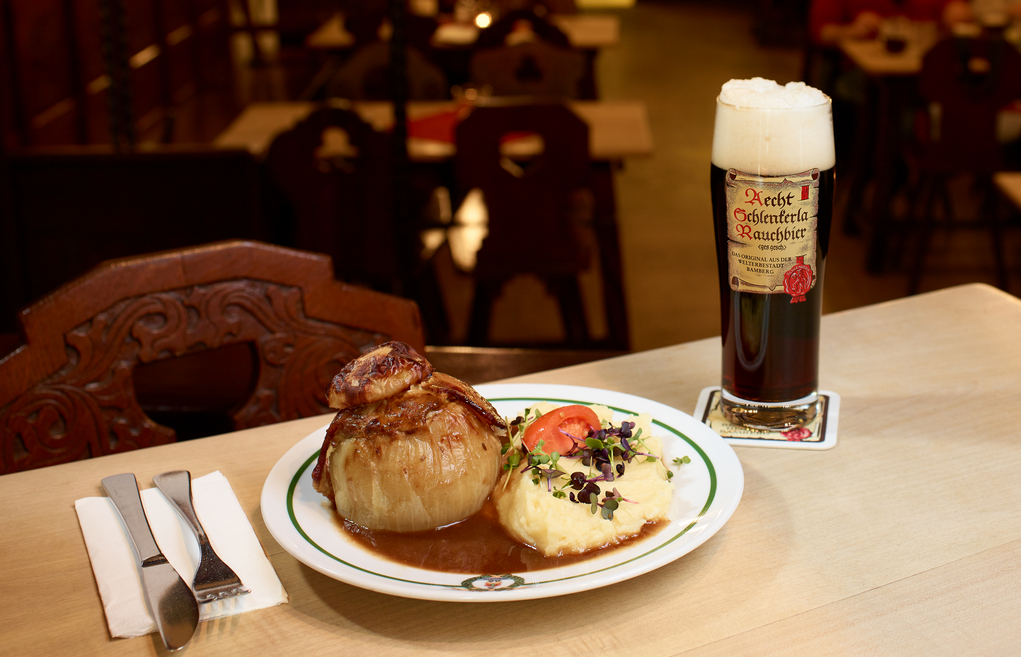
Schlenkerla’s menu offers a particularly edible introduction to Bamberg’s smoked beer: a large onion filled with pork, accompanied by bacon, mashed potatoes and Rauchbier sauce. The beer has a place in the gravy before anyone lifts a glass. Around it, the tavern’s repertoire includes roast pork shoulder, sauerkraut and dumplings—a table with plenty of browned edges and substantial bites.[1]
It is a more inviting starting point than treating Rauchbier as a test of whether someone likes the smell of a fireplace in their drink. At dinner, smoke can connect the glass to the cooking. The interesting decision is how much connection a plate needs. A beer may echo a smoked ingredient, or bring that aroma to food cooked without smoke at all.
The fire comes before the beer
In the traditional Bamberg method described by Slow Food Germany, damp malt is dried in the hot smoke of a wood fire in the brewery’s own kiln. That is where the character enters the grain. Slow Food’s Ark of Taste entry, admitted in 2017, recognizes the continuing practice at Schlenkerla and Spezial.[3]
This distinction gives the aroma a material origin. The glass carries a decision made in the malt house, long before a cook chooses a sauce. It also explains why a heritage designation and a flavor description answer different questions: the former can identify a preserved production method without promising that every brewery’s beer will taste equally smoky.
For the familiar Märzen-based style, the Beer Judge Certification Program describes toasted malt, moderate bitterness and a finish that can be fairly dry. Smoke intensity varies, and the malt should remain evident. Its guidelines also distinguish desirable wood or bacon-like aromas from harsh, acrid or burnt character.[4]
That malt matters at the table. A pairing chosen only for smoke overlooks the beer’s bread-like richness and its finish. The useful question becomes whether a sip leaves room for the next mouthful of food. These are sensory descriptions of a style, rather than a guarantee about any bottle poured tonight.
Two glasses, different weight
Schlenkerla’s classic Märzen supplies a concrete reference: a dark lager at 5.1% alcohol, with a listed bitterness of 30 IBU. The brewery describes beechwood smoking for its classic malt and service from gravity-fed wooden casks in the historic tavern. Its range also includes wheat beer, stronger bock and beers using other smoking woods.[5]
The name on the label therefore deserves the same attention as the brewery. Substituting a fuller bock for a Märzen changes more than the amount of alcohol. A pairing built around one should be tasted again with the other; “smoked beer” is too broad an instruction for a dining-room team.
Spezial provides another starting point. Bamberg’s tourism authority describes its smoked lager as amber, gently malty and milder in smoke than Schlenkerla, with approximately 4.6% alcohol. It recommends serving that lager at 7–9°C.[6] This is a documented difference in emphasis, not a ranking of quality.
For a proposed pairing, I would start with the gentler lager beside a lightly browned dish, reserving the more assertive reference for a plate with deeper roast flavors. That is a hypothesis to try with the food. The sauce, garnish and diner’s appetite for smoke can all overturn it.
The onion makes the connection visible
Schlenkerla’s published onion recipe goes further than the menu’s short description. Pork and cooked smoked pork fill the hollowed onion; bacon joins it after roasting. The cooking juices are combined with brown stock and Rauchbier to make the gravy, with potatoes alongside.[2]
The beer thus has several routes into the mouthful. Its smoky aroma can echo the smoked meat, while its malt character offers a companion to the roast and gravy. The soft onion and potatoes give the plate substantial elements that do not depend on a crisp, smoky exterior. This is my reading of the recipe’s pairing possibilities, rather than a report of tasting the dish.
It is also a useful example for a more elaborate dinner. A smaller filled onion or a carefully sauced roast can carry the same conversation between glass and plate. Changing the portion or the crockery does not remove the need to taste all the components together.
Leave some room around the smoke
There is a persuasive counterargument to the Bamberg plate’s repetition. In Nora McGunnigle’s 2016 CraftBeer.com feature, chef Adam Dulye explains that he generally prefers the beer to supply the pairing’s only smoke. Doubling it can overwhelm the palate and make the contributions harder to distinguish.[7]
That advice suggests a different experiment: browned mushrooms over a soft purée, cooked without smoked butter or smoked salt, with Rauchbier alongside. The dish is a proposed application, not one reported by Dulye. Here, the sip would introduce a new aroma instead of repeating one already in the food. A tasting portion would reveal whether the mushrooms remain distinct after the beer.
The two approaches need not produce a winner. Schlenkerla’s recipe documents a local appetite for repeated smoke; Dulye’s preference offers a way to preserve contrast. Together they make a stronger guide than a rule that every smoky beer belongs with barbecue.
For service, start with a small pour and a complete bite, including sauce and garnish. Try the beer before the food, then return to it afterward. If the onion’s sweetness or the mushrooms’ savory character disappears, reduce the smoke on the plate or try a gentler beer. If both remain legible, the glass has found a useful place at dinner. The pleasure is in returning to the fork.
Sources
- Schlenkerla, “Brewery tavern menu: food and drinks” — the stuffed onion, roast pork shoulder and accompanying dishes.
- Schlenkerla, “Recipes of Franconian specialties” — the Bamberg onion’s filling, bacon and beer gravy; source page for the accompanying brewery photograph.
- Slow Food Deutschland, “Bamberger Rauchbier traditioneller Herstellungsart” — brewery-owned smoke kilns, the continuing tradition at Schlenkerla and Spezial, and the 2017 Ark of Taste entry.
- Beer Judge Certification Program, “6B. Rauchbier,” 2021 Beer Style Guidelines — the Märzen-based style’s malt, smoke, bitterness, finish and sensory boundaries.
- Schlenkerla, “Smokebeer Varieties” — classic Märzen specifications, beechwood-smoked malt, cask service and the distinctions within the brewery’s range.
- Bamberg Tourismus, “Spezial brewery” — the smoked lager’s character, approximate alcohol content and recommended serving temperature.
- Nora McGunnigle, “3 Overlooked Beer Styles to Pair with Food,” CraftBeer.com, April 15, 2016 — Adam Dulye’s preference for letting beer provide the smoke in a pairing.