The decoration starts at the bottom of an empty pot. Almonds are pressed into its greased interior, then hidden beneath a sheet of dough. Rice and chicken follow. Only after baking, when the vessel is turned upside down, does the pattern become the face of the dish.[1][5] Perde pilavı asks the cook to imagine dinner from the outside inward.
The name supplies a useful image: a curtain drawn around pilaf. Turkey's Ministry of Culture and Tourism places the dish in southeastern Anatolia, distinguishing Siirt's “curtained” pilaf from Diyarbakır's “veiled” version and noting its place at formal dinners and wedding receptions.[2] The pleasure of the curtain is that somebody eventually opens it.
Design the surface before filling the pot
Siirt's Chamber of Commerce describes a dedicated vessel with a broad opening and a narrower base. Its recipe calls for dough rolled to about a millimetre, laid over the almonds with enough hanging beyond the rim to fold across the filling later.[1]
Think through that arrangement and the finished crust becomes easier to read. The almonds touch the vessel; the pastry lies behind them; the rice occupies the middle. What looks like a final flourish on the plate was among the first decisions in assembly. The cook must preserve the pattern while lowering a flexible sheet into the pot.
This gives the greasing stage an unusually visible consequence. It holds the decoration where it belongs before there is any baked pastry to support it. The pot is already doing some of the work normally associated with arranging food on a serving plate.
Let the rice have its own cooking time
Inside that neat wrapper sits a pilaf that has already received considerable attention. Barden Hotel in Siirt publishes a version in which washed rice is sautéed with pine nuts, then cooked with hot chicken stock, currants and seasoning until the liquid is absorbed. The rice rests before shredded, previously boiled chicken is folded through it.[3]
That pause helps explain the character of the filling. The pastry is being asked to enclose prepared food. The rice has taken up its stock, and the chicken can be distributed without depending on the final bake to cook it from raw. Each component arrives at assembly with a job already completed.
Barden's seasoning includes black pepper, red pepper and a little allspice. Currants bring small sweet interruptions; pine nuts give the rice another texture.[3] Read those ingredients together and the appeal is easy to anticipate: a savoury interior with enough variation to keep the next forkful interesting. A plain-looking stretch of pastry can conceal quite a busy spoonful.
Fold the curtain closed
Müge Çevik's recipe in the Agriculture and Forestry Ministry's magazine makes the next stage especially clear. She rolls the dough to 1–2 millimetres, lines the almond-decorated vessel, and fills it with alternating layers of pilaf and chicken. The overhanging edges fold inward; a further piece of dough covers the opening.[4]
There is a small reversal to keep in mind while watching this happen. The surface the cook is closing will sit underneath the finished dish. The decorative face is still out of sight against the pot. Care spent on the hidden lining is care spent on the eventual presentation.
Çevik pierces the dough cover to let air escape, then bakes the covered vessel at 200°C until the pastry browns.[4] Her instructions belong to that particular recipe.
The filling has room for different households
The Culture Portal's Siirt recipe gives the interior a different emphasis. Alongside chicken and almonds, it includes chicken liver, with cinnamon and black pepper added after the pilaf rests. Its dough contains eggs, margarine, olive oil and a small measure of chicken stock; the rice and chicken are layered inside.[5]
Barden's yogurt-containing dough and shredded-chicken filling offer another arrangement.[3] These are useful differences to retain. A liver-rich version and one punctuated by currants will deliver different mouthfuls, even when both arrive wearing an almond-studded crust.
For a diner, the better question is what this kitchen has put behind the curtain. For a cook, it is a reason to follow one complete formula through to the end. The shared construction is recognisable; quantities and baking instructions belong to their particular recipes.
The knife finishes the presentation
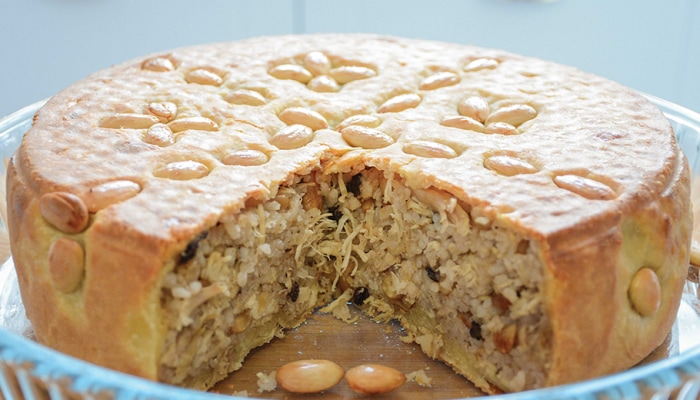
The photograph above catches the dish with a wedge removed: a thin pastry wall, grains of rice and strands of chicken within, almonds lodged in the browned surface.[4]
A whole perde pilavı gives the table a longer interval of anticipation. First there is an intact shape to admire. Then the knife makes an opening, and the filling that supplied its volume comes into view. The crisp-looking edge and the loose rice invite different uses of the fork.
The loveliest part of the technique is this delayed reward for orderly work. Those almonds were placed when the vessel was empty, then covered and entrusted to the rest of the cooking. At the table, they finally get their turn.
Sources
- Siirt Chamber of Commerce and Industry, “Siirt Perde Pilavı” — Turkish-language recipe describing the tapered pot, almond placement, thin dough, layered filling and inversion.
- Republic of Türkiye Ministry of Culture and Tourism, “Veiled Pilaf” — regional names and the dish's association with formal dinners and wedding receptions.
- Barden Hotel, Siirt, “Perde Pilav” — a local hotel's published recipe, including separately cooked and rested rice, shredded chicken, currants and yogurt dough.
- Müge Çevik, “Siirt’in coğrafi işaretli lezzeti: Perde Pilavı,” Türk Tarım Orman Dergisi, 15 June 2022 — thin dough, butter-held almonds, layered assembly and a vented dough cover.
- Türkiye Kültür Portalı, “Perde Pilavı — Siirt” — a documented version using chicken liver and a dough containing chicken stock.