A wine can glow like late-afternoon honey and still dry the gums like black tea. That is the useful surprise of Georgian qvevri amber wine. It begins with white grapes, yet prolonged contact with skins, seeds, and sometimes stems can give it tannin, savory depth, and enough physical grip to do work normally assigned to a light red.[2][3][4]
For a tasting menu, that makes the wine more than an exotic detour. It can occupy the difficult stretch after the raw, saline opening courses but before the menu wants the fruit and weight of red wine. This is where vegetables turn brown at the edges, sauces acquire nuts or sesame, fish meets smoke, and poultry gains lacquer. A conventional white can feel too polished; a red can tint every bite with itself. A well-chosen amber wine has another answer: white-wine lift with a lightly rasping frame.
The important word is chosen. Qvevri is a vessel, not a flavor, color, or guarantee of “natural” winemaking. It can hold white, amber, rosé, red, or sparkling wine, made with or without skin contact.[2] The pairing feature lives inside that broad category: dry amber wines made from white grapes with enough maceration to build texture. The clay is the room. The skins write the structure.
The Skin Writes The Texture
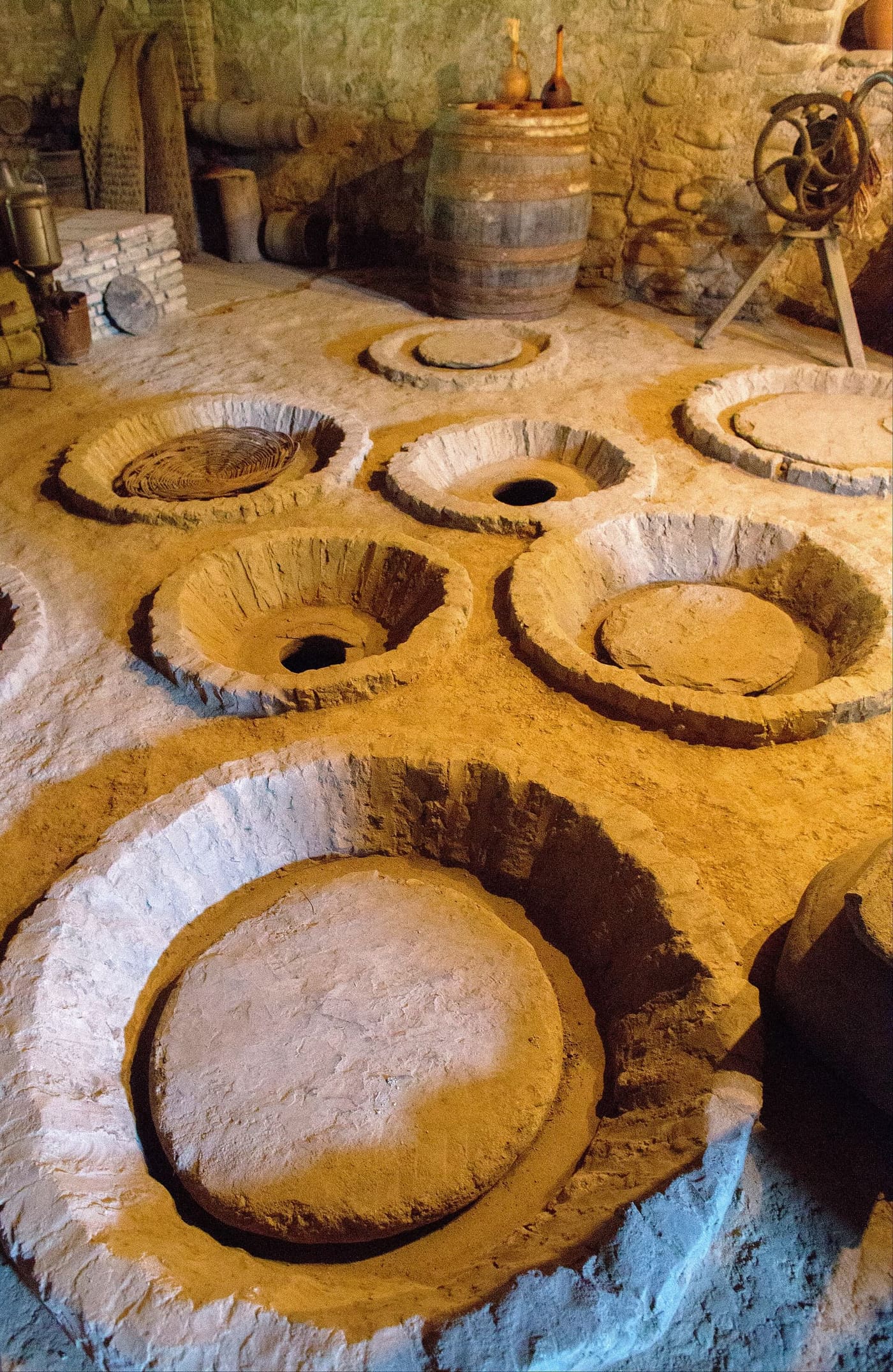
UNESCO, which inscribed the traditional Georgian qvevri method on its Representative List of Intangible Cultural Heritage in 2013, defines the qvevri as an egg-shaped earthenware vessel used to make, age, and store wine. Its account describes juice, skins, stalks, and pips entering the vessel before it is sealed and buried, while the knowledge travels through families and village communities.[1] The cellar is therefore not merely picturesque. It is working infrastructure and inherited practice.
The cover photograph makes that infrastructure legible. Several qvevri sit directly in the stone floor of a Kakhetian marani, or wine cellar; some are sealed, while two dark openings expose the vessels below.[8] They do not resemble portable amphorae because they are not portable. WSET notes that the buried vessel acts as fermenter, maturation vessel, and storage system, with earth buffering temperature and fired clay contributing virtually none of oak's wood-derived aroma.[2]
But clay alone does not turn white wine amber or tannic. Contact does. Georgia's National Wine Agency describes the regional distinction clearly: Kakhetian practice may ferment with the full quantity of chacha—the grape skins, pips, and other solids—while Imeretian practice uses a smaller proportion. It also notes that white grapes may remain with those solids until spring.[3] A 2026 peer-reviewed review reaches the useful chemical conclusion without turning it into romance: prolonged contact with skins, seeds, and stems, together with cap management, increases phenolic extraction; grape variety, site, ripeness, and technique still change the result from bottle to bottle.[4]
That is why “orange wine” is too blunt a pairing instruction. One bottle may be fresh, herbal, and gently grippy. Another may feel broad, tea-like, and almost red in its tannin. The sommelier has to taste the structure, not shop by color.
Start After The Quietest Course
The first course is usually the wrong place for the most assertive amber wine. Delicate raw shellfish, a transparent consommé, or a barely dressed white fish needs room to stay delicate. Decanter's current Georgian amber-wine guide makes the same boundary practical: fuller examples can overwhelm fine seafood, while richer or spiced fish has a better chance of meeting their body.[5]
So let the opening pour stay bright and quiet. Bring qvevri amber wine in when the kitchen begins adding friction: a charred leek with walnut cream, roast squash with cultured butter, grilled cabbage brushed with miso, aubergine with tahini, or an oily fish with sesame and smoke. Decanter specifically points toward walnut dishes, aubergine, tahini, pulses, chickpeas, miso, sesame, soy, roast pork, and gently spiced preparations.[5] The list matters less than the mechanism. These foods give tannin something to hold.
Salt, fat, and acidity are especially useful. WSET's general pairing guidance explains that this combination can make an acidic, astringent, tannic wine seem smoother and fruitier.[7] On a fine-dining plate, that might mean the salt in a glaze, the fat of poultry skin, and the acidity of a fermented plum working together. The wine supplies the rasp; the dish rounds its edge; the next sip cleans up what remains.
This is the point at which amber wine can outperform a safe Chardonnay or premature Pinot Noir. It does not merely echo butter or add red fruit. It changes the tactile rhythm of the bite.
Region Becomes A Pacing Control
A smart pairing does not treat Georgian amber wine as one fixed intensity. The regional traditions offer a natural pacing dial. WSET describes Imeretian wines as generally using fewer skins and seeds and usually omitting stems, which tends toward lighter body, brighter acidity, and more restrained tannin. Kakhetian whites more often spend months with skins, seeds, and sometimes stems, producing deeper amber color and firmer structure.[2]
That difference can shape two very different restaurant moves. An Imeretian-style wine can enter earlier, beside grilled fish, roast celeriac, or a warm bean course where freshness still matters. A more extracted Kakhetian amber can arrive later with roast pork, rich poultry, walnut sauce, or a deeply browned vegetable course. These are menu-building inferences, not regional laws: producer, grape, vintage, and maceration remain decisive.[2][4] Still, asking “Imereti or Kakheti?” is far more useful than asking only whether the wine is orange.
The dining room should resist turning that distinction into a lecture. One sentence is enough: this is a dry white-grape wine fermented on its skins; it has the grip of a light red, so taste it after the salty or fatty part of the dish. The guest now has a job for the wine rather than a history test.
The Georgian Table Provides A Stress Test
Traditional pairings are valuable here as evidence, not costume. In a practical Georgian-wine tasting reported by JancisRobinson.com, amber, skin-contact wines succeeded with both meat and buckwheat versions of stuffed cabbage, while the red wines proved too forceful. A qvevri Chinuri also worked with crisp cauliflower, beetroot, sour cream, dill, and garlic mayonnaise.[6] That is an unusually helpful result for a tasting-menu kitchen because the dishes combine sweet roots, brassica, cultured fat, herbs, frying, and acidity—the very traffic jam that can expose a one-dimensional wine.
A chef elsewhere does not need to copy those dishes. The transferable lesson is that amber wine can hold earthy sweetness and fermented or cultured richness without forcing the course into red-wine fruit. Imagine a beet glazed in its own reduction with smoked cream, or a cabbage wedge with brown butter and sour cherry. The Georgian examples show the structure at work; the restaurant should translate the mechanics rather than borrow the scenery.
There is a limit. Chilli and wasabi can exaggerate tannin and dryness, according to Decanter, so an amber pairing should not become a swaggering answer to every spicy course.[5] Nor should the most extracted bottle be dragged through the entire menu. Once dark meat, concentrated jus, or a genuinely sweet dessert takes over, another wine may have the clearer voice.
Temperature Is Part Of The Pairing
Over-chilling is the easiest way to make this idea feel punitive. Decanter recommends a large glass and a pour that is cool but not refrigerator-cold; too much cold suppresses aroma and emphasizes tannin, while air helps the wine open.[5] In service terms, that means treating the bottle more like a light red than a crisp aperitif white.
Pour size matters too. The goal is not to prove that the guest can finish a whole glass of stern skin-contact wine. A restrained pour lets the pairing alternate: soft bite, grippy sip, brighter second bite. If the wine warms and expands over the course, that evolution becomes part of the plate rather than a flaw in temperature control.
The best qvevri amber pairing therefore arrives with a precise brief. It is not “the ancient Georgian wine,” although the living tradition deserves its history.[1] It is not “the natural wine,” because the vessel makes no such promise.[2] It is the tactile middle of the menu: a white-grape wine with enough skin-built resistance to meet roast, salt, fat, nuts, and smoke before red wine gets the room.
That middle is where many tasting menus lose momentum. Qvevri amber wine can give it a pulse.
Sources
- UNESCO Intangible Cultural Heritage, “Ancient Georgian traditional Qvevri wine-making method” — 2013 inscription, vessel definition, production outline, and community transmission.
- Wine & Spirit Education Trust, “Qvevri: The ancient vessel at the heart of Georgian winemaking” (June 10, 2026) — vessel-versus-style distinction, clay behavior, and Kakhetian and Imeretian methods.
- National Wine Agency of Georgia, “Qvevri Wine” — official account of chacha contact, regional variation, buried vessels, and white-wine maturation.
- Nino Zambakhidze et al., “Georgian Grapes and Wines as a Source of Phenolic Compounds: Composition, Antioxidant Activity, and Traditional Winemaking,” Molecules 31, no. 2 (2026) — peer-reviewed review of qvevri practice and phenolic extraction.
- Caroline Gilby, “From qvevri to glass: The fascinating journey of Georgian orange wine,” Decanter (2026) — regional styles, food-pairing boundaries, and serving guidance.
- Tamlyn Currin, “#CookForUkraine and drink for Georgia,” JancisRobinson.com (2022) — comparative tasting notes on amber qvevri wines with stuffed cabbage, cauliflower, beetroot, cultured dairy, and herbs.
- James Gore, “Wine food matching essentials,” Wine & Spirit Education Trust — sensory guidance on how salt, acidity, and fat change the perception of tannic wine.
- Wikimedia Commons, “File:Kveri wine pits.jpg” — Jon Gudorf's 2017 documentary photograph of buried qvevri in a marani at Velistsikhe, Kakheti, used as the article image.