Nineteen18 is easiest to misread if you start with the star. Yes, the Vilnius restaurant sits in the Michelin conversation: Lithuania Travel's announcement of the third Michelin Guide Lithuania edition lists Nineteen18 among the country's five starred restaurants.[3] But the more interesting story is not the badge. It is how a small Baltic dining room is trying to make national memory, local produce, old-town architecture, and contemporary restraint feel like one dinner instead of four separate talking points.
The name gives the first clue. Nineteen18 says it takes its cue from 1918, the year Lithuania declared independence, then turns that date toward "produce, changing seasons, and the endless possibilities of creation."[1] That could become heavy very quickly. The promise works only if the room avoids patriotic exposition and lets the menu carry the idea quietly: one tasting sequence, Lithuanian ingredients, global fluency, and enough simplicity that the guest is not buried under symbols.[1]
The timing makes the profile sharper. Falstaff's June 2026 scene report says Nineteen18 retained its Michelin star despite a significant leadership transition: Vita Bartininkaite closed Pas Mus, returned to Nineteen18, brought much of her team with her, and joined forces with Justinas Misius to lead the kitchen.[5] Nineteen18's own current page now frames the chefs as Vita Bartininkaite and Justinas Misius, describing a shared philosophy of locality, seasonality, craft, fermentation, preserving traditions, and producer relationships.[1] The question is no longer whether Vilnius can have a starred tasting-menu restaurant. The question is what kind of language that restaurant uses next.
The Room Has To Carry History Without Becoming A Museum
The setting helps because it already has layers. Go Vilnius describes Senatorių Pasažas as a building ensemble from the 17th to 19th centuries, with older Gothic vaults, a past that includes royal goldsmiths, the Vainai Palace, the Pociejai Palace, and one of Lithuania's first bookstores, before its courtyard reopened as a passage between Stiklių and Dominikonų streets.[4] That is a lot of history for one dinner to stand inside.
The stronger move is not to explain all of it at the table. It is to let the place set the pressure. A tasting menu in a blank luxury box can drift toward international sameness. Nineteen18 does not have that escape route. Its old-town address, restored passage setting, and 1918 name make placelessness impossible.[1][4] The restaurant has to be modern without sanding away where it is.
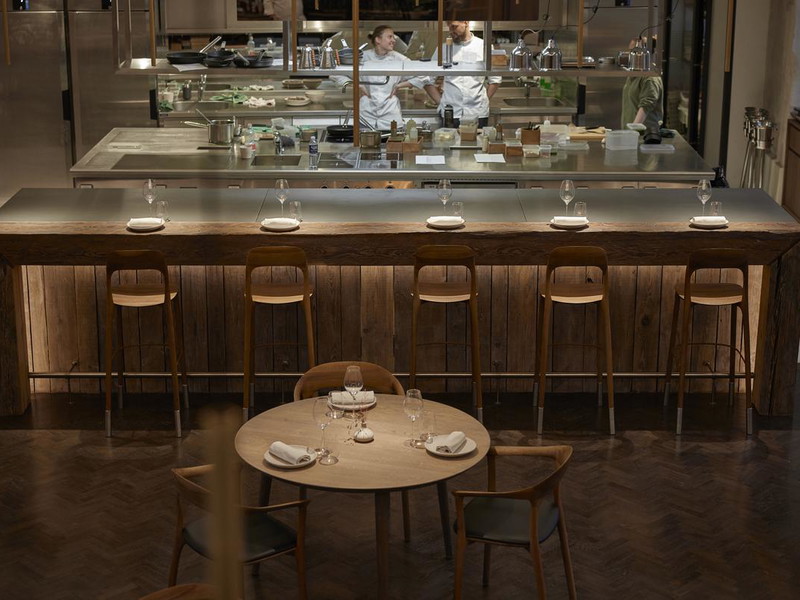
That is why the cover image matters. The photograph is not a dramatic plate shot. It shows a long counter, set tables, warm wood, and chefs visible behind the pass.[6] The visual message is almost operational: this is a room built around attention, not spectacle. The guest can read the table, the counter, the kitchen, and the pacing line at once. For a restaurant trying to translate Lithuanian seasons into fine dining, that visibility is useful. It turns locality from a menu claim into a working surface.
The New Team Makes Restraint The Point
Nineteen18's current menu language is notably compact. Dinner is a tasting menu at 115 EUR per person, constantly changing with the seasons, with drink pairings starting at 80 EUR.[1] The restaurant calls it a personal narrative combining local produce, global influences, and the spirit of Vilnius.[1] Those details matter because they position the house away from maximalist luxury. This is not a room selling twenty courses as proof of ambition. It is selling coherence.
Bartininkaite's role gives that coherence a fresh reason to pay attention. The Senatorių Pasažas page describes her as the former owner of Michelin-starred Pas mus and says Nineteen18 is entering a new era of "Creative Vilnius cuisine," rooted in forests, meadows, childhood memories, and a modern urban perspective.[2] That phrase could become soft branding, but paired with Misius's background in producer ties, fermentation, preservation, and seasonal rhythm, it points to something more practical: a kitchen trying to make memory behave like craft.[1][2][5]
That is a difficult line to hold. A restaurant can become too nostalgic, treating childhood and forest as decorative comfort. It can also become too international, borrowing technique so aggressively that local ingredients become accents. Nineteen18's best possible version sits between those failures. It should make the Lithuanian pantry feel current without making it anonymous, and make global technique useful without letting it become the subject.
Lithuania's Michelin Moment Raises The Stakes
The broader dining scene now gives Nineteen18 less room to coast. Lithuania Travel's announcement of the third Michelin Guide Lithuania edition says the guide included 44 restaurants and that five restaurants received stars: Deep Roots, Red Brick, Demo, Dziaugsmas, and Nineteen18.[3] Falstaff reads the same moment as a maturing Lithuanian culinary scene, with Nineteen18 retaining its star while Deep Roots and Red Brick joined the starred group.[5] In other words, Nineteen18 is no longer a lone proof-of-concept for Lithuanian gastronomic ambition. It is one address in a growing national map.
That is good for the restaurant. Early-star rooms can get trapped in ambassador mode, asked to represent too much because there are too few peers. A denser scene lets each restaurant become more specific. Demo can make one argument, Red Brick another, Dziaugsmas another, and Nineteen18 can refine its own lane rather than perform "Lithuania" in the broadest possible sense.[4]
The lane seems clear: a polished old-town tasting menu that treats seasonality as structure, not garnish. Senatorių Pasažas describes Nineteen18 as relaxed yet refined, with a tasting menu shaped entirely by the seasons of Lithuania.[2] The official restaurant page narrows that to simplicity, authenticity, restraint, local ingredients, and the belief that true luxury can be quiet.[1] Falstaff's report adds that Michelin inspectors saw Nineteen18 continuing to showcase proudly Lithuanian cuisine with deep respect for local produce.[5] If the kitchen can keep those words honest, the room has a strong identity: Baltic fine dining as concentration rather than escalation.
What The Restaurant Has To Get Right
The service details reveal the kind of experience Nineteen18 is building. Reservations are accepted online only; groups larger than eight are asked to contact the restaurant; simple dietary requirements can be accommodated, but multiple or combined restrictions may not be possible; children aged 14 and above follow the same tasting menu; and a 10% service fee is added to the bill.[1] These are not romantic details, but they matter. They show a kitchen protecting the format.
That protection can either feel rigid or generous depending on execution. In a small tasting-menu restaurant, saying no to complex modifications is not automatically inhospitable. It can be a way to preserve a menu whose value depends on sequence, preparation, and seasonal supply. The risk is that the guest experiences the constraints before the welcome. The opportunity is that the room uses those constraints to make dinner feel calm: clear booking rules, one format, one pace, one story.
This is where the new Nineteen18 will prove itself. The sources describe the idea: Lithuania's 1918 memory, Vilnius old-town setting, seasonal local produce, forests and meadows, preservation and fermentation, a renewed chef team, a Michelin-recognized national scene.[1][2][3][4][5] The restaurant's job is to make all of that disappear into appetite. The guest should not feel as if they are being assigned a cultural thesis. They should feel a progression: something fresh, something preserved, something warm, something sharp, something remembered, something newly made.
The most promising thing about Nineteen18 is that its ambition sounds subtractive. It is not trying to make Vilnius feel expensive by importing the usual global luxury signals. It is trying to make a room in Vilnius feel precise enough that local restraint reads as luxury. That is a smaller claim than "the future of Baltic cuisine," and a better one. A restaurant does not need to carry a whole region on its back. It needs to make one room feel inevitable.
Nineteen18 now has the conditions for that: a name with civic weight, a site with architectural memory, a national dining scene strong enough to share the burden, and a chef handoff that gives the house a genuine why-now. If the new kitchen can keep the story quiet and the flavors clear, Vilnius gets something more valuable than another starred address. It gets a fine-dining room that knows where it is standing.
Sources
- Nineteen18 official site - current restaurant framing, 1918 name origin, tasting-menu price, drink-pairing price, chefs Vita Bartininkaite and Justinas Misius, reservation rules, and service details.
- Senatorių Pasažas official site - Nineteen18 overview, current chef-era framing, Creative Vilnius cuisine language, seasonal tasting-menu positioning, and the broader sustainable food complex.
- Lithuania Travel, "Third edition of the MICHELIN Guide Lithuania unveiled: 44 restaurants make the list" - national tourism announcement of the 2026 Michelin Guide Lithuania selection and starred restaurants.
- Go Vilnius, "Senatorių Pasažas: Discover organic Lithuanian cuisine in the heart of Vilnius Old Town" - official city tourism page on the complex's building history, courtyard passage, and Nineteen18 context.
- Tove Oskarsson Henckel, "Lithuania Finds Its Voice," Falstaff, June 6, 2026 - scene report on Lithuania's 2026 Michelin results, Nineteen18's leadership transition, Vita Bartininkaite's return, and the restaurant's continued Lithuanian-produce focus.
- Falstaff image asset, "Photo_-Nineteen181.jpg" - real 2026 photograph credited to Nineteen18, showing the dining room, counter, and open kitchen, used as the article image.