
French cooks have a name for the potato slice that comes out of the fryer perfectly flat. They call it a postcard. It might be golden, salty and quite good to eat. Still, somebody at the stove was hoping to send out a little pillow, its two sides so thin that a diner could break them both with one bite. The joke appears in the minutes of a French molecular gastronomy seminar devoted to the question of how to get the pillow every time. [3]
Le Cordon Bleu Paris filmed the manoeuvre for its series on French cooking techniques. On a first viewing, the pleasure is in seeing how much potato can seem to come from one slice. For a second look, wind back to 0:00. Take in the salt crystals on the finished potatoes in the opening sequence, then follow a pale slice into the first pan of oil. The moment its face begins to lift, the cook has a decision to make. The school’s written instructions use that slight change of shape as the cue to take the slice out. Imagine having to make that call for a whole panful. [1][2]
What the cook buys with an even cut
At the start of the demonstration, the potato gets trimmed into something like a bar of soap. It looks like a bit of fuss over the outline of a garnish. Consider the next cut, though. Once the cook starts slicing across that trimmed potato, each piece has much the same footprint. With the blade set to give a thickness of three to four millimetres, the cook can put a group into the oil together and reasonably expect them to be ready to move together. A wedge with a paper-thin tip and a thick heel would give two quite different accounts of what was happening in the pan. [1][2]
Beside the mandoline, the cook lays both hands flat on a sheet of absorbent paper. That light press takes water off the cut faces. There is still plenty of water a little deeper in the flesh, and the success of the dish depends on keeping some there. In the school’s account, the faces dry and form a crust as the slice fries. When water inside turns to steam, that crust briefly holds it. The two faces bow apart, still joined around the rim. The thing that inflates the potato was in the potato all along. [2]
Reading a panful
In the first bath, at about 130°C in the school’s method, the slices keep moving. Watch the change in their profile as they begin to swell. At this point the cook can drain them for a pause or move them straight to the hotter bath. At about 180°C the cook spoons hot oil over them as they rise. A timer would be handy for remembering when a batch went in. It could tell you very little about which particular slice to lift first. For that you need to be able to see the pieces separately. [1][2]
In June 2005 a group of cooks and researchers had the chance to ask Georges Roux of the Académie culinaire de France about that motion. Roux used a ladle to circulate the oil and ease the slices apart. A wire skimmer, he explained, could injure their developing crust. The observers even recorded the pace, roughly one circuit of the pan every two seconds. Read that detail alongside the film and the gesture looks different. You can move a whole batch by moving the liquid around it. Each pale slice comes back into view without anybody having to prod its tender face. [3]
Roux also repeated the operation with white-fleshed potatoes after succeeding with yellow ones. Both batches puffed throughout. The record has a pleasingly candid detail about temperature. Roux gave the group a figure for the first bath, but nobody had measured it there. His success makes a good case for paying attention to his hands. It leaves open how closely another cook would have to reproduce the temperature in his pan. [3]
Something to put inside
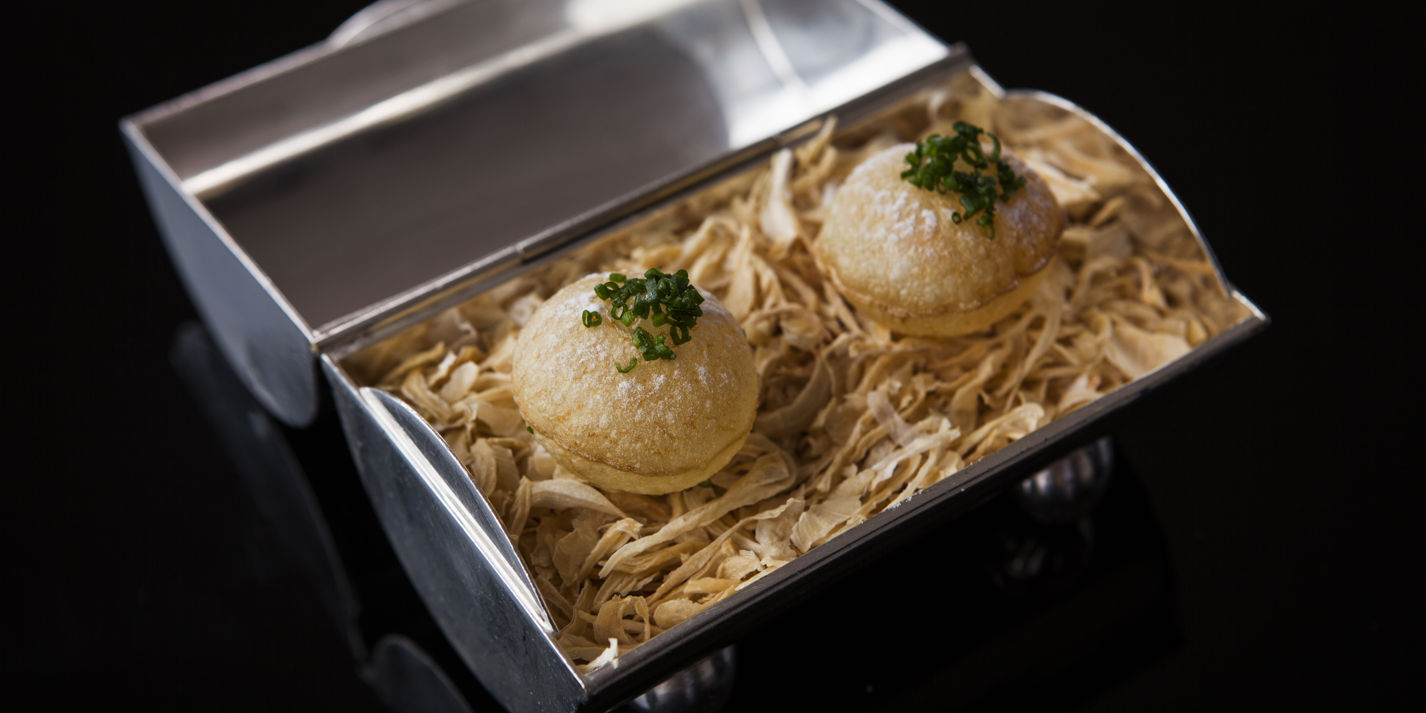
At Midsummer House in Cambridge, Daniel Clifford wanted the flavour of a sour cream and chive Pringle. His recipe goes to considerable trouble to make a hollow potato of predictable size. He brushes thin slices with a paste of egg white and cornflour, pairs them, then stamps circles through both layers. After drying the edges and frying the discs, he puts the fine nozzle of a siphon through the underside of each puff. In goes sour cream and chive foam. A dot of lime gel covers the tiny entry hole. [4]
Seen after the Cordon Bleu film, Clifford’s recipe reads almost like a drawing of the classical potato in cross section. He starts with the two walls that the first cook has to coax out of one slice. For the diner that changes the little drama of biting down. In the school’s version, the teeth meet a crisp surface, travel through empty space and meet potato again. At Clifford’s table the first crack releases the flavour he remembers from a packet of crisps. Both cooks have gone to work on the same few millimetres between the walls. Only one wants to serve them empty. [1][4]
Sources
- Le Cordon Bleu Paris, “How to make Pommes Soufflées” (film, 2017).
- Le Cordon Bleu, “French Cuisine Technique: Pommes Soufflées,” written method and chef’s notes.
- INRA molecular gastronomy seminar, minutes of 16 June 2005, including the observations of Georges Roux’s demonstration (in French).
- Daniel Clifford, “Pomme soufflé,” Great British Chefs, recipe and photograph.