Elmina arrived in Washington carrying more than dinner. Chef Eric Adjepong named his first permanent restaurant for the Ghanaian coastal town whose beauty, fishing life, and trade history sit beside the violence of Elmina Castle. He then placed the idea inside a richly worked, multi-level room just north of U Street: indigo upholstery, warm brick, curved plaster, woven cloth, and materials meant to hold stories of migration and exchange.[3][8]
That is a great deal of meaning to ask a dining room to bear. The useful question, after Elmina's first year, is whether the restaurant becomes lighter once the plates land. Read together, the opening coverage, critic reviews, Michelin listing, and current menu suggest that it does. The strongest evidence is not the room's symbolism or Adjepong's television profile. It is the tactile pleasure of fufu meeting peanut soup, shito clinging to charred meat, black-eyed peas carrying crisp plantain, and jollof rice absorbing duck fat.[4][5][6]
There is also an important boundary around any 2026 verdict. Tom Sietsema reviewed a $105 four-course tasting in March 2025; by June and August, other reviewers assessed a $135 version, still alongside the less formal bar menu.[4][7][10] Elmina's current site now advertises a new tasting experience at $265 per person and a substantially expanded à la carte selection.[1][2] The first reviews make a persuasive case for the restaurant's cooking. They cannot, by themselves, establish the value of a tasting offer that has since changed so materially.
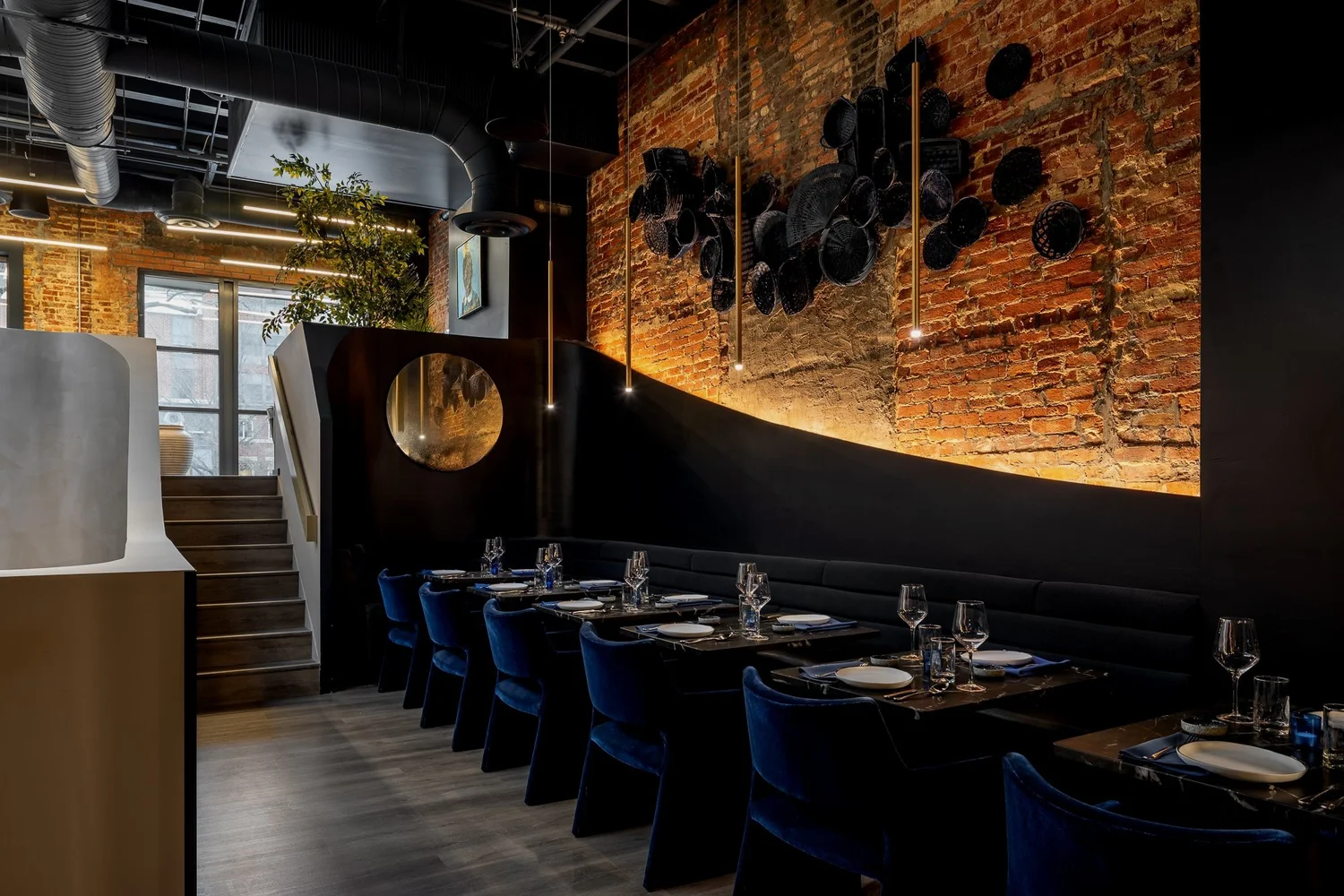
Image context: the cover is Kate Wichlinski's photograph of an empty Elmina dining room, published on the restaurant's site and credited in Drummond Projects' design record. The exposed brick, blue chairs, woven wall forms, pendant light, and curving stair make the restaurant's visual ambition tangible. An empty room is also an honest test: all that design is only a frame until food and hospitality give it life.[1][8][11]
Two doors into the same kitchen
Elmina's smartest opening decision was to offer two distances from the food. Eater's February 2025 opening report described a choice-driven tasting menu in the dining rooms and an à la carte menu at the bars, modeled loosely on the sociable accessibility of Ghanaian chop bars. The former organized cold, warm, protein, shared-main, and dessert choices; the latter offered skewers, fried snacks, and sauces without requiring a full evening's choreography.[3]
That division could have created a first-class and second-class restaurant. The reviews instead found two valid moods. The Infatuation recommended the dining rooms for celebrations but treated a spontaneous bar meal as an equal pleasure, built from okra fries, octopus kebabs glazed with shito, and hamachi collar with plantain chips.[4] Michelin likewise presents the multicourse menu and the chop-bar-inspired à la carte list as parallel routes, not a prestige ladder.[6]
The current menu has pushed that second route further. It now ranges from $13 kelewele and $16 okra fries to chichinga skewers, palm-nut stew, crab fried rice, a $65 waakye platter, and an $85 jollof duck pot.[2] Those numbers matter less as a shopping list than as evidence of scale. A guest can build a quick, smoky meal around plantain, one skewer, and shito, or let rice, stew, fish, and dessert fill the table. The menu understands that access is not the opposite of seriousness.
The critics kept returning to texture
"Modern Ghanaian" can become a foggy label if every ingredient is made to symbolize identity. Elmina's best-reviewed dishes are more concrete. Washingtonian's 2026 restaurant list praised fried okra against burnt-leek ranch, smoky eggplant dip with roti, charred kebabs with soft mojo onions, umami-rich crab fried rice, crisp-skinned chicken, and seafood jollof with the abundance of a celebratory rice dish.[5] The sequence is full of useful collisions: crisp and creamy, smoke and acid, starch and concentrated sauce.
The Infatuation found the same strength in red red, where stewed black-eyed peas meet sweet plantain and avocado, and in bofrot dressed with nutmeg cream, toffee, candy crunch, and Milo gelato.[4] Michelin's inspectors singled out braised goat with fufu and a tableside pour of deep orange-red peanut sauce, then pointed to malva pudding with pickled apricot as the bright finish.[6] Across these accounts, pleasure does not come from making Ghanaian food look delicate. It comes from preserving generosity while tightening contrast.
Adjepong's own explanation clarifies the method. In a 2025 Washingtonian interview, he described childhood memories of fufu and red red, recipes transmitted through his mother and earlier generations, and a New York upbringing shaped by friends' Albanian, Puerto Rican, and Jamaican tables. His jollof duck keeps the rice close to tradition, then bends the plate with duck egg, breast, confit leg, and tamarind glaze. For him, tradition and modernity are not opponents.[9]
That philosophy works when the adaptation changes the mechanics of a dish rather than merely decorating it. Duck fat enriches the rice; tamarind cuts it; shito adds fermented depth and heat. Peanut soup does not sit beside fufu as an explanatory sample—it changes how the pounded plantain and cassava move across the palate. The reviews are persuasive because they describe relationships, not just rare ingredients.
The dissent keeps the praise honest
The most consequential warning came from Sietsema's March review. He found the food well rehearsed but the hospitality unfinished: a server did not know who had ordered which plate, another table lost its server's attention, and basic information could be difficult to obtain. His shared duck platter also paired a too-rare breast with a better leg, even as the kitchen kept the heavily seasoned jollof rice fluffy.[10] These are not cosmetic flaws in a restaurant asking service and communal dining to carry so much meaning.
The early food verdict was not unanimous either. KenScale's June 2025 review admired the opening stretch, especially a curried corn bisque, a spicy roasted-eggplant dip, fufu with braised goat, and short rib with prekese sauce. The meal then lost force for that reviewer: the duck breast in the jollof pot needed refinement, and the malva pudding lacked the expected moisture.[7]
That sits directly against later enthusiasm. The Infatuation treated the layered jollof duck pot as a signature, while Washingtonian praised the seafood version and Michelin found delight in the current dessert course.[4][5][6] The point is not to declare one palate correct. It is to notice where Elmina takes its largest risks. Shared rice pots and home-memory desserts have to deliver comfort, texture, and spectacle at once; if one component dries out, the idea becomes easier to admire than to crave.
Both the jollof duck pot and malva pudding remain on the current à la carte menu.[2] Their survival suggests confidence, but it does not erase the dissent. A useful review summary should leave that tension intact: Elmina's high points sound exuberant, while its most ambitious centerpieces depend on execution that no amount of cultural framing can rescue.
The room must not eat the meal
Elmina's design is unusually explicit. Wallpaper describes a 3,720-square-foot, multi-level interior whose distinct areas refer to commodities and materials entangled with transatlantic trade, including tobacco, cotton, indigo, sugarcane, and timber. A curved central stair links the spaces; kente cloth from Adjepong's mother and work by contemporary artists make the story personal as well as historical.[8]
This could become oppressive or over-authored. A restaurant cannot settle history through velvet, plaster, and menu copy. Adjepong's stated aim is narrower and more defensible: Eater reports that he chose the name to insist that Elmina is not reducible to the castle and the departure of enslaved Africans, but is also a living place of wealth, beauty, fishing, and peace.[3] The design asks guests to hold those realities together.
The critics' response suggests that hospitality keeps the concept from hardening into a museum set. Michelin emphasizes the room's warmth and invitation to linger; Washingtonian says the floors feel distinct but finds no bad seat; The Infatuation treats the bar as somewhere to visit on a whim.[4][5][6] These are small but important judgments. The room succeeds when it gives pleasure permission to be the present tense.
The same standard should apply to the plate. Shito should be delicious before it becomes a lesson. Fufu should feel necessary to the stew, not included as a cultural caption. Jollof should make the table lean inward. When those things happen, the symbolism recedes to the edges and starts doing what good design does: holding the experience without demanding to be congratulated for it.
The new tasting experience needs a new verdict
At publication, Elmina's official menu lists its prix-fixe tasting experience at $265 per person, available Thursday through Sunday. It does not publish the courses on that page. The same site promotes a lighter summer tasting menu and an expanded à la carte offer, making clear that the restaurant has entered a new phase.[1][2]
That price is nearly double the $135 menu assessed in the mid-2025 reviews and more than two and a half times the opening menu reviewed in March.[4][7][10] It may buy a longer, more ambitious, or more inclusive experience; the public menu does not provide enough detail to say. Treating the old reviews as proof of current value would therefore confuse continuity of restaurant with continuity of product.
The evidence supports a cleaner conclusion. Elmina itself has earned serious attention: it entered Michelin's Washington selection, reached No. 6 on Washingtonian's 2026 list, and built a recognizable repertoire in less than a year.[5][6] The current à la carte menu still exposes that repertoire dish by dish, from kelewele and chichinga to waakye and jollof duck.[2] The $265 tasting experience is a separate proposition and should be reviewed on its own terms.
That distinction actually strengthens Elmina's case. The restaurant does not need borrowed certainty. Its most convincing idea is already visible: Ghanaian food can occupy a sumptuous Washington room without being reduced to heritage display or polished into anonymity. Let the sauces stain, let the rice carry fat, let the fufu pull against the spoon, and let the bar remain a real way in. When pleasure outruns symbolism, Elmina feels fully alive.
Sources
- Elmina, official homepage — current restaurant framing, summer-menu notice, service information, and source page for the dining-room photograph used as the cover.
- Elmina, official menu — current $265 tasting experience, availability, à la carte dishes, prices, cocktails, and table-duration policy.
- Tierney Plumb, "Celebrity Chef Eric Adjepong's First-Ever Restaurant Rises in D.C.," Eater DC (February 20, 2025) — opening date, original two-format menu, chop-bar logic, jollof duck construction, the restaurant's name, and design intent.
- Omnia Saed, "Elmina," The Infatuation (August 6, 2025) — four-course price at review, dining-room and bar use cases, and evaluations of the jollof duck, red red, bofrot, crudo, kebabs, and snacks.
- Washingtonian staff, "Elmina," 100 Very Best Restaurants 2026 (January 20, 2026) — No. 6 placement, format summary, room assessment, and critic-recommended dishes.
- MICHELIN Guide, "Elmina — Washington" — current guide listing, two-menu framing, hospitality assessment, and inspector-noted dishes.
- KenScale, "Elmina" (June 11, 2025) — independent early tasting-menu review, $135 price, praised opening courses, and reservations about the jollof duck and malva pudding.
- Sofia de la Cruz, "Ghanaian cuisine has a story to tell at Washington, DC restaurant Elmina," Wallpaper (April 28, 2025) — interior scale, room sequence, material references, personal objects, and opening menu context.
- Jane Godiner, "Eric Adjepong on Mixing Tradition and Modernity at His DC Restaurant Elmina," Washingtonian (July 30, 2025) — Adjepong's account of family recipes, New York influences, fufu, red red, and the construction of jollof duck.
- Tom Sietsema, "At the enticing new Elmina, Eric Adjepong brings Ghana into focus," The Washington Post (March 13, 2025) — the $105 opening tasting menu, repeat visits to both formats, dish criticism, and early hospitality weaknesses.
- Hospitality Snapshots, "Elmina Restaurant" — Drummond Projects' 3,720-square-foot design record and Kate Wichlinski photography credit for the interior image set containing the cover view.