For the first time, a red Michelin plaque can organize an Auckland weekend. The more interesting route begins after the stars have done their scheduling work.
The inaugural Michelin Guide to New Zealand, announced on July 1, 2026, gave one star to five restaurants in the Auckland region: Ahi, Tala, Paris Butter, Mudbrick, and The Estate. The announcement made history—the guide’s first restaurant selection in Oceania—but its more interesting gift is a question. What, exactly, connects a downtown dining room supplied by a garden in South Auckland, a Samoan tasting counter in Parnell, and a French-named restaurant in Herne Bay serving New Zealand produce with Asian inflections?[1]
The shared answer is a city comfortable with several meanings of home.
This Thursday-through-Saturday route keeps to the three urban restaurants. Mudbrick and The Estate are vineyard destinations; each deserves an excursion rather than being squeezed into an inner-city sprint.[1] Begin with Ahi at Thursday lunch, when its producer map and harbour-side setting can introduce the country at full scale. Give Friday evening to Tala, preferably at the chef’s counter, where Samoan memory becomes the structure of the meal. Finish on Saturday at Paris Butter, whose tasting menu shows how confidently New Zealand ingredients can travel through French and Asian technique without losing their address.[3][4][6]
The practical details and live menus below were checked on July 16, 2026. This is a reported route, not a composite claim to have eaten three meals in one imaginary weekend. Menus, prices, and service days move; reconfirm them when booking.
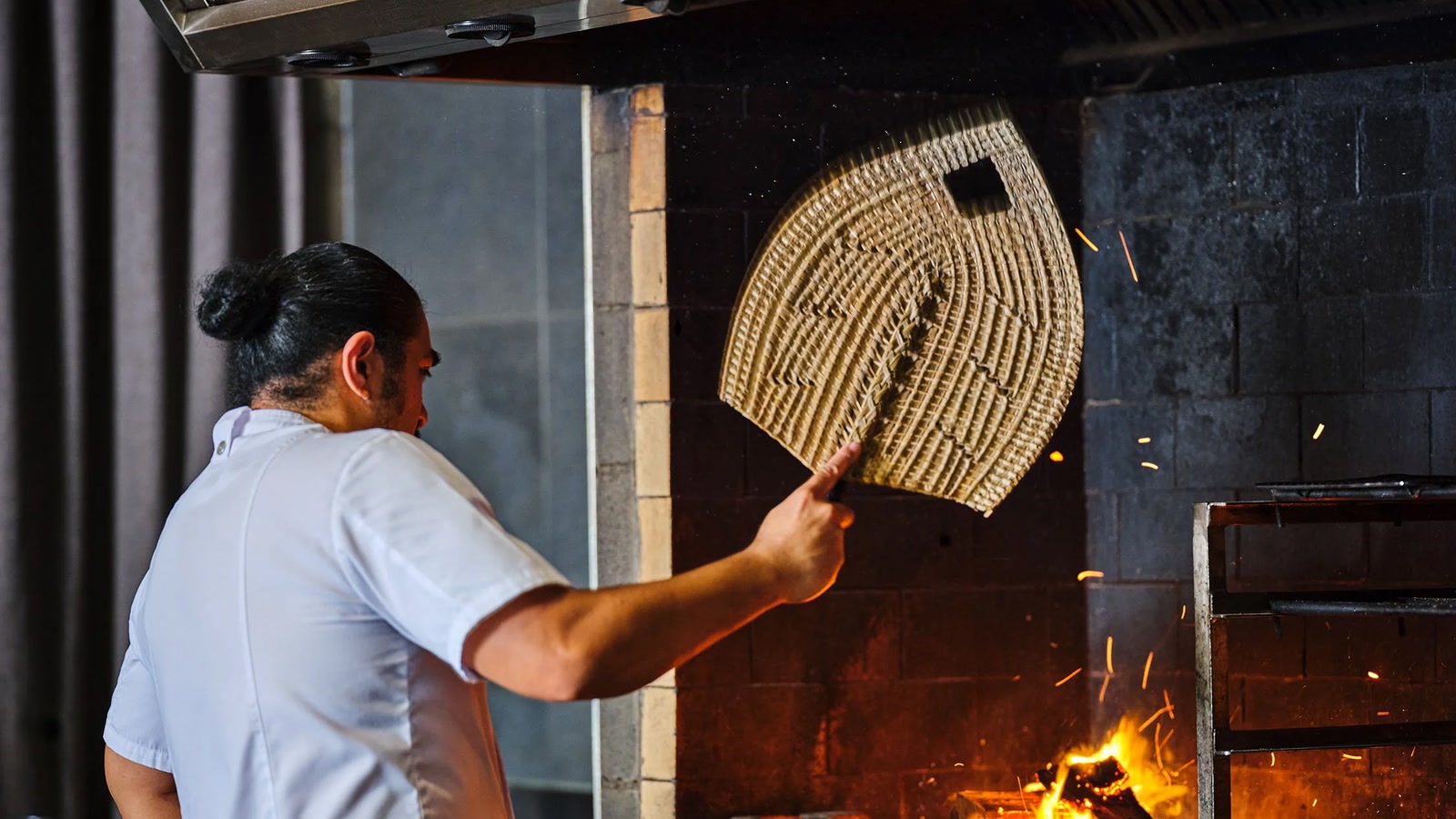
Image context: the cover photograph comes from Tala’s official site and shows the fire inside the room. The flame is working equipment and part of the restaurant’s Samoan storytelling, which makes it an honest visual center for a route about the different forms “local” can take.[4][5]
First stop: Ahi makes provenance visible
Ahi is the right opening meal because it gives Auckland’s most expansive answer. The restaurant is on level two of Commercial Bay, downtown by the Waitematā Harbour, but its ingredient story reaches south to a kitchen garden in Patumāhoe and outward to growers and makers around the country.[2][3] You arrive in a commercial center; the menu tries to turn that centrality into a map.
The name means “fire” in te reo Māori, and Michelin’s inspectors emphasize both the wood-fired hearth and the restaurant’s use of traceable ingredients. Ahi’s own account is more specific. Its garden sits in red volcanic soil, follows organic and seasonal growing practices, and receives composted kitchen waste back into the growing cycle. The restaurant frames whakapapa—connection and ancestry—as the relationship linking ingredient, land, producer, and plate.[1][2]
That language can become weightless when a restaurant uses it as branding. Ahi’s menu design gives it ballast. Suppliers and origins are printed beside ingredients; kawakawa sourdough, seafood, garden vegetables, and New Zealand drinks are presented as products with locations rather than anonymous luxury nouns.[2][8] The geography stays legible even when the ingredient has travelled far.
Use Ahi for lunch rather than stacking three formal dinners. The restaurant currently serves lunch and dinner daily, and daylight suits its role in the route: this is the broad survey, the meal that introduces land, water, cultivation, and the national pantry before the itinerary narrows into more personal stories.[3] If you choose drinks, the restaurant says its wine list is designed to represent New Zealand’s regions and styles, extending the same logic into the glass.[3]
Skip the checklist of “Kiwi” ingredients. Watch how often the menu tells you who grew something, where it came from, and what fire or fermentation did to it. Ahi’s idea of home is relational: New Zealand appears as a chain of custody the diner is invited to see.
Second stop: Tala lets memory cross the ocean
The next evening, the route gets smaller and more intimate. Tala occupies a compact room in Parnell, and its two current experiences divide by viewpoint: the longer Chef’s Journey is served at the counter with direct sight of the kitchen; the shorter Fāgogo Journey places guests on the dining-room banquette.[4][5] Choose the counter if you can. From that seat, the open fire in the cover photograph becomes working grammar for the meal.
Chef Henry Onesemo builds the menu from Samoan food and from his memories of growing up in Samoa. The published sequence names palolo, pisupo, panikeke, oka, roadside barbecue, copra, pani popo, Koko Samoa, and a centerpiece of chicken cooked with the logic of an umu. Auckland’s tourism site describes that chicken wrapped in banana leaves with herbs and citrus, while the meal also incorporates apa fafano, a traditional handwashing welcome.[4]
The important word is not “elevated.” That old fine-dining verb implies that a cuisine begins below the room and requires rescue by tweezers, tasting portions, or imported technique. Tala’s more interesting move is translation without apology. Childhood snacks, preserved meat, coconut, earth-oven cooking, hospitality ritual, and personal narration enter a contemporary tasting format, but the format serves the story rather than conferring legitimacy upon it.
That is why Tala changes the meaning of an Auckland dining trip. “Local” expands beyond ingredients grown inside New Zealand’s borders to include the memories and foodways that Aucklanders carry into the city, sustain there, and make public. Michelin’s star—the first awarded to a restaurant devoted to contemporary Samoan food—recognizes execution; the story remains Onesemo’s to tell.[1][5]
The commitment is substantial. Current reporting lists the 14-dish Chef’s Journey at NZ$215 per person; the restaurant’s menu can change, so treat both the count and price as a booking-day check rather than a permanent promise.[7] More important is the choice of seat. At the counter, fire, narration, and service happen in one field of view. On the banquette, Fāgogo offers a shorter path. Neither is a lesser claim to Samoan hospitality, but they produce different proximities.
Let the evening end there. Tala’s stories need room after the last bite; adding another “essential” bar would only turn attention back into itinerary arithmetic.
Third stop: Paris Butter makes fluency feel local
For the final dinner, move west to Herne Bay. Despite the French name, Paris Butter’s current menu speaks in a wider vocabulary. Michelin describes peak New Zealand produce handled with European technique and subtle Asian influence; the restaurant calls the result “creative New Zealand dining.”[1][6]
The June 2026 sample menu makes that sentence edible. Kingfish meets jalapeño, olive, and goat’s cheese. Snapper sits with nam jim, yuzu, and scampi. Lamb is paired with pine nut, apple, and caviar; beef with miso, onion, and ponzu. Even the bread course moves through tomato honey, truffle butter, and Northland olive oil.[6] These combinations travel easily across culinary borders; the coherence comes from the season and the kitchen’s command of several languages.
Paris Butter therefore belongs last. Ahi begins with provenance; Tala moves into autobiographical and cultural memory; Paris Butter closes the route by showing what happens after technique no longer needs to declare one passport. Its version of home is fluency—the confidence to put local snapper beside nam jim and yuzu without selling the plate as a stunt about “fusion.”
The live menu offers a six-course Evolution menu at NZ$195 and an eight-course version at NZ$260, before drinks. Local and international wine pairings are listed separately. Service currently begins at 5:30 p.m., Tuesday through Saturday.[6] The six-course option gives most travelers the clearest finish, protecting attention after two ambitious meals.
There is a useful tension here. Paris Butter is the most conventionally legible tasting-menu room of the three: snacks, bread, fish, meat, dessert, pairings. Yet its menu may be the clearest proof that Auckland no longer needs one signature dish to certify a serious dining culture. The city’s identity lives in how comfortably the kitchen combines what grew nearby with techniques and flavors that arrived from elsewhere.
Three thresholds, one Auckland
Across three days, “home” changes scale. At Ahi, it is a visible network: garden, soil, grower, coast, fire, bottle. At Tala, Samoa is carried through memory, ritual, and hospitality into an Auckland room. At Paris Butter, home is the point where cosmopolitan technique feels natural enough to serve local snapper, lamb, and olive oil without a speech about fusion.
The geography makes that progression tangible. Thursday begins in Commercial Bay’s glass-and-water city center. Friday draws close to fire in Parnell. Saturday moves west to Herne Bay, where the tasting menu lets the borders soften. The restaurants sit within one urban weekend, yet each crosses a different threshold: producer into dining room, private memory into public ritual, imported technique into local habit.
Michelin supplies the pins. Auckland supplies the connective tissue. By Sunday, the route has travelled only across the inner city, while the meaning of “home” has widened from a patch of volcanic soil to an ocean-crossing memory and finally to a kitchen fluent in several places at once.
Sources
- Michelin, “New Zealand: first MICHELIN Guide selection unveiled” (July 1, 2026) — inaugural selection totals and the five Auckland one-star descriptions.
- Ahi, “The Ahi Story” — Patumāhoe garden, volcanic soil, seasonal growing, whakapapa, suppliers, and kitchen leadership.
- Ahi, official homepage — Commercial Bay location, daily lunch and dinner, harbour setting, ingredient philosophy, and beverage program.
- Auckland NZ, “Tala” (updated July 16, 2026) — room formats, current menu highlights, umu chicken, handwashing welcome, and Parnell location.
- Tala, official site — restaurant concept, Michelin recognition, and source of the cover photograph.
- Paris Butter, current menu page — June 2026 dishes, six- and eight-course prices, pairings, address, and service hours.
- 1News, “How much does it cost to eat at New Zealand’s Michelin restaurants?” (July 1, 2026) — reported current Tala menu price and course count.
- Ahi, current “A New Zealand Food Story” set menu (June 2026) — supplier origins, ingredient locations, and the menu’s provenance-first presentation.