A slice of Dobos torte gives the eye two different pleasures: the pale lines of sponge alternating with chocolate buttercream, and the glossy caramel roof above them. The classic construction has six thin sponge layers, with the uppermost carrying the hardened sugar.[1] Beneath that bright surface, everything looks soft. The top promises a different kind of bite.
It is an unusually legible cake. A cut face shows how it was assembled; the caramel announces it across a pastry counter. Yet for years, knowing what a Dobos torte looked like was quite different from knowing how to make one. Its creator, the Budapest chef and delicatessen owner József C. Dobos, kept the recipe to himself before handing it to a professional guild in 1906.[2][3]
That change makes the cake's history particularly satisfying. First the finished dessert travelled. Then the knowledge did.
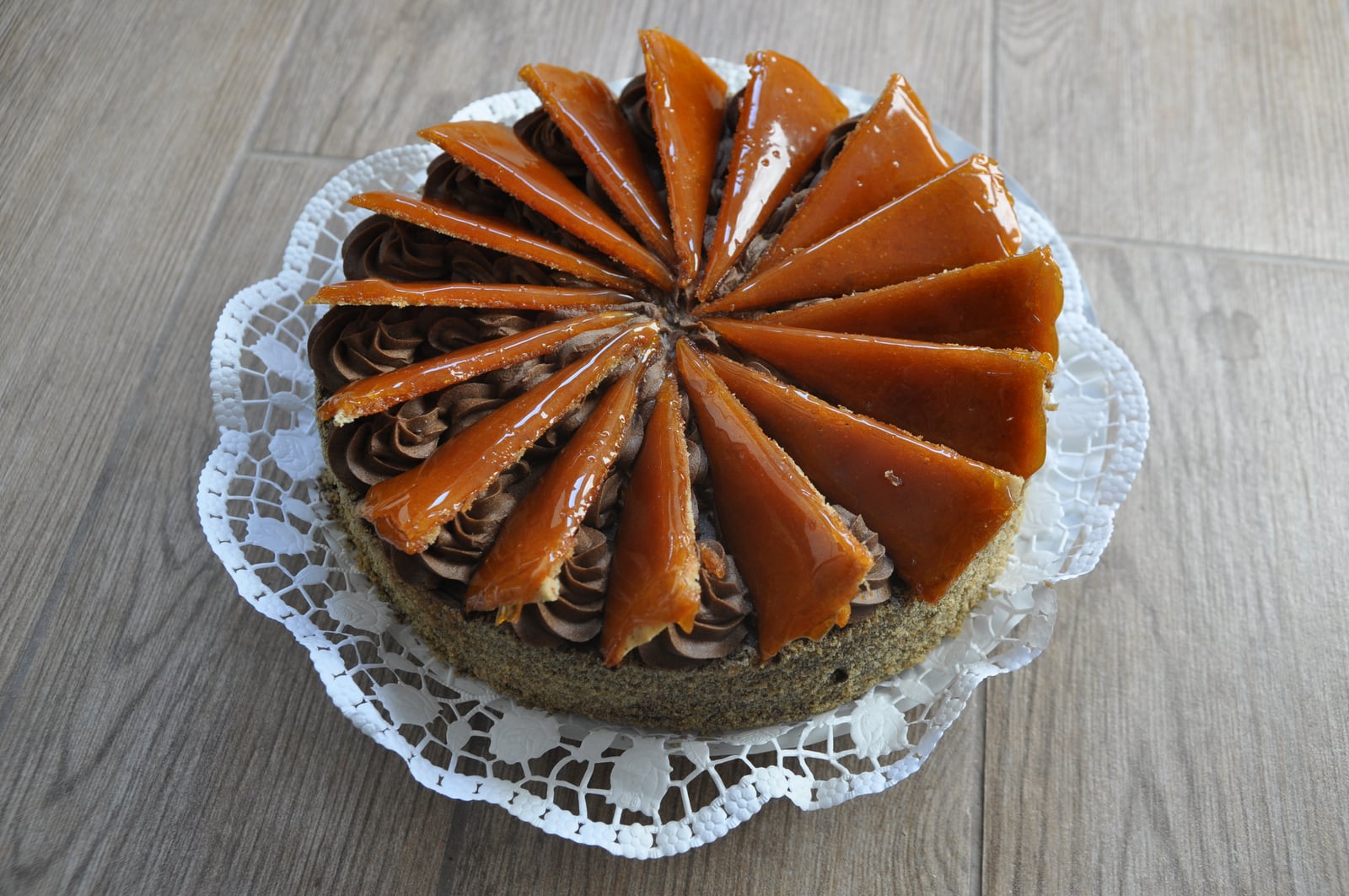
A new cake in the exhibition crowd
The Hungarian Museum of Trade and Tourism's account dates the cake's creation to 1884 and its public presentation to the National General Exhibition of 1885. Dobos's pavilion became a popular stop. The museum identifies two distinguishing features: buttercream in place of the cooked creams familiar at the time, and an elegantly unconventional appearance.[2]
The appearance is easy to appreciate without recreating the exhibition. A smooth, low roof gives the caramel room to shine. The attraction depends on the finish of a broad surface and the regularity of the layers underneath. There is plenty of work here, but the finished object need not advertise every hour of it.
Dobos also had a practical ambition. According to the museum, he wanted a dessert that would remain enjoyable for longer despite the unreliable cooling methods available to him.[2] That places keeping quality inside the story of luxury. An impressive cake needed to reach its eater in good condition; applause at an exhibition was only the beginning.
The box belongs in the story
The official Hungarikum collection records shipments leaving Dobos's Kecskeméti Street workshop for distant cities, protected by ice blocks and special packaging.[3] The caramel top may be the part that catches the light, but the ice is the detail worth pausing over.
It prevents a tempting exaggeration. A cake designed to keep better was still a cake that needed care in transit. The historical account describes a whole arrangement for getting it to another table. It does not establish that a sugar lid could do the work of cooling.
Think of the experience at the receiving end: the buyer wanted the polished surface, the orderly slice and the chocolate filling, not evidence of a difficult journey. Packaging and temperature were backstage contributions to the same pleasure. The travelling cake makes the connection between pastry craft and delivery unusually tangible. A confectioner could perfect a recipe in the workshop and still have work left to do before anyone elsewhere tasted it.
The plain-looking part takes practice
A modern recipe published by Bíró Cukrászda makes the labour beneath the caramel visible. The batter is divided between six paper circles, spread evenly, baked and trimmed to a common size.[4] These are separately formed sheets, rather than slices cut from one tall sponge.
That sequence explains the quiet precision of the cut face. Repetition creates the pattern: spread, bake, trim, stack. A little unevenness in one sheet becomes more conspicuous when the next is laid above it. The cake's apparent simplicity gives the pastry cook fewer places to hide.
The lid adds another small deadline. Carolyn Bánfalvi's account for Taste Hungary describes dividing the caramel-covered top into portions before it hardens; the pieces can then lie flat or stand at an angle.[1] The familiar wedges are therefore a serving decision as well as decoration. A hard surface has to become something that can be offered neatly to individual guests.
When the recipe left the workshop
Hungarikum's account says Dobos finally gave his guarded recipe to Budapest's confectioners' and gingerbread makers' guild after seeing poor imitations. Members could then make the original freely.[3] The museum independently records the transfer in 1906, the year he gave up his business.[2]
Read that sequence as a change in how a reputation could survive. While the recipe remained secret, customers depended on the maker's finished cakes. Sharing it gave other workshops a route to carrying the name forward. The shop could close without taking all its knowledge with it.
A written formula could not supply a steady hand, of course. Someone still had to spread those sheets and catch the caramel at the right moment. The gift made faithful repetition possible; it left the work of repetition to confectioners.
That is a good history to bring back to the plate. The glossy top is the first thing to notice. The thin layers reward a second look. And behind both sits a decision by a retiring maker: let someone else learn to do this properly.
Sources
- Carolyn Bánfalvi, “Dobos Torta: Hungary's Iconic Layered Beauty (With a Recipe),” Taste Hungary, 3 May 2019, updated 1 February 2023 — six-layer construction, caramel portioning and presentations.
- Hungarian Museum of Trade and Tourism, “Egykori MKVM vendéglátóipari kiállítás Budapest 1983,” Hungarian National Digital Archive — museum-supplied historical account accompanying a photograph of a Dobos memorial plaque; creation, exhibition debut, keeping quality and the 1906 recipe transfer.
- Hungarikum Collection, “Dobostorta” — Hungarian-language institutional account of ice-protected shipments, special packaging and the recipe's release to guild members.
- Bíró Cukrászda, “Eredeti Dobos torta recept és eredete,” 10 November 2020 — a confectioner's published recipe, used here for the preparation of individual sponge sheets, not as independent proof of the original formula.
- Christo, “Dobos torta.jpg,” Wikimedia Commons — photograph taken at Napfényes Cukrászat, Budapest, 1 April 2017; source, date and CC BY-SA 4.0 attribution.