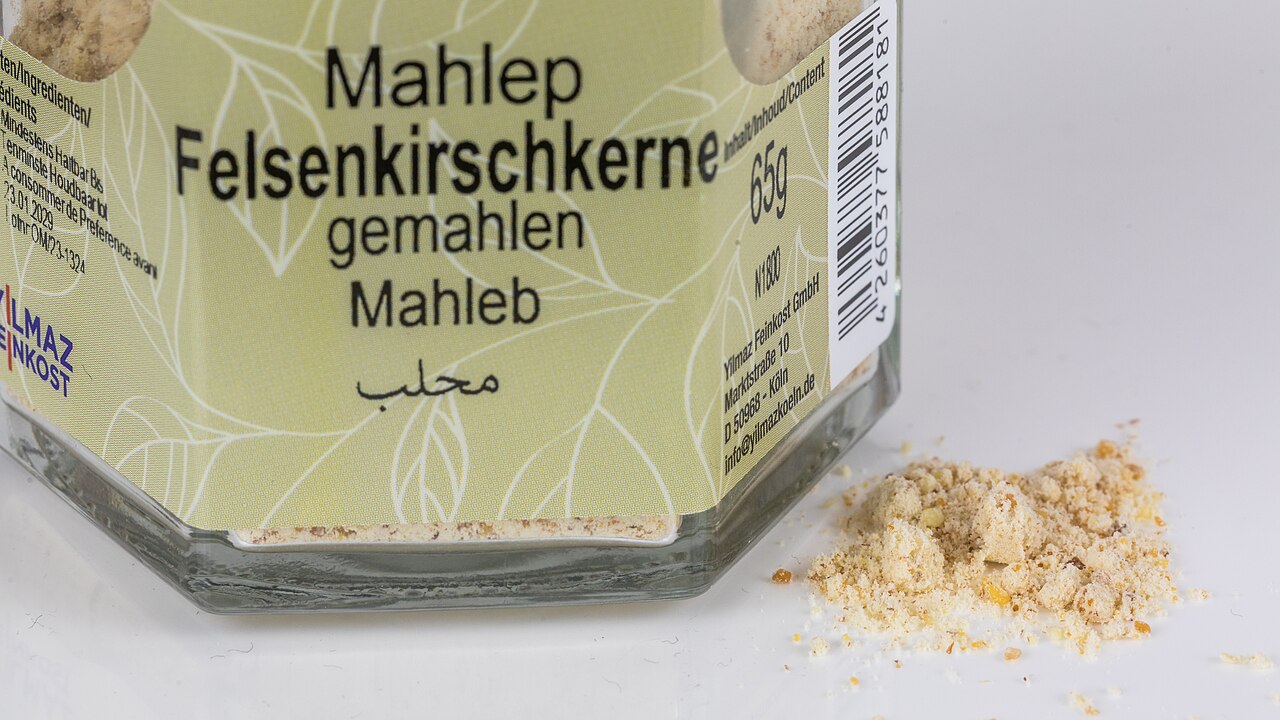
A small heap of mahleb gives little away: pale, teardrop-shaped kernels, each only about five millimeters long. Spice writer Gernot Katzer describes an aromatic bitterness that develops toward bitter almond.[1] Nothing in that modest appearance prepares you for the ingredient's place in a glossy, braided celebration bread.
Mahleb rewards attention before the dough is mixed. Its identity matters, the form in which it arrives matters, and so does the interval between grinding and baking. For a pastry kitchen, this is a sourcing story that continues all the way to the spice mill.
Inside the stone
The spice is the inner kernel of Prunus mahaleb, also called the St. Lucie cherry. It sits within the fruit's stone; that soft interior is the part described in Katzer's monograph.[1] Calling it simply “cherry pit” compresses two different materials into one phrase. A buyer wants the culinary kernel, already separated from its hard enclosure.
Kew accepts Prunus mahaleb as a distinct species and records a broad native range: Europe through Central Asia to northern Pakistan, with Morocco also included.[2] That geography describes the tree. It cannot tell a restaurant where a particular packet was harvested. For that, the supplier has to provide the answer.
A menu that names an origin should be able to follow the ingredient back beyond its common name.
The work before the jar
Turkish exporter Tarege offers one concrete view of the trade. Its product specification identifies Turkish origin and describes collection, sun-drying, cracking and the removal of stalks and other foreign material. It offers whole mahleb in 25-kilogram bags and powder in 10-kilogram bags.[3] Those are the supplier's formats, rather larger than the little jar beside a baker's scales.
The sequence makes the ingredient easier to picture. The material has been dried, the kernels recovered from their stones and the usable spice sorted before anyone starts discussing how much belongs in a loaf. A pale spoonful of powder conceals that work particularly well.
Tarege also gives a storage period of 24 months under specified cool, dry conditions in closed bags away from sunlight.[3] That commercial specification should travel with its conditions. Once a kitchen opens a bag and begins milling small portions, it has a different handling problem. A supplier's storage statement and a baker's judgment of aroma answer different questions.
For a restaurant making an occasional bread, a smaller purchase leaves less spice waiting between batches.
Leave the grinding until the dough is near
Katzer recommends buying whole kernels because their oil-rich powder spoils quickly.[1] Greek cook and author Diane Kochilas makes the same practical choice in her guide to tsoureki: purchase mahlepi whole and grind it before baking.[4]
For choreg, Andrew Janjigian advises freezing whole mahlab in a sealed container and grinding it just before use. Purchased powder should be used promptly, with the remainder frozen.[5]
Together, those instructions suggest a quiet piece of kitchen choreography: keep the reserve protected, measure the recipe's portion, then grind. The mill becomes part of preparing the dough rather than a task completed weeks earlier. That last handling decision belongs in the ingredient's quality story alongside its origin.
Freshness does not invite a heavier hand. Kochilas warns that excessive mahlepi and mastiha can leave tsoureki bitter.[4] Increasing the dose changes the balance of the bread; it is a poor substitute for buying and keeping the spice well.
A fragrance with company
Kochilas places mahlepi beside mastiha and citrus zest in tsoureki, an enriched bread containing eggs, milk and butter.[4] That combination offers a useful way to imagine its role: almond-like fragrance surrounded by citrus brightness, resinous aroma and a rich crumb. The pleasure comes from their relationship.
Janjigian's Armenian choreg pairs mahlab with nigella. His formula uses five grams of mahlab for a batch yielding one large braided loaf or twelve rolls.[5] The quantity makes its supporting role tangible: a small measured ingredient can help give a substantial bread its identity.
For a restaurant developing a bread course or a pastry served with coffee, these published preparations are good places to begin tasting. Bake a documented recipe, learn how its aromatics behave together, and only then decide what a variation should change. Neither a supplier's adjective nor a captivating origin story can perform that tasting.
The finished loaf will give most of the attention to its shining crust and the crumb beneath. Mahleb's contribution is less visible. Preserving it asks for an accurately identified ingredient, a manageable purchase and a timely turn of the grinder. A very small kernel deserves that much care.
Sources
- Gernot Katzer, “Mahaleb Cherry” — kernel identity, dimensions, sensory description and preference for buying whole kernels.
- Royal Botanic Gardens, Kew, “Prunus mahaleb L.,” Plants of the World Online — accepted species and native distribution.
- Tarege Trade, “Mahlep - Mahleb - Mahaleb - Prunus Mahaleb” — the exporter's own origin, processing, pack-size and storage specifications.
- Diane Kochilas, “Tsoureki 101: The Tips and Tricks You Need to Make this Easter Bread,” 19 April 2022 — aromatic partners, fresh grinding and restrained proportions.
- Andrew Janjigian, “Choreg (Armenian Easter Bread),” Serious Eats — recipe and storage advice.
- Photograph licensed under CC BY-SA 4.0: Raimond Spekking, “A jar of mahleb-7629,” Wikimedia Commons, 3 April 2025 — source of the article's photograph.