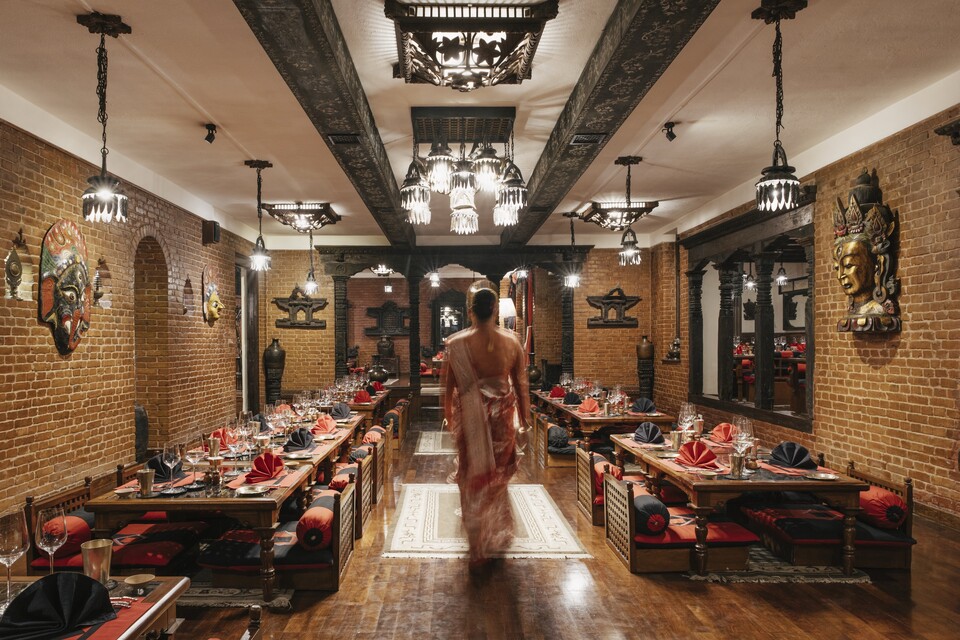
Before the first mouthful, there is somewhere to put your shoes. In journalist Sharmila Chand's account of Krishnarpan, published in August 2015, the entrance has a designated place for footwear and a brass pot for pouring water over guests' hands. Beyond it wait low seats, cushions and a table set with metal and earthenware.[1] Dinner begins by changing what the body is doing.
That sequence offers a useful way into this Nepali restaurant at The Dwarika's in Kathmandu. The long menu attracts attention, but the welcome deserves equal billing. A feast requires appetite; it also requires a guest who knows how to settle into it. Published dining accounts reveal the work of making an elaborate evening feel navigable.
Getting comfortable is part of service
Chand describes black and red drapery, wooden ceiling panels and a personalized menu on deep-red handmade paper. Later, as she eats through the early dishes, her host encourages her to slow down because more food is coming.[1] The paper tells her what lies ahead; the spoken reminder helps her make room for it.
These are small interventions with practical consequences. A guest confronted with unfamiliar dishes cannot estimate the meal's scale from its opening plate. An explanation can protect the pleasure of the courses still in the kitchen. Pacing starts before the server clears anything.
The low seating makes comfort equally tangible. Sonia Awale ends her 2015 Nepali Times review with the effort of standing after eating cross-legged.[2] That is a useful detail beneath the attractive room description. For someone who finds low seats difficult, discussing seating when booking is part of arranging a good dinner. Hospitality has to work for knees as well as eyes.
The room has a material history
The hotel's own history starts with a rescued piece of wood. In its account, founder Dwarika Das Shrestha encountered carved timber being discarded during the demolition of a Kathmandu house in 1952. He bought a fragment; collecting and restoring woodwork became a sustained undertaking. The property incorporates salvaged carving, while its workshop continues restoration work.[3]
This gives the restaurant's surroundings a context beyond expensive decoration. The hotel's project places old craftsmanship inside rooms that people use. At dinner, the corresponding opportunity is to encounter a setting through ordinary actions: sitting, unfolding a menu, reaching across a table.
That connection is an interpretation of the service, rather than proof that every gesture has an ancient pedigree. Krishnarpan is a restaurant making deliberate choices about how to present Nepali hospitality. Its interest lies partly in those choices becoming visible.
Six courses can contain a feast
Awale's review supplies a vivid example of service requiring skill: a server directs a long, narrow stream of aila from a brass vessel into a small clay cup. The opening food includes an offering before eating. Her account then moves through bread and accompaniments, dumplings and soup toward a main course of rice, lentils, curry, vegetables and pickles.[2]
The structure matters more than copying that historical menu. A course may hold several preparations, and the main course can gather a substantial meal onto one plate. Counting courses alone therefore tells a diner surprisingly little about how much food is coming.
The server occupies the gap between the printed number and the guest's appetite. Explaining where a dish sits in the sequence can be as valuable as naming its ingredients. A generous meal remains enjoyable when diners can recognize its shape before they reach its fullest point.
These descriptions belong to reported visits in 2015 and earlier; they establish a documented approach to hospitality, not a promise that the same dishes or ceremonies appear at every service today.[1][2]
The evening begins with the booking
The hotel's pages checked on 11 October 2026 show why a little conversation still matters. Its main restaurant page lists six, twelve and twenty-one courses, dinner hours of 6–10 p.m., and required reservations. The form asks for course selection, dietary restrictions and special requests.[4]
A separate experience page lists six, nine, twelve or twenty-two courses and advertises lunch as well as dinner, with at least 24 hours' advance booking. It also describes a welcome aperitif, a personalized menu to keep and a wood-carving tour after the meal.[5] Those pages do not fully agree. Confirm the available menu, service time and package inclusions directly before planning an evening around them.
The useful booking conversation extends to seating, dietary needs and expected duration. None of those questions diminishes the ceremony. They let a guest arrive ready to enjoy it, without discovering a physical difficulty or a scheduling problem halfway through.
Krishnarpan's service, as these accounts describe it, gives the meal a beginning before the food arrives and a memory after the table is cleared. The brass catches the eye. The more consequential gesture may be the quiet reminder to leave room for what comes next.
Sources
- Sharmila Chand, “An unforgettable dining experience at Krishnarpan in Kathmandu,” 27 August 2015 — the journalist's republication of her Yahoo Lifestyle feature; arrival, room, personalized menu and pacing.
- Sonia Awale, “Krishnarpan,” Nepali Times, 28 August 2015 — a reported meal, aila service, course sequence and low seating. Historical menu details are not presented as current availability.
- The Dwarika's Collection, “Our Story” — the hotel's account of its founder's woodwork rescue and continuing restoration workshop.
- The Dwarika's, “Krishnarpan” — restaurant information, reservation form and the article's photograph, filename dwarikaselisehassey7310; checked 11 October 2026.
- The Dwarika's, “Krishnarpan Experience” — the separate offer's course choices, booking requirements and inclusions; checked 11 October 2026.