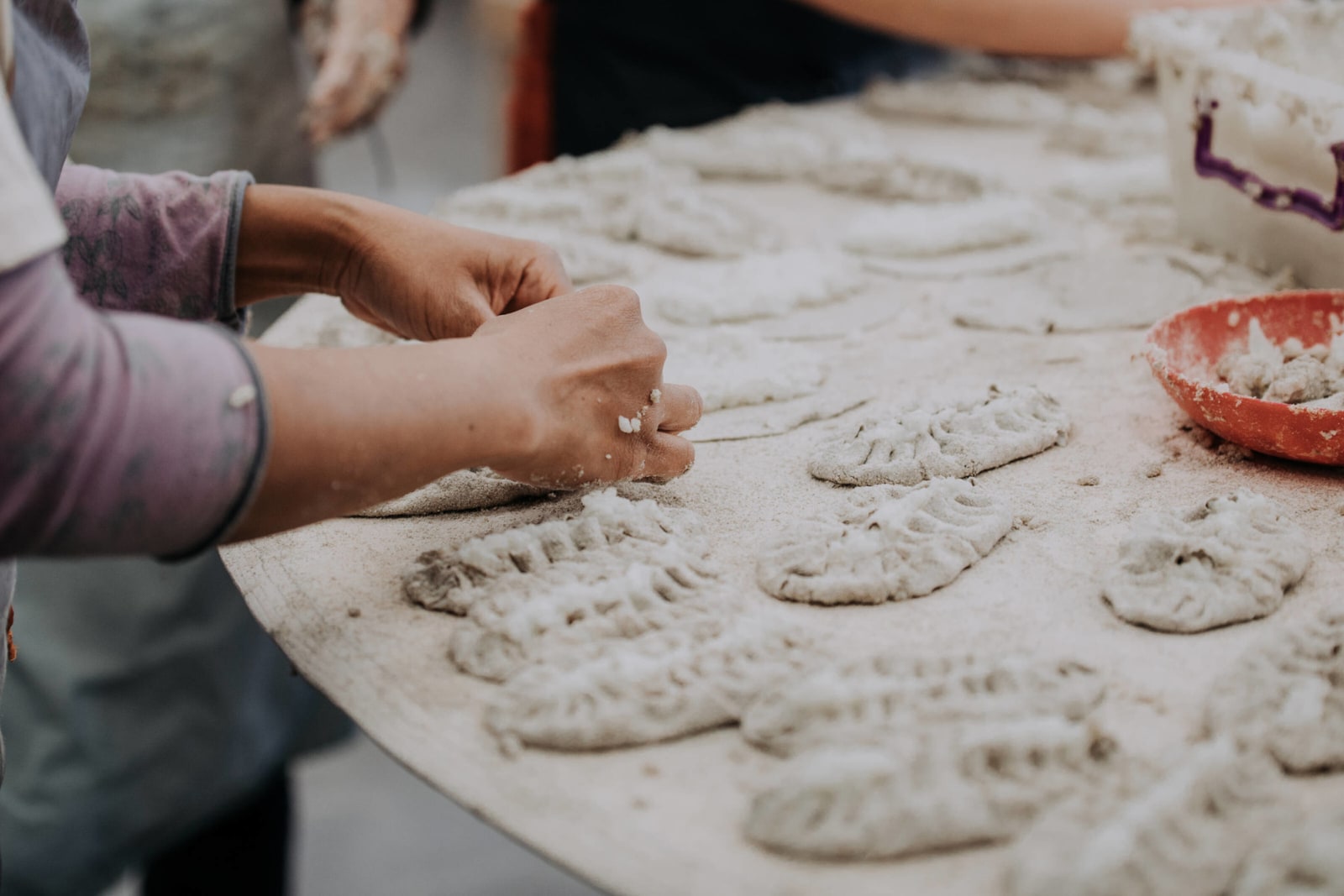
The last piece of equipment a Karelian pasty needs is a cloth. After the little rye boats come out of a fierce oven, their pale rice filling framed by browned pleats, they are buttered, gathered together and covered. ThisisFINLAND's traditional recipe makes the purpose explicit: the covering softens the crust.[2] The baking is finished; the texture still needs attention.
That final pause is a good place to begin understanding karjalanpiirakat. Their looks invite admiration for the neat edge, but the pleasure of eating one depends on the whole sequence: a thin wrapper, a spreadable filling, careful folds and a finish that makes room for tenderness.
The Finnish living-heritage account places the pastry in both everyday meals and celebrations. It describes families, small bakeries, schools and associations passing on the skill, with rice, barley and potato among the fillings.[4] This is precise cooking with a broad social life. Its delicacy belongs as comfortably to a kitchen table as to a carefully arranged plate.
A wrapper that keeps the cook busy
The dough gives little warning of the work ahead. Martat, Finland's home-economics organisation, uses water, salt, rye flour and a smaller quantity of wheat flour in its recipe. It first cuts rounds from a thicker sheet, then rolls each round into a thin circle or oval with a pastry rolling pin.[3] The small disc is a starting point; the thin wrapper is the achievement.
Keeping those wrappers usable takes organisation. Martat advises covering the stacks, dusting between the rolled sheets and filling them promptly so they do not stick together.[3] A row of completed pasties begins with a less photogenic arrangement of protected dough and flour on the bench. The cook is managing the pieces still waiting for attention as carefully as the one under the rolling pin.
Valio's recipe adds an easily overlooked gesture: brush away excess flour before spreading the porridge.[5] It is a small cleanup with a visible consequence. Once the filling goes down, the working surface becomes the inside of the pastry. What helped the dough move across the table should not remain there in a loose, dusty layer.
Give the porridge room to spread
For the rice version, the filling is already cooked before assembly. ThisisFINLAND's traditional recipe starts the rice in water, adds milk, simmers it into thick porridge and lets it cool.[2] The oven will bake a filled pastry; the saucepan has already done the work of cooking the grain.
Timo Lepistö's recipe for the same publication makes consistency a matter of judgment. After cooking short-grain rice with milk and adding butter, he permits more milk if the mixture has become too thick to work with.[1] A filling can have the right ingredients and still need adjustment before it meets such a thin sheet of dough.
Martat leaves roughly a centimetre of bare dough around its filling.[3] That modest border supplies material for the pleats. It also gives the cook a useful way to think about generosity: enough porridge to make a satisfying centre, enough free edge to shape it without a struggle.
The pleats have a job in the oven
Lepistö folds the sides inward and presses the crimps slightly into the filling to help prevent them burning.[1] Seen this way, the scalloped outline records a practical decision about exposure to heat. A handsome edge must survive the bake.
The published methods do not share a single oven schedule. Lepistö specifies about eight minutes at 250°C; Valio gives approximately 10–12 minutes at 275–300°C.[1][5] Those instructions belong to their respective recipes. For a cook following one, keeping its dough, portioning and baking directions together is more useful than treating the temperatures as interchangeable.
The visual lesson is easier to carry between kitchens: attend to the rim as well as the middle. The filling draws the eye, but the thin folds are doing some of the most demanding work.
Butter, then a little patience
There are several ways to finish. Lepistö briefly immerses each baked pasty in warm water mixed with melted butter, then cools it under a clean towel.[1] Valio brushes with a butter-and-milk mixture and covers with a baking cloth.[5] The older ThisisFINLAND recipe allows melted butter or butter mixed with water, followed by the covered rest that softens the crust.[2]
This makes the finish part of the craft. The cook has deliberately used high heat and then attends to how that baked wrapper will feel in the mouth. Browning and tenderness belong to successive stages of the same pastry.
Egg butter provides a familiar topping; the traditional recipe recommends serving the pasties warm with butter or chopped egg mixed into butter.[2] I would start with a modest spoonful, leaving a little of the pleated border visible. The first bite should give the rye, rice and topping a chance to register together.
The living-heritage account describes pie-making courses for children and adults and summer-morning baking by Martha Organisation members at Joensuu's market-square café.[4] Those settings help explain why a written recipe only takes the learner so far. Someone beside you can show how thin a wrapper feels, where a finger presses and when an awkward fold needs another try. The finished pastry carries that teaching all the way to the table, beneath its butter-softened edge.
Sources
- Timo Lepistö, “Rolling out pies, rye bread and other essential eastern Finnish recipes,” ThisisFINLAND, March 2022 — recipe and credited photograph.
- ThisisFINLAND, “Finnish recipes,” Karelian pasties section — cooked rice filling, butter finish, covered softening and warm service.
- Martat, “Karjalanpiirakat” — dough ingredients, rolling, protecting the wrappers and leaving a filling border; in Finnish.
- “Karelian pie tradition,” Wiki-inventory for Living Heritage — community account of fillings, teaching and the Joensuu Martta Café.
- Valio, “Karjalanpiirakat” — brushing off flour, baking instructions and the butter-and-milk finish; in Finnish.