A fine-dining fish course usually enters the room as a finished sentence: one immaculate slice, one polished sauce, perhaps a server's mention of the boat or bay. Ikejime forces the sentence to begin earlier. It asks how the fish was caught, how quickly it was made insensible, whether its brain and spinal cord were reached accurately, how it was bled and chilled, and how long the kitchen waited before cutting it. The plate can reveal the answer, but it cannot repair a careless chain.
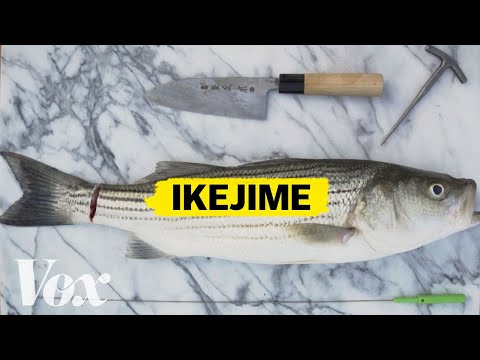
That is what makes Vox's short film useful. It is not a restaurant portrait and it does not romanticize a quiet Japanese counter. Instead, it shows the physical sequence that the luxury word ikejime can conceal: a live striped bass, a spike, three bleeding cuts, a wire, and an ice slurry.[1] The sequence is graphic. It is also more honest than treating “fresh” as a self-explanatory compliment.
The best way to watch is with two ideas held together. First, the method can replace prolonged asphyxiation with faster handling and can preserve more options for the cook. Second, a Japanese name does not make an imperfect strike humane or a badly managed fish delicious. Recent research has made that second boundary harder to ignore.[2][3]
Viewing note: the video contains close-up footage of a live fish being killed and bled.
The Difficult Opening Is The Argument
Around 0:26, the film shows the baseline it wants to displace: fish taken from water and left to die by asphyxiation. The images make the ethical case before the culinary one. Struggling spends muscular energy and changes the animal before a chef ever touches it; more fundamentally, a slow death is a welfare failure.[1]
The evidence published since the film appeared sharpens that point. In a 2026 neurophysiological study of rainbow trout and hybrid striped bass, asphyxiation produced prolonged distress, while manual and automated ikejime performed better but did not reliably create immediate insensibility in every fish.[2] A 2024 review from the French Reference Centre for Animal Welfare likewise treats asphyxiation in air as cruel and stresses that any spiking method depends on precision, anatomical knowledge, training, and safe restraint.[3]
This matters in fine dining because “humane” should describe a verified outcome, not an intention. A cook or fisher can miss a small target. Brain location changes with species and body shape. A fish that is difficult to hold can make a practiced motion unreliable. The recent study therefore recommends an effective stunning step before ikejime so that the animal is immediately insensible even if the spike is not perfect.[2] The visual neatness of the technique must never outrank the animal's actual state.
Four Verbs, Not One Magic Word
The film's clearest passage begins around 2:03. Andrew Tsui first spikes the brain. While the heart retains enough activity to move blood, he cuts the gill arches and the artery near the tail. He then passes a metal pith down the spinal canal to stop residual nerve signals and finally lowers the fish into an ice-water slurry.[1] In restaurant shorthand, all of that may be compressed into ikejime. On the board, the differences matter.
Spiking addresses the brain. Bleeding removes a warm, nutrient-rich medium that can compromise aroma, color, and keeping quality. Pithing—often called shinkei jime when the spinal cord is destroyed—limits involuntary muscular signaling. Chilling pulls down temperature while the fish finishes bleeding.[1][3] Skip a verb and the next one inherits a worse fish.
The sequence also explains why this is not a trick for the final prep cook. By the time a whole fish reaches a restaurant in a box, the decisive window may already have closed. A buyer who truly values the method needs a fisher, aquaculturist, or specialist supplier who can identify the species, execute the appropriate procedure promptly, maintain hygiene, and document the cold chain. Fine dining likes to celebrate the last hand on an ingredient. Ikejime makes the first hands impossible to ignore.
The Most Honest Bite Comes At 4:19
The film performs a same-day comparison at roughly 4:19, and the tasters say the conventionally killed and ikejime fish taste fairly similar.[1] That modest result is more illuminating than a dramatic victory would have been. Ikejime is not a seasoning. Its strongest promise is not that a brain spike creates instant umami; it is that controlled slaughter and handling may slow deterioration and leave a cook a wider, cleaner aging window.
The later comparison—one ordinary retail fish a few days old against an ikejime fish held much longer—is vivid, but it should not become a universal storage formula.[1] Species, size, fat, initial condition, sanitation, temperature, bleeding, gutting, wrapping, and the decision to age whole or filleted all change the clock. The 2026 study found encouraging product-quality patterns, yet explicitly described that part of its work as exploratory and called for larger studies.[2] The 2024 welfare review found too little evidence to declare spinal pithing superior to brain spiking alone across both welfare and product-quality outcomes.[3]
Restaurant practice reflects that variability. Eater's reporting from New York follows chefs using fish aged for different periods and in different preparations: seared mackerel, kombu-cured fluke, ceviche, grilled collar, and sashimi. One chef describes planning the service date with the supplier rather than accepting a generic “freshest possible” rule.[4] That is the serious fine-dining lesson. Aging begins as a scheduling decision, not an act of bravado.
The Premium Pays For Coordination
At about 6:09, the film names the obstacle: cost and scale. Handling fish individually requires time, tools, knowledge, space, and a market willing to pay for care that most guests will never see.[1] The wire is cheap. The coordinated chain is not.
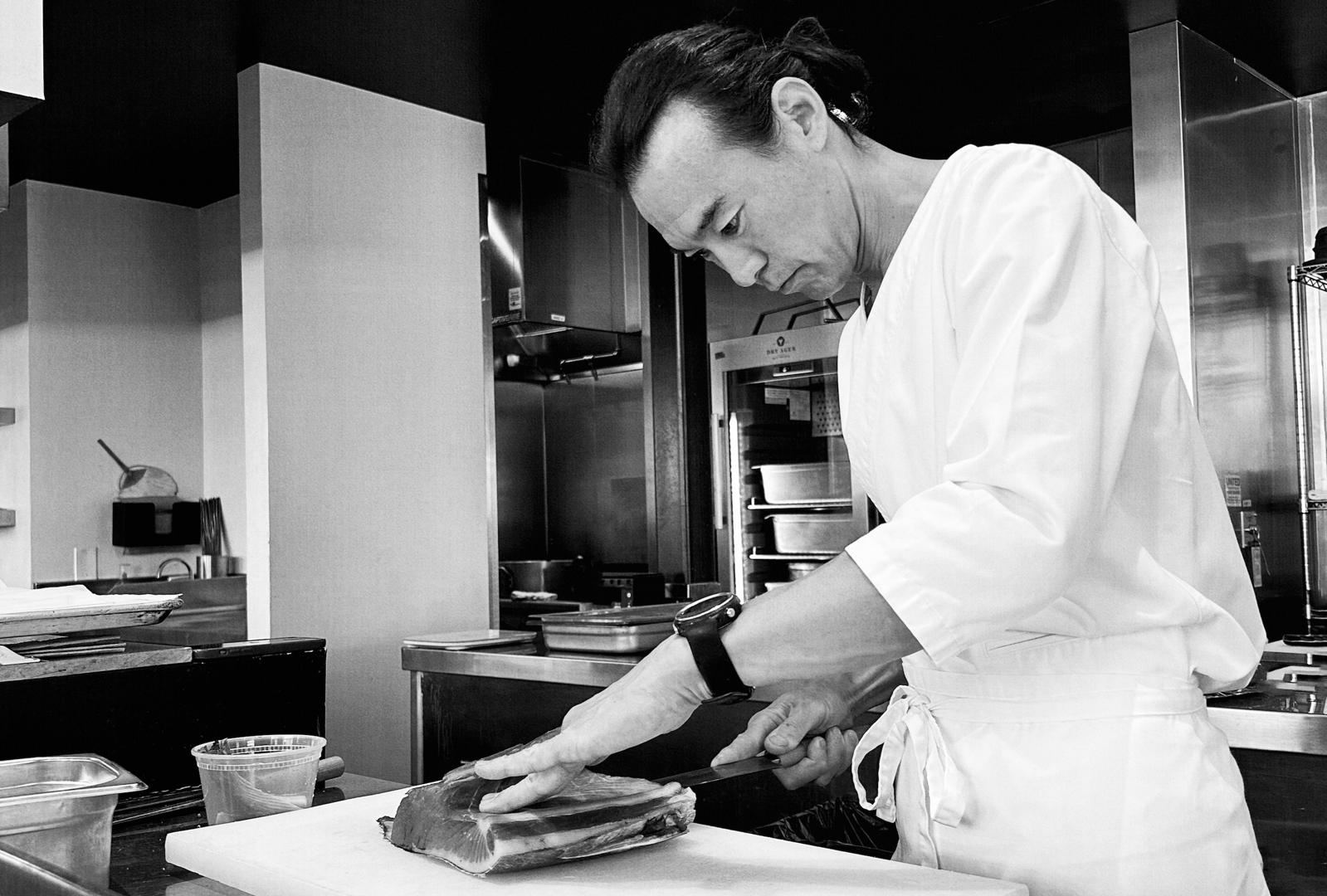
Southern California offers a useful example of what that premium can build. Hannah Goldfield reports that chef Junya Yamasaki taught local fishers ike and shinkei jime because the quality of nearby catch reaching his Los Angeles kitchen did not match its potential. The knowledge moved outward from YESS to fishers and then into a small restaurant market, including Providence.[5] Forbes describes the same network from the supplier side: training allowed fisher Bailey Raith to charge more for carefully handled catch and to teach others.[6]
That is more interesting than importing the word as a badge. The method can shorten the distance between a chef and local water only when the restaurant rewards the person on the boat for slowing down, learning anatomy, and rejecting volume-first handling. It can also fail at scale, or become marketing pasted onto an unverifiable chain. A menu that says ikejime has offered a claim, not proof.
The right questions are pleasantly concrete. Who dispatched the fish? What did that person do before the spike, and how did they confirm insensibility? Was the fish bled, pithed, and chilled for its species rather than by rote? When was it killed, when was it filleted, and why is tonight the chosen service point? A server need not deliver a lecture beside the plate. The restaurant should still know the answers.
Vox's film succeeds because the procedure remains visible and a little uncomfortable.[1] It returns luxury seafood to the moment when care has consequences. The finest fish course may look effortless under dining-room light, but its texture and integrity were negotiated much earlier—on a deck, beside a tank, over an ice slurry, by someone whose precision deserves to be part of the price.
Sources
- Vox, “The right way to kill a fish” — the embedded YouTube video demonstrating the ikejime sequence, same-day and aged comparisons, and the cost barrier.
- Albin Gräns, Linas Kenter, Waiman Meinhold, Andreas Saxer, Thorsten Schwerte, and Jeroen Brijs, “From tradition to innovation: Effects of manual and automated ikejime on welfare and product quality of rainbow trout and hybrid striped bass,” Aquaculture 613, 2026 — open-access neurophysiological study and evidence boundary.
- French Reference Centre for Animal Welfare, Literature review on the welfare of farmed fish at slaughter, 2024 — review of spiking, pithing, bleeding, asphyxiation, operator precision, and remaining evidence gaps.
- Caroline Shin, “How a Once-Secret Japanese Technique Is Shaping New York Seafood Menus,” Eater NY, May 15, 2025 — reporting on species-specific aging, supplier coordination, and uses beyond sushi.
- Hannah Goldfield, “How to Kill a Fish,” The New Yorker, January 19, 2026 — reporting on Junya Yamasaki and the Southern California fisher-to-restaurant network.
- Andrew Watman, “This Japanese Chef Is Transforming LA's Seafood Supply Chain,” Forbes, August 12, 2024 — profile of Yamasaki, Bailey Raith, local supplier training, and the YESS photograph used as the article image.