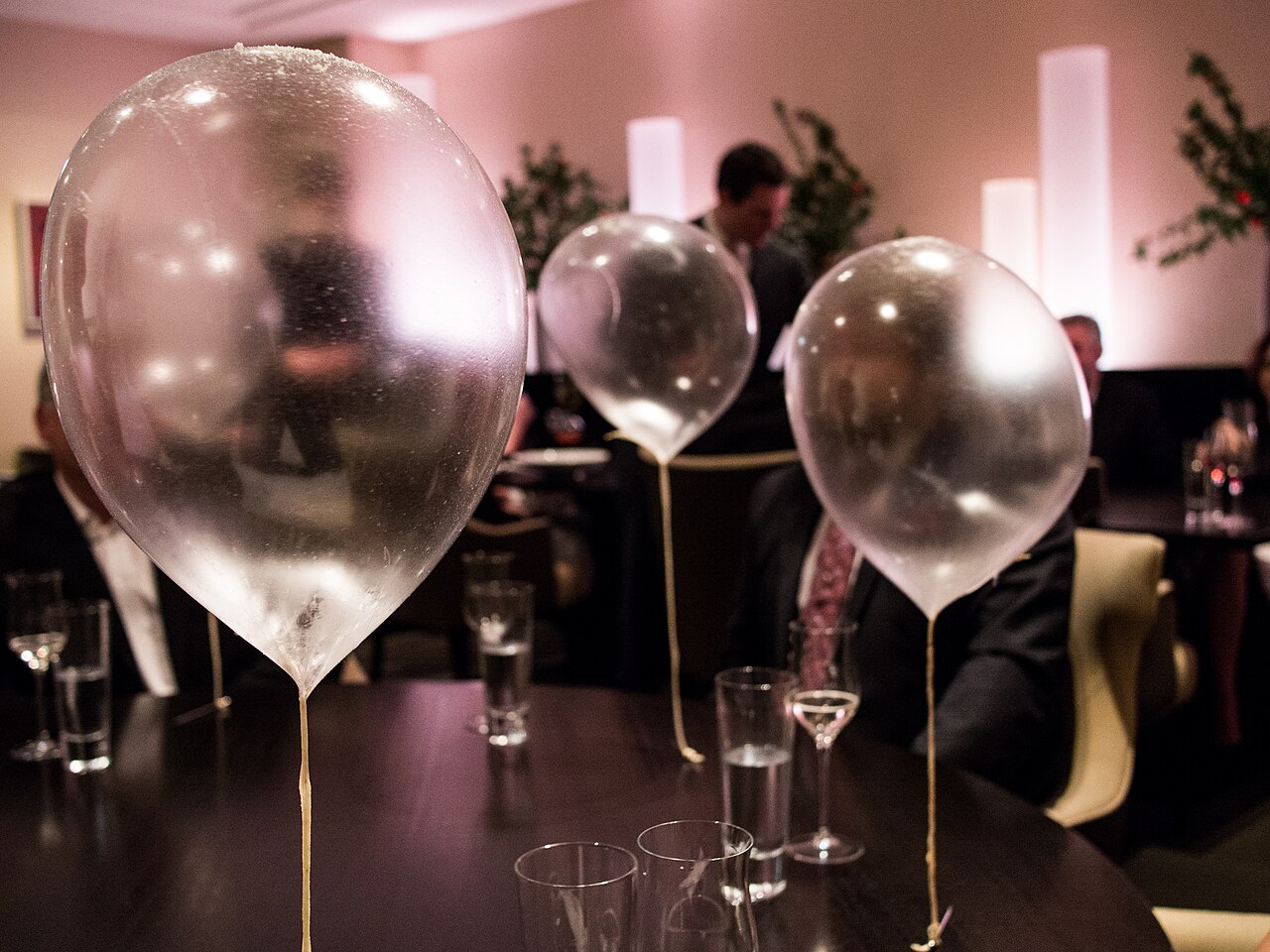

Alinea's edible helium balloon is easy to misread because the first reaction is usually laughter. A floating dessert makes adults behave briefly like children; the diner leans forward, inhales, hears the helium change the voice, and then eats what had just been hanging in the air. That is the joke. It is not the whole dish.
The more interesting reading is that the balloon turns service into a material. Alinea's own restaurant page frames the meal as a multi-course tasting-menu experience offered through distinct rooms and formats, from the Kitchen Table to the Gallery and Salon.[2] In that context, the balloon does not arrive as a loose stunt. It arrives inside a house style that already asks guests to accept pacing, reveal, instruction, and controlled surprise as part of dinner.
That is why the Business Insider video is useful.[1] It shows the dessert as a small sequence rather than a still image: a delicate green-apple membrane, a tether, a server or cook helping the object survive the trip to the table, and a diner who has to decide how much to play along. Watch less for the novelty and more for the contract. The course succeeds only if the room makes a ridiculous object feel precise.
Watch The Membrane, Not Only The Joke
The video naturally pulls attention toward the moment of helium. That is the public payoff, and it is why the course traveled so well online. But the real fine-dining problem appears before anyone inhales. The balloon has to be thin enough to float and eat, strong enough to hold gas, dry enough not to sag, and elastic enough not to tear before the guest receives it.
Eater's 2012 item on the Alinea balloon points to the elemental simplicity of the idea: helium inside, with the string identified as dehydrated apple.[3] WIRED's contemporary account adds the flavor and construction logic, describing a green-apple, malic-acid, and sugar build with an edible apple-leather tether.[4] Those details matter because they keep the course from becoming empty theater. The balloon is not a prop beside dessert. It is dessert taking a prop's shape.
That shape creates a brutal technical standard. A plated dessert can hide imperfection under quenelles, sauces, crumbs, and shadows. The balloon cannot. If the membrane wrinkles too heavily, the illusion becomes tired. If the shell is too thick, the bite turns chewy and labored. If it ruptures early, the course collapses into cleanup. If it floats too assertively, the server has to fight the table. Fine dining often celebrates concentration: a sauce reduced, a puree smoothed, a fish cooked to a narrow center. Here the discipline is the opposite. The kitchen has to make something almost not there.
Technique Does Not Stop At The Pass
The best part of the video is the way the dessert moves from kitchen technique into guest management. Alinea can make the balloon, but the course is not complete until a person at the table understands what kind of participation is being invited. That is more delicate than it sounds. The diner is being asked to put a floating object to the mouth, make a funny sound, and then eat the shell. In a less confident room, the same move could feel embarrassing or coercive.
This is where Alinea's service grammar matters. The official site describes a restaurant built around multi-course experiences rather than ordinary menu choice.[2] That format gives the staff a certain permission: they can guide, pause, frame, and reset. The balloon uses that permission. It asks the room to make play feel hosted instead of chaotic.
Notice also that the dessert reverses the usual direction of luxury. Many expensive courses become impressive by adding visible matter: truffle, caviar, gold leaf, aged beef, heavy porcelain, smoke under a cloche. The balloon becomes impressive by adding almost nothing. Its luxury is a temporary state. Helium supplies lift. Sugar supplies a skin. Apple supplies flavor and tether. Service supplies confidence. The course exists at the edge of disappearance, which is why it needs such a clear script.
Green Apple Is A Design Choice
The apple flavor is not incidental. Green apple gives the balloon a clean acidity and an almost candy-like memory, while malic acid sharpens the association.[4] That narrow profile is useful because the object already asks the diner to process too much: floating form, table instruction, helium voice, texture, and edible string. A more complex flavor might fight the course's real subject, which is the sensation of eating air.
The apple string is just as important. Eater's note that the string is dehydrated apple gives the tether a culinary job rather than a purely mechanical one.[3] It prevents the dessert from dividing into edible balloon plus non-edible equipment. The pin, if used, is a tool; the tether remains part of the bite. That keeps the fantasy cleaner. The diner does not have to exit the course by sorting hardware from food, except where the service clearly makes that boundary.
This restraint is why the balloon remains more interesting than many modern novelty desserts. It does not try to become a whole patisserie cabinet in the air. It is not a layered cake pretending to levitate. It is a single-sensation course: tart sweetness, thin chew, helium lift, and a little social risk.
Why The Footage Still Helps
The 2012 Wikimedia photograph used for this post is valuable because it freezes the architectural problem: a translucent sphere held at table height by a thin line, surrounded by ordinary dining-room objects.[5] The video adds what the photograph cannot. It shows the balloon as a course with time inside it. Someone has to carry it. Someone has to explain it. Someone has to accept it before it stops being impressive.
That time element is the difference between gimmick and hospitality. A gimmick is complete when it is seen. A good course is complete only when it has been received. The balloon asks Alinea to manage a guest's uncertainty for a few seconds, then turn uncertainty into appetite. That is why the video should be watched as service footage, not merely as a viral-food clip.
There is also an implicit warning here for restaurants tempted by spectacle. The balloon works because the technical idea, flavor, room, and instruction all point in the same direction. If a kitchen copies only the levitation, the result is thin. If it copies only the helium voice, it becomes party entertainment. The useful lesson is not "make food float." It is that theatrical dining needs a precise edible logic under the effect.
Alinea's edible balloon survives because it makes a strange proposition feel complete: air can be plated, but only if the kitchen gives it flavor, the dining room gives it timing, and the guest is allowed to laugh without being left alone with the joke.
Sources
- Business Insider, "The best restaurant in America serves helium balloons you can actually eat" - YouTube video used as the embedded viewing anchor for Alinea's edible balloon course.
- Alinea, "Dining At Alinea" - official restaurant page describing the tasting-menu experience, rooms, and service format.
- Eater, "Watch the Chefs at Alinea Make an Edible Helium Balloon" - 2012 report noting the helium-filled course and dehydrated-apple string.
- WIRED, "Chicago restaurant serves up edible helium balloons" - contemporary 2012 account of the green-apple, malic-acid, sugar, and helium construction.
- Wikimedia Commons, "File:Alinea 2012 Balloon (7303714802).jpg" - Edsel Little's 2012 photograph used as the article image.